Richelle L. Winkler, Jeffrey A. G. Clark, Dexter H. Locke, Peleg Kremer, Myla F. J. Aronson, Fushcia-Ann Hoover, Hogyeum Evan Joo, Daniele La Rosa, KangJae Jerry Lee, Susannah B. Lerman, Hamil Pearsall, Timothy L. V. Vargo, Charles H. Nilon, Christopher A. Lepczyk
{"title":"在美国城市公园里,享受社会、环境和健康设施的机会不平等","authors":"Richelle L. Winkler, Jeffrey A. G. Clark, Dexter H. Locke, Peleg Kremer, Myla F. J. Aronson, Fushcia-Ann Hoover, Hogyeum Evan Joo, Daniele La Rosa, KangJae Jerry Lee, Susannah B. Lerman, Hamil Pearsall, Timothy L. V. Vargo, Charles H. Nilon, Christopher A. Lepczyk","doi":"10.1038/s44284-024-00153-2","DOIUrl":null,"url":null,"abstract":"Urban parks provide vital social, environmental and health benefits to residents. However, the spatial distribution of parks, and the amenities they provide, may not be equitably distributed within cities. We examine the accessibility of urban parks with different social, environmental and health amenities by race and ethnicity. We identified 122,988 urban parks across the USA, measured the racial/ethnic population distribution within a 10-min walkshed around each park and compared these distributions to the overall demographics of the city. We found that the spatial distribution of parks as well as park amenities differ according to the neighborhood demographics. Racial/ethnic compositions of neighborhoods surrounding parks tend to be whiter than other parts of the same cities, though there are regional differences. Parks in predominantly white neighborhoods are cooler in the summer and have more tree cover compared with parks in neighborhoods with greater proportions of Hispanic and Black residents. Differences in amenities hold across regions of the country. Our study demonstrates that inequities in access to high-quality parks are widespread across the USA. Parks provide deep value to urban residents, but the distribution of those services is unclear. This study finds that US urban residents have unequal access to the crucial environmental, social and health amenities of urban parks.","PeriodicalId":501700,"journal":{"name":"Nature Cities","volume":"1 12","pages":"861-870"},"PeriodicalIF":15.3000,"publicationDate":"2024-11-08","publicationTypes":"Journal Article","fieldsOfStudy":null,"isOpenAccess":false,"openAccessPdf":"","citationCount":"0","resultStr":"{\"title\":\"Unequal access to social, environmental and health amenities in US urban parks\",\"authors\":\"Richelle L. Winkler, Jeffrey A. G. Clark, Dexter H. Locke, Peleg Kremer, Myla F. J. Aronson, Fushcia-Ann Hoover, Hogyeum Evan Joo, Daniele La Rosa, KangJae Jerry Lee, Susannah B. Lerman, Hamil Pearsall, Timothy L. V. Vargo, Charles H. Nilon, Christopher A. Lepczyk\",\"doi\":\"10.1038/s44284-024-00153-2\",\"DOIUrl\":null,\"url\":null,\"abstract\":\"Urban parks provide vital social, environmental and health benefits to residents. However, the spatial distribution of parks, and the amenities they provide, may not be equitably distributed within cities. We examine the accessibility of urban parks with different social, environmental and health amenities by race and ethnicity. We identified 122,988 urban parks across the USA, measured the racial/ethnic population distribution within a 10-min walkshed around each park and compared these distributions to the overall demographics of the city. We found that the spatial distribution of parks as well as park amenities differ according to the neighborhood demographics. Racial/ethnic compositions of neighborhoods surrounding parks tend to be whiter than other parts of the same cities, though there are regional differences. Parks in predominantly white neighborhoods are cooler in the summer and have more tree cover compared with parks in neighborhoods with greater proportions of Hispanic and Black residents. Differences in amenities hold across regions of the country. Our study demonstrates that inequities in access to high-quality parks are widespread across the USA. Parks provide deep value to urban residents, but the distribution of those services is unclear. This study finds that US urban residents have unequal access to the crucial environmental, social and health amenities of urban parks.\",\"PeriodicalId\":501700,\"journal\":{\"name\":\"Nature Cities\",\"volume\":\"1 12\",\"pages\":\"861-870\"},\"PeriodicalIF\":15.3000,\"publicationDate\":\"2024-11-08\",\"publicationTypes\":\"Journal Article\",\"fieldsOfStudy\":null,\"isOpenAccess\":false,\"openAccessPdf\":\"\",\"citationCount\":\"0\",\"resultStr\":null,\"platform\":\"Semanticscholar\",\"paperid\":null,\"PeriodicalName\":\"Nature Cities\",\"FirstCategoryId\":\"1085\",\"ListUrlMain\":\"https://www.nature.com/articles/s44284-024-00153-2\",\"RegionNum\":0,\"RegionCategory\":null,\"ArticlePicture\":[],\"TitleCN\":null,\"AbstractTextCN\":null,\"PMCID\":null,\"EPubDate\":\"\",\"PubModel\":\"\",\"JCR\":\"\",\"JCRName\":\"\",\"Score\":null,\"Total\":0}","platform":"Semanticscholar","paperid":null,"PeriodicalName":"Nature Cities","FirstCategoryId":"1085","ListUrlMain":"https://www.nature.com/articles/s44284-024-00153-2","RegionNum":0,"RegionCategory":null,"ArticlePicture":[],"TitleCN":null,"AbstractTextCN":null,"PMCID":null,"EPubDate":"","PubModel":"","JCR":"","JCRName":"","Score":null,"Total":0}
Unequal access to social, environmental and health amenities in US urban parks
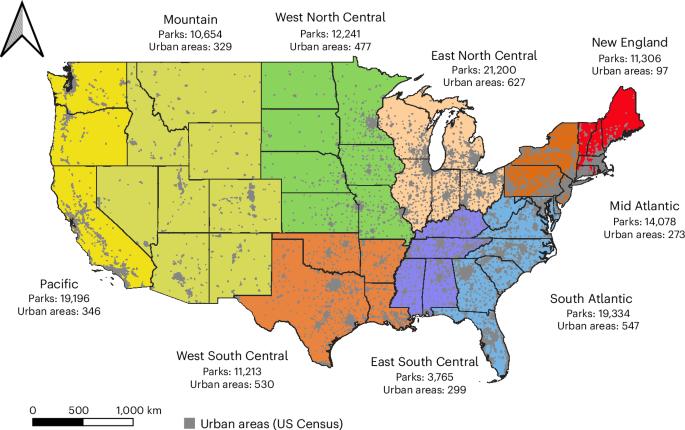
Urban parks provide vital social, environmental and health benefits to residents. However, the spatial distribution of parks, and the amenities they provide, may not be equitably distributed within cities. We examine the accessibility of urban parks with different social, environmental and health amenities by race and ethnicity. We identified 122,988 urban parks across the USA, measured the racial/ethnic population distribution within a 10-min walkshed around each park and compared these distributions to the overall demographics of the city. We found that the spatial distribution of parks as well as park amenities differ according to the neighborhood demographics. Racial/ethnic compositions of neighborhoods surrounding parks tend to be whiter than other parts of the same cities, though there are regional differences. Parks in predominantly white neighborhoods are cooler in the summer and have more tree cover compared with parks in neighborhoods with greater proportions of Hispanic and Black residents. Differences in amenities hold across regions of the country. Our study demonstrates that inequities in access to high-quality parks are widespread across the USA. Parks provide deep value to urban residents, but the distribution of those services is unclear. This study finds that US urban residents have unequal access to the crucial environmental, social and health amenities of urban parks.




 京公网安备 11010802042870号
京ICP备2023020795号-1
京公网安备 11010802042870号
京ICP备2023020795号-1

 分享
分享

 求助内容:
求助内容: 应助结果提醒方式:
 扫码关注我们
