Parijat Borah, Natalie McLeod, Nipun Kumar Gupta, Reuben J. Yeo, Tanmay Ghosh, Zainul Aabdin, Lidao Li, Prajna Bhatt, Yuhan Liu, Robert Palgrave, Yee-Fun Lim, Zhengtao Xu and Albertus Denny Handoko
{"title":"将铋纳米颗粒嵌顿到含硫醇的金属有机框架中,用于电催化和光催化。","authors":"Parijat Borah, Natalie McLeod, Nipun Kumar Gupta, Reuben J. Yeo, Tanmay Ghosh, Zainul Aabdin, Lidao Li, Prajna Bhatt, Yuhan Liu, Robert Palgrave, Yee-Fun Lim, Zhengtao Xu and Albertus Denny Handoko","doi":"10.1039/D4MH01153H","DOIUrl":null,"url":null,"abstract":"<p >Close integration of metal nanoparticles (NPs) into a metal–organic framework (MOF) can be leveraged to achieve tailored functionality of the resulting composite structure. Here, we demonstrate a “ship-in-a-bottle” approach to produce ≈4.0 nm bismuth (Bi) NPs within a thiol-rich zirconium-based MOF of Zr-DMBD (DMBD = 2,5-dimercapto-1,4-benzenedicarboxylate). We found that the incorporation of Bi NPs into the Zr-DMBD framework relies on the free-standing thiol groups. These thiols have two roles – (i) aid in binding precursor Bi<small><sup>3+</sup></small> preventing to form the insoluble bismuthyl unit (BiO<small><sup>+</sup></small>) and (ii) controlling the growth of Bi NPs. The resulting composite, denoted as BiNP@Zr-DMBD-1, displayed enhanced catalytic activity due to strong interactions between Bi NPs and organic linkers mediated by sulfur, promoting charge transfer from the Bi NP to the MOF matrix. BiNP@Zr-DMBD-1 remained stable after CO<small><sub>2</sub></small> electroreduction to formate in a flow setting, with >88% faradaic efficiency at 25 mA cm<small><sup>−2</sup></small> current density. Additionally, BiNP@Zr-DMBD-1 composite was shown to exhibit photoactivity beyond the typical near-UV absorption range of Bi NPs, where it completely degraded methylene blue dye within 1 h of blue LED irradiation. This work therefore underlines the potential of thiol-rich MOFs in developing new nanomaterials for diverse catalytic applications.</p>","PeriodicalId":87,"journal":{"name":"Materials Horizons","volume":" 4","pages":" 1290-1302"},"PeriodicalIF":11.4000,"publicationDate":"2024-11-22","publicationTypes":"Journal Article","fieldsOfStudy":null,"isOpenAccess":false,"openAccessPdf":"https://pubs.rsc.org/en/content/articlepdf/2025/mh/d4mh01153h?page=search","citationCount":"0","resultStr":"{\"title\":\"Incarcerating bismuth nanoparticles into a thiol-laced metal–organic framework for electro and photocatalysis†\",\"authors\":\"Parijat Borah, Natalie McLeod, Nipun Kumar Gupta, Reuben J. Yeo, Tanmay Ghosh, Zainul Aabdin, Lidao Li, Prajna Bhatt, Yuhan Liu, Robert Palgrave, Yee-Fun Lim, Zhengtao Xu and Albertus Denny Handoko\",\"doi\":\"10.1039/D4MH01153H\",\"DOIUrl\":null,\"url\":null,\"abstract\":\"<p >Close integration of metal nanoparticles (NPs) into a metal–organic framework (MOF) can be leveraged to achieve tailored functionality of the resulting composite structure. Here, we demonstrate a “ship-in-a-bottle” approach to produce ≈4.0 nm bismuth (Bi) NPs within a thiol-rich zirconium-based MOF of Zr-DMBD (DMBD = 2,5-dimercapto-1,4-benzenedicarboxylate). We found that the incorporation of Bi NPs into the Zr-DMBD framework relies on the free-standing thiol groups. These thiols have two roles – (i) aid in binding precursor Bi<small><sup>3+</sup></small> preventing to form the insoluble bismuthyl unit (BiO<small><sup>+</sup></small>) and (ii) controlling the growth of Bi NPs. The resulting composite, denoted as BiNP@Zr-DMBD-1, displayed enhanced catalytic activity due to strong interactions between Bi NPs and organic linkers mediated by sulfur, promoting charge transfer from the Bi NP to the MOF matrix. BiNP@Zr-DMBD-1 remained stable after CO<small><sub>2</sub></small> electroreduction to formate in a flow setting, with >88% faradaic efficiency at 25 mA cm<small><sup>−2</sup></small> current density. Additionally, BiNP@Zr-DMBD-1 composite was shown to exhibit photoactivity beyond the typical near-UV absorption range of Bi NPs, where it completely degraded methylene blue dye within 1 h of blue LED irradiation. This work therefore underlines the potential of thiol-rich MOFs in developing new nanomaterials for diverse catalytic applications.</p>\",\"PeriodicalId\":87,\"journal\":{\"name\":\"Materials Horizons\",\"volume\":\" 4\",\"pages\":\" 1290-1302\"},\"PeriodicalIF\":11.4000,\"publicationDate\":\"2024-11-22\",\"publicationTypes\":\"Journal Article\",\"fieldsOfStudy\":null,\"isOpenAccess\":false,\"openAccessPdf\":\"https://pubs.rsc.org/en/content/articlepdf/2025/mh/d4mh01153h?page=search\",\"citationCount\":\"0\",\"resultStr\":null,\"platform\":\"Semanticscholar\",\"paperid\":null,\"PeriodicalName\":\"Materials Horizons\",\"FirstCategoryId\":\"88\",\"ListUrlMain\":\"https://pubs.rsc.org/en/content/articlelanding/2025/mh/d4mh01153h\",\"RegionNum\":2,\"RegionCategory\":\"材料科学\",\"ArticlePicture\":[],\"TitleCN\":null,\"AbstractTextCN\":null,\"PMCID\":null,\"EPubDate\":\"\",\"PubModel\":\"\",\"JCR\":\"Q1\",\"JCRName\":\"CHEMISTRY, MULTIDISCIPLINARY\",\"Score\":null,\"Total\":0}","platform":"Semanticscholar","paperid":null,"PeriodicalName":"Materials Horizons","FirstCategoryId":"88","ListUrlMain":"https://pubs.rsc.org/en/content/articlelanding/2025/mh/d4mh01153h","RegionNum":2,"RegionCategory":"材料科学","ArticlePicture":[],"TitleCN":null,"AbstractTextCN":null,"PMCID":null,"EPubDate":"","PubModel":"","JCR":"Q1","JCRName":"CHEMISTRY, MULTIDISCIPLINARY","Score":null,"Total":0}
Incarcerating bismuth nanoparticles into a thiol-laced metal–organic framework for electro and photocatalysis†
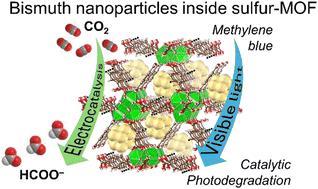
Close integration of metal nanoparticles (NPs) into a metal–organic framework (MOF) can be leveraged to achieve tailored functionality of the resulting composite structure. Here, we demonstrate a “ship-in-a-bottle” approach to produce ≈4.0 nm bismuth (Bi) NPs within a thiol-rich zirconium-based MOF of Zr-DMBD (DMBD = 2,5-dimercapto-1,4-benzenedicarboxylate). We found that the incorporation of Bi NPs into the Zr-DMBD framework relies on the free-standing thiol groups. These thiols have two roles – (i) aid in binding precursor Bi3+ preventing to form the insoluble bismuthyl unit (BiO+) and (ii) controlling the growth of Bi NPs. The resulting composite, denoted as BiNP@Zr-DMBD-1, displayed enhanced catalytic activity due to strong interactions between Bi NPs and organic linkers mediated by sulfur, promoting charge transfer from the Bi NP to the MOF matrix. BiNP@Zr-DMBD-1 remained stable after CO2 electroreduction to formate in a flow setting, with >88% faradaic efficiency at 25 mA cm−2 current density. Additionally, BiNP@Zr-DMBD-1 composite was shown to exhibit photoactivity beyond the typical near-UV absorption range of Bi NPs, where it completely degraded methylene blue dye within 1 h of blue LED irradiation. This work therefore underlines the potential of thiol-rich MOFs in developing new nanomaterials for diverse catalytic applications.




 京公网安备 11010802042870号
京ICP备2023020795号-1
京公网安备 11010802042870号
京ICP备2023020795号-1

 分享
分享
 求助内容:
求助内容: 应助结果提醒方式:
 扫码关注我们
