Qian Zhang, Bo Jiang, Yuming Gao, Lin Li and Dawei Tang
{"title":"光热活化悬浮气凝胶触发双相界面反应,高效和无添加剂制氢。","authors":"Qian Zhang, Bo Jiang, Yuming Gao, Lin Li and Dawei Tang","doi":"10.1039/D4MH00964A","DOIUrl":null,"url":null,"abstract":"<p >The need for a sustainable hydrogen supply has sparked significant efforts to develop effective liquid hydrogen carriers with high hydrogen content that can be safely stored and undergo controlled hydrogen release. However, a major challenge lies in the ultralow hydrogen evolution rate caused by the direct dehydrogenation of liquid hydrogen carriers. Conventionally, accelerant additives are employed to improve the dehydrogenation rate, but this strategy inevitably sacrifices the hydrogen storage density. Therefore, achieving high-efficiency hydrogen release and high storage density remains a daunting task. Herein, we develop an innovative photothermally-activated suspended biphasic reaction strategy, which absorbs solar radiation and re-radiates infrared photons to induce photothermal evaporation and <em>in situ</em> dehydrogenation of liquid hydrogen carriers, fundamentally circumventing the employment of additives. Furthermore, by leveraging this phase transition-induced biphasic reaction design, the strategy improves the required reaction temperature and drastically lowers hydrogen transport resistance. Therefore, an impressive hydrogen evolution rate of 386 mmol g<small><sup>−1</sup></small> h<small><sup>−1</sup></small> is achieved from pure formic acid with an ultrahigh hydrogen storage density of 53 g L<small><sup>−1</sup></small>, representing a threefold improvement in rate compared to state-of-the-art strategies. Our approach introduces a fresh perspective for the dehydrogenation of liquid hydrogen carriers, encompassing formic acid, hydrazine hydrate, and so on, and concurrently guarantees exceptional hydrogen release capabilities and excellent hydrogen storage density.</p>","PeriodicalId":87,"journal":{"name":"Materials Horizons","volume":" 5","pages":" 1516-1523"},"PeriodicalIF":11.4000,"publicationDate":"2024-11-22","publicationTypes":"Journal Article","fieldsOfStudy":null,"isOpenAccess":false,"openAccessPdf":"","citationCount":"0","resultStr":"{\"title\":\"Photothermally-activated suspended aerogel triggers a biphasic interface reaction for high-efficiency and additive-free hydrogen generation†\",\"authors\":\"Qian Zhang, Bo Jiang, Yuming Gao, Lin Li and Dawei Tang\",\"doi\":\"10.1039/D4MH00964A\",\"DOIUrl\":null,\"url\":null,\"abstract\":\"<p >The need for a sustainable hydrogen supply has sparked significant efforts to develop effective liquid hydrogen carriers with high hydrogen content that can be safely stored and undergo controlled hydrogen release. However, a major challenge lies in the ultralow hydrogen evolution rate caused by the direct dehydrogenation of liquid hydrogen carriers. Conventionally, accelerant additives are employed to improve the dehydrogenation rate, but this strategy inevitably sacrifices the hydrogen storage density. Therefore, achieving high-efficiency hydrogen release and high storage density remains a daunting task. Herein, we develop an innovative photothermally-activated suspended biphasic reaction strategy, which absorbs solar radiation and re-radiates infrared photons to induce photothermal evaporation and <em>in situ</em> dehydrogenation of liquid hydrogen carriers, fundamentally circumventing the employment of additives. Furthermore, by leveraging this phase transition-induced biphasic reaction design, the strategy improves the required reaction temperature and drastically lowers hydrogen transport resistance. Therefore, an impressive hydrogen evolution rate of 386 mmol g<small><sup>−1</sup></small> h<small><sup>−1</sup></small> is achieved from pure formic acid with an ultrahigh hydrogen storage density of 53 g L<small><sup>−1</sup></small>, representing a threefold improvement in rate compared to state-of-the-art strategies. Our approach introduces a fresh perspective for the dehydrogenation of liquid hydrogen carriers, encompassing formic acid, hydrazine hydrate, and so on, and concurrently guarantees exceptional hydrogen release capabilities and excellent hydrogen storage density.</p>\",\"PeriodicalId\":87,\"journal\":{\"name\":\"Materials Horizons\",\"volume\":\" 5\",\"pages\":\" 1516-1523\"},\"PeriodicalIF\":11.4000,\"publicationDate\":\"2024-11-22\",\"publicationTypes\":\"Journal Article\",\"fieldsOfStudy\":null,\"isOpenAccess\":false,\"openAccessPdf\":\"\",\"citationCount\":\"0\",\"resultStr\":null,\"platform\":\"Semanticscholar\",\"paperid\":null,\"PeriodicalName\":\"Materials Horizons\",\"FirstCategoryId\":\"88\",\"ListUrlMain\":\"https://pubs.rsc.org/en/content/articlelanding/2025/mh/d4mh00964a\",\"RegionNum\":2,\"RegionCategory\":\"材料科学\",\"ArticlePicture\":[],\"TitleCN\":null,\"AbstractTextCN\":null,\"PMCID\":null,\"EPubDate\":\"\",\"PubModel\":\"\",\"JCR\":\"Q1\",\"JCRName\":\"CHEMISTRY, MULTIDISCIPLINARY\",\"Score\":null,\"Total\":0}","platform":"Semanticscholar","paperid":null,"PeriodicalName":"Materials Horizons","FirstCategoryId":"88","ListUrlMain":"https://pubs.rsc.org/en/content/articlelanding/2025/mh/d4mh00964a","RegionNum":2,"RegionCategory":"材料科学","ArticlePicture":[],"TitleCN":null,"AbstractTextCN":null,"PMCID":null,"EPubDate":"","PubModel":"","JCR":"Q1","JCRName":"CHEMISTRY, MULTIDISCIPLINARY","Score":null,"Total":0}
引用次数: 0
摘要
对可持续氢供应的需求引发了开发高效液氢载体的重大努力,这些液氢载体具有高氢含量,可以安全储存并进行可控的氢释放。然而,主要的挑战在于液氢载体直接脱氢导致的超低析氢速率。为了提高脱氢速率,通常采用助燃剂添加剂,但这种策略不可避免地牺牲了储氢密度。因此,实现高效的氢气释放和高储存密度仍然是一项艰巨的任务。在此,我们开发了一种创新的光热激活悬浮双相反应策略,该策略吸收太阳辐射并重新辐射红外光子来诱导液氢载体的光热蒸发和原位脱氢,从根本上绕过了添加剂的使用。此外,通过利用这种相变诱导的双相反应设计,该策略提高了所需的反应温度,并大大降低了氢的传输阻力。因此,从纯甲酸中获得了令人印象深刻的386 mmol g-1 h-1的析氢速率,其超高储氢密度为53 g L-1,与最先进的策略相比,其速率提高了三倍。我们的方法为液氢载体(包括甲酸、水合肼等)的脱氢提供了一个新的视角,同时保证了卓越的氢释放能力和优异的氢储存密度。
Photothermally-activated suspended aerogel triggers a biphasic interface reaction for high-efficiency and additive-free hydrogen generation†
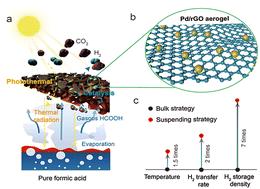
The need for a sustainable hydrogen supply has sparked significant efforts to develop effective liquid hydrogen carriers with high hydrogen content that can be safely stored and undergo controlled hydrogen release. However, a major challenge lies in the ultralow hydrogen evolution rate caused by the direct dehydrogenation of liquid hydrogen carriers. Conventionally, accelerant additives are employed to improve the dehydrogenation rate, but this strategy inevitably sacrifices the hydrogen storage density. Therefore, achieving high-efficiency hydrogen release and high storage density remains a daunting task. Herein, we develop an innovative photothermally-activated suspended biphasic reaction strategy, which absorbs solar radiation and re-radiates infrared photons to induce photothermal evaporation and in situ dehydrogenation of liquid hydrogen carriers, fundamentally circumventing the employment of additives. Furthermore, by leveraging this phase transition-induced biphasic reaction design, the strategy improves the required reaction temperature and drastically lowers hydrogen transport resistance. Therefore, an impressive hydrogen evolution rate of 386 mmol g−1 h−1 is achieved from pure formic acid with an ultrahigh hydrogen storage density of 53 g L−1, representing a threefold improvement in rate compared to state-of-the-art strategies. Our approach introduces a fresh perspective for the dehydrogenation of liquid hydrogen carriers, encompassing formic acid, hydrazine hydrate, and so on, and concurrently guarantees exceptional hydrogen release capabilities and excellent hydrogen storage density.




 京公网安备 11010802042870号
京ICP备2023020795号-1
京公网安备 11010802042870号
京ICP备2023020795号-1

 分享
分享
 求助内容:
求助内容: 应助结果提醒方式:
 扫码关注我们
