{"title":"水土保持服务供需协调变化及其影响因素——来自黄土高原的证据","authors":"Yu Shi, Wei Wei","doi":"10.1016/j.scitotenv.2024.177793","DOIUrl":null,"url":null,"abstract":"<p><p>Soil conservation service (SCS) is crucial for the regulation of fragile ecosystems. As the Loess Plateau is a typically erosion-threatened region, determining the spatial matching pattern and drivers of SCS supply (soil conservation) and demand (soil erosion) is essential for sustainable development and effective resource management. This study innovatively proposed the coupling coordination framework between SCS supply and demand to assess the current state and clarify the subsequent regulation direction. First, the RUSLE model was employed to evaluate the SCS supply and demand from 1990 to 2020 and acquire the ecological supply-demand ratio (ESDR). Then, the SCS supply-demand coordination relationship was spatially quantified by utilizing the coupling coordination degree (CCD) model, and a function fitting was performed between ESDR and CCD. Using the geo-detector model, the Getis-Ord Gi<sup>⁎</sup> method, and the local Moran's I index, the influences of natural, engineering, and socio-economic factors on the SCS supply-demand coordination were explored from global and local perspectives. The results showed that: (1) the annual average supply of SCS increased by 64.93 % in 1990-2020; the average demand decreased by 52.43 %; the average ESDR increased by 28.06 %; supply surplus was the predominant feature, more conspicuously in the central and eastern regions; (2) the highest supply-demand CCD was captured in the central and eastern regions, showing \"Moderate balance\" and \"High balance\" respectively, and its area increased by 27 % in 30 years; the lowest CCD regions were mainly in the northwest and their area shrank; (3) enhancing the supply of SCS and reducing demand facilitated the coordination of the supply-demand relationship, and the threshold for the supply-demand coordination state decreased over time; (4) climate, topography and soil properties dominated the spatially non-stationary change of the SCS supply-demand pattern, followed by engineering measures such as afforestation and terraces, and finally socio-economic factors. This study offers support for cross-regional soil erosion management and natural ecosystem restoration on the Loess Plateau.</p>","PeriodicalId":422,"journal":{"name":"Science of the Total Environment","volume":"957 ","pages":"177793"},"PeriodicalIF":8.0000,"publicationDate":"2024-12-20","publicationTypes":"Journal Article","fieldsOfStudy":null,"isOpenAccess":false,"openAccessPdf":"","citationCount":"0","resultStr":"{\"title\":\"Changes in soil conservation service supply-demand coordinations and their influencing factors: Evidence from the Loess Plateau of China.\",\"authors\":\"Yu Shi, Wei Wei\",\"doi\":\"10.1016/j.scitotenv.2024.177793\",\"DOIUrl\":null,\"url\":null,\"abstract\":\"<p><p>Soil conservation service (SCS) is crucial for the regulation of fragile ecosystems. As the Loess Plateau is a typically erosion-threatened region, determining the spatial matching pattern and drivers of SCS supply (soil conservation) and demand (soil erosion) is essential for sustainable development and effective resource management. This study innovatively proposed the coupling coordination framework between SCS supply and demand to assess the current state and clarify the subsequent regulation direction. First, the RUSLE model was employed to evaluate the SCS supply and demand from 1990 to 2020 and acquire the ecological supply-demand ratio (ESDR). Then, the SCS supply-demand coordination relationship was spatially quantified by utilizing the coupling coordination degree (CCD) model, and a function fitting was performed between ESDR and CCD. Using the geo-detector model, the Getis-Ord Gi<sup>⁎</sup> method, and the local Moran's I index, the influences of natural, engineering, and socio-economic factors on the SCS supply-demand coordination were explored from global and local perspectives. The results showed that: (1) the annual average supply of SCS increased by 64.93 % in 1990-2020; the average demand decreased by 52.43 %; the average ESDR increased by 28.06 %; supply surplus was the predominant feature, more conspicuously in the central and eastern regions; (2) the highest supply-demand CCD was captured in the central and eastern regions, showing \\\"Moderate balance\\\" and \\\"High balance\\\" respectively, and its area increased by 27 % in 30 years; the lowest CCD regions were mainly in the northwest and their area shrank; (3) enhancing the supply of SCS and reducing demand facilitated the coordination of the supply-demand relationship, and the threshold for the supply-demand coordination state decreased over time; (4) climate, topography and soil properties dominated the spatially non-stationary change of the SCS supply-demand pattern, followed by engineering measures such as afforestation and terraces, and finally socio-economic factors. This study offers support for cross-regional soil erosion management and natural ecosystem restoration on the Loess Plateau.</p>\",\"PeriodicalId\":422,\"journal\":{\"name\":\"Science of the Total Environment\",\"volume\":\"957 \",\"pages\":\"177793\"},\"PeriodicalIF\":8.0000,\"publicationDate\":\"2024-12-20\",\"publicationTypes\":\"Journal Article\",\"fieldsOfStudy\":null,\"isOpenAccess\":false,\"openAccessPdf\":\"\",\"citationCount\":\"0\",\"resultStr\":null,\"platform\":\"Semanticscholar\",\"paperid\":null,\"PeriodicalName\":\"Science of the Total Environment\",\"FirstCategoryId\":\"93\",\"ListUrlMain\":\"https://doi.org/10.1016/j.scitotenv.2024.177793\",\"RegionNum\":1,\"RegionCategory\":\"环境科学与生态学\",\"ArticlePicture\":[],\"TitleCN\":null,\"AbstractTextCN\":null,\"PMCID\":null,\"EPubDate\":\"2024/11/30 0:00:00\",\"PubModel\":\"Epub\",\"JCR\":\"Q1\",\"JCRName\":\"ENVIRONMENTAL SCIENCES\",\"Score\":null,\"Total\":0}","platform":"Semanticscholar","paperid":null,"PeriodicalName":"Science of the Total Environment","FirstCategoryId":"93","ListUrlMain":"https://doi.org/10.1016/j.scitotenv.2024.177793","RegionNum":1,"RegionCategory":"环境科学与生态学","ArticlePicture":[],"TitleCN":null,"AbstractTextCN":null,"PMCID":null,"EPubDate":"2024/11/30 0:00:00","PubModel":"Epub","JCR":"Q1","JCRName":"ENVIRONMENTAL SCIENCES","Score":null,"Total":0}
引用次数: 0
摘要
土壤保持服务对脆弱生态系统的调节至关重要。黄土高原是典型的水土流失威胁区,确定土壤资源供给(土壤保持)和需求(土壤侵蚀)的空间匹配模式和驱动因素,对实现黄土高原的可持续发展和有效的资源管理至关重要。本研究创新性地提出了SCS供需之间的耦合协调框架,以评估现状,明确后续的调控方向。首先,采用RUSLE模型对1990 - 2020年的生态供需进行了评价,得到了生态供需比(ESDR)。然后,利用耦合协调度(CCD)模型对供应链供需协调关系进行空间量化,并在ESDR和CCD之间进行函数拟合。利用地理探测器模型、Getis-Ord Gi -方法和当地Moran's I指数,从全球和当地视角探讨了自然、工程和社会经济因素对南海供需协调的影响。结果表明:(1)1990-2020年,全国SCS年平均供应量增长64.93%;平均需求量下降52.43%;ESDR平均增长28.06%;供给过剩是主要特征,在中东部地区更为明显;(2)供需失调最大的区域为中部和东部,分别呈现“中等平衡”和“高平衡”,面积在30 a内增长了27%;CCD最低区主要集中在西北部,面积逐渐缩小;(3)增加SCS的供给和减少需求有利于供需关系的协调,供需协调状态的阈值随着时间的推移而降低;④气候、地形、土壤等因素主导了南海供需格局的空间非平稳性变化,其次是造林、梯田等工程措施,最后是社会经济因素。该研究为黄土高原跨区域水土流失治理和自然生态系统修复提供了依据。
Changes in soil conservation service supply-demand coordinations and their influencing factors: Evidence from the Loess Plateau of China.
Soil conservation service (SCS) is crucial for the regulation of fragile ecosystems. As the Loess Plateau is a typically erosion-threatened region, determining the spatial matching pattern and drivers of SCS supply (soil conservation) and demand (soil erosion) is essential for sustainable development and effective resource management. This study innovatively proposed the coupling coordination framework between SCS supply and demand to assess the current state and clarify the subsequent regulation direction. First, the RUSLE model was employed to evaluate the SCS supply and demand from 1990 to 2020 and acquire the ecological supply-demand ratio (ESDR). Then, the SCS supply-demand coordination relationship was spatially quantified by utilizing the coupling coordination degree (CCD) model, and a function fitting was performed between ESDR and CCD. Using the geo-detector model, the Getis-Ord Gi⁎ method, and the local Moran's I index, the influences of natural, engineering, and socio-economic factors on the SCS supply-demand coordination were explored from global and local perspectives. The results showed that: (1) the annual average supply of SCS increased by 64.93 % in 1990-2020; the average demand decreased by 52.43 %; the average ESDR increased by 28.06 %; supply surplus was the predominant feature, more conspicuously in the central and eastern regions; (2) the highest supply-demand CCD was captured in the central and eastern regions, showing "Moderate balance" and "High balance" respectively, and its area increased by 27 % in 30 years; the lowest CCD regions were mainly in the northwest and their area shrank; (3) enhancing the supply of SCS and reducing demand facilitated the coordination of the supply-demand relationship, and the threshold for the supply-demand coordination state decreased over time; (4) climate, topography and soil properties dominated the spatially non-stationary change of the SCS supply-demand pattern, followed by engineering measures such as afforestation and terraces, and finally socio-economic factors. This study offers support for cross-regional soil erosion management and natural ecosystem restoration on the Loess Plateau.
期刊介绍:
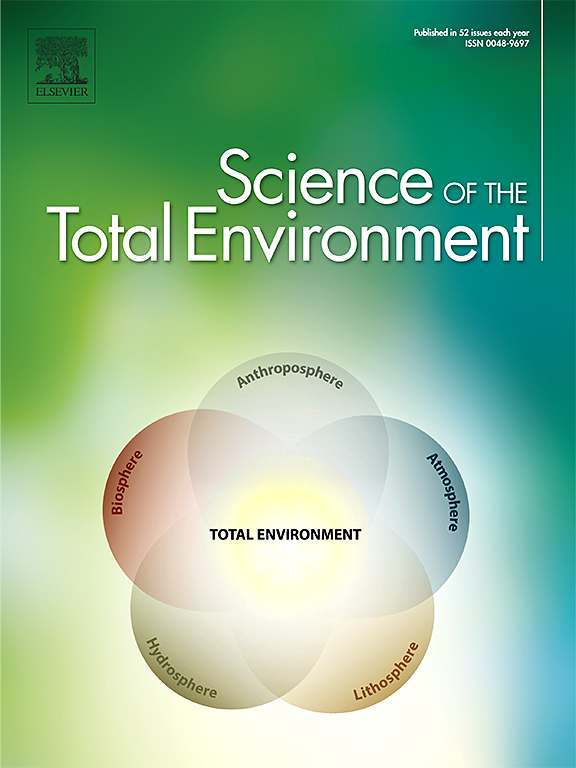
The Science of the Total Environment is an international journal dedicated to scientific research on the environment and its interaction with humanity. It covers a wide range of disciplines and seeks to publish innovative, hypothesis-driven, and impactful research that explores the entire environment, including the atmosphere, lithosphere, hydrosphere, biosphere, and anthroposphere.
The journal's updated Aims & Scope emphasizes the importance of interdisciplinary environmental research with broad impact. Priority is given to studies that advance fundamental understanding and explore the interconnectedness of multiple environmental spheres. Field studies are preferred, while laboratory experiments must demonstrate significant methodological advancements or mechanistic insights with direct relevance to the environment.




 京公网安备 11010802042870号
京ICP备2023020795号-1
京公网安备 11010802042870号
京ICP备2023020795号-1

 分享
分享
 求助内容:
求助内容: 应助结果提醒方式:
 扫码关注我们
