Jikke Bosveld, Tri Q. Nguyen, Joost L. Boormans, J. Alfred Witjes, Antoine G. van der Heijden, Niven Mehra, Lambertus A. Kiemeney, Katja K.H. Aben, ProBCI Study Group, Richard P. Meijer, Anke Richters
{"title":"膀胱切除术后切缘阳性对肿瘤预后的影响:一项全国性研究","authors":"Jikke Bosveld, Tri Q. Nguyen, Joost L. Boormans, J. Alfred Witjes, Antoine G. van der Heijden, Niven Mehra, Lambertus A. Kiemeney, Katja K.H. Aben, ProBCI Study Group, Richard P. Meijer, Anke Richters","doi":"10.1111/bju.16611","DOIUrl":null,"url":null,"abstract":"<div>\n \n <section>\n \n <h3> Objective</h3>\n \n <p>To evaluate whether surgical margin status, alongside existing postoperative risk indicators, improves the identification of bladder cancer patients who may benefit from adjuvant therapy following radical cystectomy (RC).</p>\n </section>\n \n <section>\n \n <h3> Methods</h3>\n \n <p>In this nationwide cohort study, patients aged ≥18 years diagnosed with muscle-invasive bladder cancer (MIBC) without nodal or distant metastasis (cT2-4aN0/xM0) between November 2017 and December 2020 who underwent RC were selected from the Netherlands Cancer Registry. Detailed information on surgical margin status was obtained through linkage with the Dutch central pathology database, Palga. Overall survival (OS) and progression-free survival (PFS) were assessed using the Kaplan–Meier method. Multivariable Cox regression analysis was performed to assess the independent prognostic effect of positive surgical margins (carcinoma <i>in situ</i> (CIS) only or invasive carcinoma) on PFS and OS.</p>\n </section>\n \n <section>\n \n <h3> Results</h3>\n \n <p>We identified 1445 MIBC patients treated by RC (53% open, 47% robot-assisted), of whom 135 (9.3%) had positive surgical margins (10.7% in the open and 7.7% in the robot-assisted cohort). In the entire cohort, OS was 79% and 60% at 12 and 48 months after RC, respectively. PFS was 70% and 61% at 12 and 24 months, respectively. Multivariable Cox regression showed worse PFS (hazard ratio (HR) 2.13, 95% confidence interval (CI) 1.67–2.72) and OS (HR 2.02, 95% CI 1.58–2.58) in patients with surgical margins with invasive carcinoma vs patients with negative margins. Patients with only CIS in the margins also appeared to have worse PFS (HR 1.60, 95% CI 1.00–2.58) but these results were not statistically significant. No difference was found for OS (HR 1.30, 95% CI 0.80–2.12).</p>\n </section>\n \n <section>\n \n <h3> Conclusion</h3>\n \n <p>Positive margins should be considered a ‘high risk feature’, as they result in increased risk of disease progression and impaired survival outcomes. These findings support further investigation of the potential efficacy of adjuvant therapy (i.e., radiotherapy and systemic therapy) among patients with positive surgical margins.</p>\n </section>\n </div>","PeriodicalId":8985,"journal":{"name":"BJU International","volume":"135 5","pages":"766-774"},"PeriodicalIF":4.1000,"publicationDate":"2025-04-07","publicationTypes":"Journal Article","fieldsOfStudy":null,"isOpenAccess":false,"openAccessPdf":"https://onlinelibrary.wiley.com/doi/epdf/10.1111/bju.16611","citationCount":"0","resultStr":"{\"title\":\"The impact of positive surgical margins after cystectomy on oncological outcomes: a nationwide study\",\"authors\":\"Jikke Bosveld, Tri Q. Nguyen, Joost L. Boormans, J. Alfred Witjes, Antoine G. van der Heijden, Niven Mehra, Lambertus A. Kiemeney, Katja K.H. Aben, ProBCI Study Group, Richard P. Meijer, Anke Richters\",\"doi\":\"10.1111/bju.16611\",\"DOIUrl\":null,\"url\":null,\"abstract\":\"<div>\\n \\n <section>\\n \\n <h3> Objective</h3>\\n \\n <p>To evaluate whether surgical margin status, alongside existing postoperative risk indicators, improves the identification of bladder cancer patients who may benefit from adjuvant therapy following radical cystectomy (RC).</p>\\n </section>\\n \\n <section>\\n \\n <h3> Methods</h3>\\n \\n <p>In this nationwide cohort study, patients aged ≥18 years diagnosed with muscle-invasive bladder cancer (MIBC) without nodal or distant metastasis (cT2-4aN0/xM0) between November 2017 and December 2020 who underwent RC were selected from the Netherlands Cancer Registry. Detailed information on surgical margin status was obtained through linkage with the Dutch central pathology database, Palga. Overall survival (OS) and progression-free survival (PFS) were assessed using the Kaplan–Meier method. Multivariable Cox regression analysis was performed to assess the independent prognostic effect of positive surgical margins (carcinoma <i>in situ</i> (CIS) only or invasive carcinoma) on PFS and OS.</p>\\n </section>\\n \\n <section>\\n \\n <h3> Results</h3>\\n \\n <p>We identified 1445 MIBC patients treated by RC (53% open, 47% robot-assisted), of whom 135 (9.3%) had positive surgical margins (10.7% in the open and 7.7% in the robot-assisted cohort). In the entire cohort, OS was 79% and 60% at 12 and 48 months after RC, respectively. PFS was 70% and 61% at 12 and 24 months, respectively. Multivariable Cox regression showed worse PFS (hazard ratio (HR) 2.13, 95% confidence interval (CI) 1.67–2.72) and OS (HR 2.02, 95% CI 1.58–2.58) in patients with surgical margins with invasive carcinoma vs patients with negative margins. Patients with only CIS in the margins also appeared to have worse PFS (HR 1.60, 95% CI 1.00–2.58) but these results were not statistically significant. No difference was found for OS (HR 1.30, 95% CI 0.80–2.12).</p>\\n </section>\\n \\n <section>\\n \\n <h3> Conclusion</h3>\\n \\n <p>Positive margins should be considered a ‘high risk feature’, as they result in increased risk of disease progression and impaired survival outcomes. These findings support further investigation of the potential efficacy of adjuvant therapy (i.e., radiotherapy and systemic therapy) among patients with positive surgical margins.</p>\\n </section>\\n </div>\",\"PeriodicalId\":8985,\"journal\":{\"name\":\"BJU International\",\"volume\":\"135 5\",\"pages\":\"766-774\"},\"PeriodicalIF\":4.1000,\"publicationDate\":\"2025-04-07\",\"publicationTypes\":\"Journal Article\",\"fieldsOfStudy\":null,\"isOpenAccess\":false,\"openAccessPdf\":\"https://onlinelibrary.wiley.com/doi/epdf/10.1111/bju.16611\",\"citationCount\":\"0\",\"resultStr\":null,\"platform\":\"Semanticscholar\",\"paperid\":null,\"PeriodicalName\":\"BJU International\",\"FirstCategoryId\":\"3\",\"ListUrlMain\":\"https://onlinelibrary.wiley.com/doi/10.1111/bju.16611\",\"RegionNum\":2,\"RegionCategory\":\"医学\",\"ArticlePicture\":[],\"TitleCN\":null,\"AbstractTextCN\":null,\"PMCID\":null,\"EPubDate\":\"2024/12/4 0:00:00\",\"PubModel\":\"Epub\",\"JCR\":\"Q1\",\"JCRName\":\"UROLOGY & NEPHROLOGY\",\"Score\":null,\"Total\":0}","platform":"Semanticscholar","paperid":null,"PeriodicalName":"BJU International","FirstCategoryId":"3","ListUrlMain":"https://onlinelibrary.wiley.com/doi/10.1111/bju.16611","RegionNum":2,"RegionCategory":"医学","ArticlePicture":[],"TitleCN":null,"AbstractTextCN":null,"PMCID":null,"EPubDate":"2024/12/4 0:00:00","PubModel":"Epub","JCR":"Q1","JCRName":"UROLOGY & NEPHROLOGY","Score":null,"Total":0}
The impact of positive surgical margins after cystectomy on oncological outcomes: a nationwide study
Objective
To evaluate whether surgical margin status, alongside existing postoperative risk indicators, improves the identification of bladder cancer patients who may benefit from adjuvant therapy following radical cystectomy (RC).
Methods
In this nationwide cohort study, patients aged ≥18 years diagnosed with muscle-invasive bladder cancer (MIBC) without nodal or distant metastasis (cT2-4aN0/xM0) between November 2017 and December 2020 who underwent RC were selected from the Netherlands Cancer Registry. Detailed information on surgical margin status was obtained through linkage with the Dutch central pathology database, Palga. Overall survival (OS) and progression-free survival (PFS) were assessed using the Kaplan–Meier method. Multivariable Cox regression analysis was performed to assess the independent prognostic effect of positive surgical margins (carcinoma in situ (CIS) only or invasive carcinoma) on PFS and OS.
Results
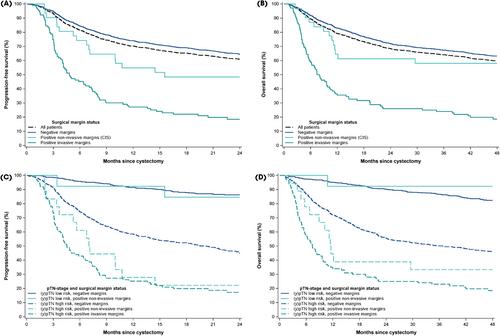
We identified 1445 MIBC patients treated by RC (53% open, 47% robot-assisted), of whom 135 (9.3%) had positive surgical margins (10.7% in the open and 7.7% in the robot-assisted cohort). In the entire cohort, OS was 79% and 60% at 12 and 48 months after RC, respectively. PFS was 70% and 61% at 12 and 24 months, respectively. Multivariable Cox regression showed worse PFS (hazard ratio (HR) 2.13, 95% confidence interval (CI) 1.67–2.72) and OS (HR 2.02, 95% CI 1.58–2.58) in patients with surgical margins with invasive carcinoma vs patients with negative margins. Patients with only CIS in the margins also appeared to have worse PFS (HR 1.60, 95% CI 1.00–2.58) but these results were not statistically significant. No difference was found for OS (HR 1.30, 95% CI 0.80–2.12).
Conclusion
Positive margins should be considered a ‘high risk feature’, as they result in increased risk of disease progression and impaired survival outcomes. These findings support further investigation of the potential efficacy of adjuvant therapy (i.e., radiotherapy and systemic therapy) among patients with positive surgical margins.
期刊介绍:
BJUI is one of the most highly respected medical journals in the world, with a truly international range of published papers and appeal. Every issue gives invaluable practical information in the form of original articles, reviews, comments, surgical education articles, and translational science articles in the field of urology. BJUI employs topical sections, and is in full colour, making it easier to browse or search for something specific.






 京公网安备 11010802042870号
京ICP备2023020795号-1
京公网安备 11010802042870号
京ICP备2023020795号-1

 分享
分享
 求助内容:
求助内容: 应助结果提醒方式:
 扫码关注我们
