{"title":"非光化学猝灭不会改变高温下太阳诱导荧光与总初级产量之间的关系","authors":"Michal Antala, Radosław Juszczak, Anshu Rastogi","doi":"10.1111/nph.20312","DOIUrl":null,"url":null,"abstract":"<p>Sun-induced fluorescence (SIF) is a remote sensing signal that has recently received substantial attention due to its origin from plants' photosynthetic apparatus, which makes it more related to photosynthesis than reflectance-based vegetation indices (Mohammed <i>et al</i>., <span>2019</span>). Upon absorption by the light-harvesting complex of photosystems, the energy can be used by four major paths: (1) photochemistry (<i>p</i>), which mainly, but not exclusively, results in gross primary production (GPP; or simply photosynthetic assimilation of carbon); (2) light-intensity-dependent heat dissipation, commonly referred to as nonphotochemical quenching (<i>npq</i>); (3) light-intensity-independent (or basal) heat dissipation (<i>d</i>); and (4) fluorescence (<i>f</i>), which is, in natural conditions, termed SIF. These four processes compete for the absorbed energy, and <i>p</i> and <i>npq</i> together normally constitute <i>c</i>. 80% of the energy use (Lazár, <span>2015</span>). Only 1–2% of absorbed energy is normally emitted as <i>f</i>. The widespread notion of using this small proportion of emitted energy for the estimation of photosynthesis originates in the covariance of <i>f</i> and <i>p</i> that originate from reaction centres (RCs) due to <i>npq</i> that decreases the amount of energy reaching RCs, therefore available for further partitioning into <i>p</i>, <i>f</i> and <i>d</i> (Van Der Tol <i>et al</i>., <span>2014</span>; Magney <i>et al</i>., <span>2020</span>). However, the assumption of the proportional impact of <i>npq</i> on <i>f</i> and <i>p</i> and the stable share of <i>p</i> being used for GPP is close to the truth only in optimal conditions. The range of environmental stresses affecting plants decreases the SIF vs GPP correlation, and during severe stress, this correlation may cease to exist completely (Wieneke <i>et al</i>., <span>2018</span>). One of the most impactful studies in regard to not only reporting the broken SIF vs GPP correlation during heat stress but also interpreting the plant physiology behind the broken correlation by leaf-level active Chl <i>f</i> measurements was published by Martini <i>et al</i>. (<span>2022</span>). However, it could not escape our attention, that this study somewhat misinterpreted the results and not very correctly assigned the broken correlation to nonphotochemical quenching (NPQ) of maximal fluorescence saturation. Therefore, we wrote this short commentary to point out overlooked factors from the article of Martini <i>et al</i>. (<span>2022</span>), its supplementary materials and raw data (10.5281/zenodo.5773208), and bring an impulse for a different interpretation of this interesting and important dataset.</p><p>Despite the title of Martini <i>et al</i>. (<span>2022</span>) suggests that the heatwave (HW) which occurred at the beginning of August 2018 caused the broken correlation of SIF and GPP, a look at the time series of the used data suggests that the correlation was also broken in the ‘normal’, pre-HW, conditions (Fig. 1). Before noon (9:00–12:00 h), SIF and GPP do not correlate as GPP is steadily decreasing from morning till afternoon, but SIF is increasing with increasing photosynthetically active radiation (PAR) and decreasing solar zenith angle (SZA) and peaking at noon. In the afternoon hours (14:00–16:00 h), when SIF decreases following PAR decrease and SZA increase, SIF and GPP may exhibit a positive correlation. During the HW and particularly on 3 and 6 August, SIF did not decrease in the afternoon but kept rising, which drives the negative correlation of SIF and GPP in HW. The positive correlation of pre-HW SIF and GPP is driven solely by differences among days. The within-day correlations are not significant for any of the 8 pre-HW days. The last 3 d in the pre-HW period even show a negative SIF vs GPP trend (Fig. 2). That, and decreasing SIF and GPP (Fig. 1), suggest that at least 31 July and 1 August were not pre-HW, but rather the beginning of HW days.</p><p>Modifications of xanthophylls, known as the xanthophyll cycle, are one of the major components of <i>npq</i>. As the xanthophyll pool of plants is not infinite and the other <i>npq</i>-related changes in photosynthetic apparatus (for a detailed description, see Ruban, <span>2016</span>) cannot continue forever, the safe energy dissipation by <i>npq</i> may saturate under severe stress and high light intensity (Lazár, <span>2015</span>; Ruban, <span>2016</span>). However, despite the claims of Martini <i>et al</i>. (<span>2022</span>) about the role of NPQ in energy partitioning and SIF vs GPP correlation modulation making theoretical sense, the presented data do not support them. One of the main points of the publication is the NPQ saturation in the HW. Nevertheless, fig. 4 of Martini <i>et al</i>. (<span>2022</span>) does not support this idea when NPQ clearly does not saturate with decreasing GPP and also does not reach the saturation point with increasing VPD. The apparent saturation of SIF and NPQ is, paradoxically, driven by low values of NPQ. We would like to draw attention to the fact that the parameter NPQ is a ratio of the quantum yield of light-dependent heat dissipation (φNPQ) and the sum of the quantum yield of basal heat dissipation and quantum yield of fluorescence (Van Der Tol <i>et al</i>., <span>2014</span>; Lazár, <span>2015</span>; Kalaji <i>et al</i>., <span>2017</span>). That means that NPQ also contains information about the fluorescence emission; therefore, it is not correct to use NPQ as an energy partitioning parameter explaining changes in SIF and GPP. Instead, φNPQ or, as the authors called it, NPQ yield, should be used to explain the use of absorbed energy for different pathways (Lazár, <span>2015</span>; Kalaji <i>et al</i>., <span>2017</span>). Correlating φNPQ with a quantum yield of photochemistry further supports no saturation of φNPQ in measured data and suggests that the excess energy was dissipated by <i>npq</i> also during HW (data not shown, but available at 10.5281/zenodo.5773208).</p><p>Martini <i>et al</i>. (<span>2022</span>) further argued that during the HW, there was a change in the energy allocation from NPQ towards SIF. This seems to be very unlikely not only for the reasons stated above but also because of the disproportionally high decrease in SIF described below.</p><p>If NPQ was not the cause of broken linearity between SIF and GPP, then the logical question is: what was causing the decoupling of SIF's and GPP's daily courses?</p><p>As mentioned earlier, in normal conditions, SIF and GPP correlate because the SIF intensity and amount of fixed carbon are both regulated by the amount of energy reaching RCs. Hence, they are both dependent on the absorbed PAR, which in turn largely depends on PAR reaching the top of the canopy (Van Der Tol <i>et al</i>., <span>2014</span>; Magney <i>et al</i>., <span>2020</span>). However, during heat and drought stress, photosynthesis is not limited by PAR but by water availability, which regulates the stomatas’ opening and closure (Farquhar <i>et al</i>., <span>1980</span>). The limitation of gas exchange between the atmosphere and leaf interior induces a cascade of changes in photosynthetic apparatus activity, including upregulation of alternative electron sinks that can use the energy passed to <i>p</i>, causing a situation whereby SIF increases due to energy reaching RCs, but GPP does not increase because of electrons being used for alternative processes (Alric & Johnson, <span>2017</span>).</p><p>The data from Martini <i>et al</i>. (<span>2022</span>) and the associated dataset (10.5281/zenodo.5773208) help us to understand the broken linearity of SIF and GPP. While SIF was strongly correlated with PAR, especially in the pre-HW period (Supporting Information Fig. S1B), GPP was not significantly correlated with PAR for any of the analysed days (Fig. S1A). However, GPP was negatively dependent on vapour pressure deficit (VPD, which is largely temperature-dependent) every day in pre-HW and HW periods (Fig. S1C). By contrast, SIF did not correlate significantly with VPD in the pre-HW period but correlated strongly in 3 of the 5 HW days (Fig. S1D). As high VPD is a main driver of stomata closure, these results indicate that stomatal limitation of photosynthesis was the main cause of the broken correlation between SIF and GPP during pre-HW, but stomatal conductance alone cannot explain the reverse relationship during HW (Grossiord <i>et al</i>., <span>2020</span>). The below-discussed changes in SIF must be taken into account in severe heat conditions.</p><p>One of the strongest effects of HW reported by Martini <i>et al</i>. (<span>2022</span>) was a significant decrease in SIF. This decrease is undoubtedly caused by plant physiology; however, as seen in Fig. 1, the SIF retrieval stopped being reliable, as some of the reported values were negative. Negative SIF is a theoretical nonsense as negative emission of photons is impossible and practically had to result from lowering the signal-to-noise ratio to such an extent that even as simple a method as improved Fraunhofer line depth (iFLD) stopped yielding trustworthy results (Alonso <i>et al</i>., <span>2008</span>). Correcting SIF by the near-infrared reflectance of vegetation (NIRv)-derived fluorescence escape ratio and absorbed PAR yielded even more negative values than top-of-canopy SIF itself. Such results point to our general lack of understanding of top-of-canopy SIF and top-of-canopy SIF-derived parameters during severe stress, such as temperatures above 40°C. Therefore, more attention should be paid to the impact of environmental and plant stress conditions on retrieved SIF reliability, which is an important outcome of the Martini <i>et al</i>. (<span>2022</span>) study that did not get enough attention in the publication.</p><p>The decrease in SIF in HW was disproportionally larger than the decrease in GPP or increase in NPQ. This would cause a large error in linear regression-based GPP estimation using either instantaneous or mid-day SIF. Moreover, such a large decrease in SIF due to severe stress is not well understood and should be further examined. One possible, although rather speculative, explanation for the observed large decrease in SIF is the temperature dependency of fluorescence emission after crossing the physiological threshold of plants (Kouřil <i>et al</i>., <span>2004</span>). Kouřil <i>et al</i>. (<span>2004</span>) also reported an increase in fluorescence after leaves were heated to 40–45°C, similar to data presented in Fig. 1 and Fig. S1D during HW, especially on 3 and 6 August. Therefore, more consideration should be given to temperature as a factor influencing SIF in future studies performed in extreme heat conditions.</p><p>We believe that this Correspondence will induce a new way of thinking about the SIF : GPP : NPQ relationship, the absorbed energy partitioning between photochemical and nonphotochemical processes, the role of stomata in the SIF : GPP relationship and the changes in SIF emission under severe heat or other abiotic and biotic stress conditions.</p><p>None declared.</p><p>MA, RJ and AR developed the concept. MA prepared the figures and wrote the first draft. RJ and AR reviewed and edited the text.</p><p>These data were derived from the following resources available in the public domain: 10.5281/zenodo.5773208.</p><p>The New Phytologist Foundation remains neutral with regard to jurisdictional claims in maps and in any institutional affiliations.</p>","PeriodicalId":214,"journal":{"name":"New Phytologist","volume":"245 3","pages":"927-930"},"PeriodicalIF":8.1000,"publicationDate":"2025-01-08","publicationTypes":"Journal Article","fieldsOfStudy":null,"isOpenAccess":false,"openAccessPdf":"https://onlinelibrary.wiley.com/doi/epdf/10.1111/nph.20312","citationCount":"0","resultStr":"{\"title\":\"Nonphotochemical quenching does not alter the relationship between sun-induced fluorescence and gross primary production under heatwave\",\"authors\":\"Michal Antala, Radosław Juszczak, Anshu Rastogi\",\"doi\":\"10.1111/nph.20312\",\"DOIUrl\":null,\"url\":null,\"abstract\":\"<p>Sun-induced fluorescence (SIF) is a remote sensing signal that has recently received substantial attention due to its origin from plants' photosynthetic apparatus, which makes it more related to photosynthesis than reflectance-based vegetation indices (Mohammed <i>et al</i>., <span>2019</span>). Upon absorption by the light-harvesting complex of photosystems, the energy can be used by four major paths: (1) photochemistry (<i>p</i>), which mainly, but not exclusively, results in gross primary production (GPP; or simply photosynthetic assimilation of carbon); (2) light-intensity-dependent heat dissipation, commonly referred to as nonphotochemical quenching (<i>npq</i>); (3) light-intensity-independent (or basal) heat dissipation (<i>d</i>); and (4) fluorescence (<i>f</i>), which is, in natural conditions, termed SIF. These four processes compete for the absorbed energy, and <i>p</i> and <i>npq</i> together normally constitute <i>c</i>. 80% of the energy use (Lazár, <span>2015</span>). Only 1–2% of absorbed energy is normally emitted as <i>f</i>. The widespread notion of using this small proportion of emitted energy for the estimation of photosynthesis originates in the covariance of <i>f</i> and <i>p</i> that originate from reaction centres (RCs) due to <i>npq</i> that decreases the amount of energy reaching RCs, therefore available for further partitioning into <i>p</i>, <i>f</i> and <i>d</i> (Van Der Tol <i>et al</i>., <span>2014</span>; Magney <i>et al</i>., <span>2020</span>). However, the assumption of the proportional impact of <i>npq</i> on <i>f</i> and <i>p</i> and the stable share of <i>p</i> being used for GPP is close to the truth only in optimal conditions. The range of environmental stresses affecting plants decreases the SIF vs GPP correlation, and during severe stress, this correlation may cease to exist completely (Wieneke <i>et al</i>., <span>2018</span>). One of the most impactful studies in regard to not only reporting the broken SIF vs GPP correlation during heat stress but also interpreting the plant physiology behind the broken correlation by leaf-level active Chl <i>f</i> measurements was published by Martini <i>et al</i>. (<span>2022</span>). However, it could not escape our attention, that this study somewhat misinterpreted the results and not very correctly assigned the broken correlation to nonphotochemical quenching (NPQ) of maximal fluorescence saturation. Therefore, we wrote this short commentary to point out overlooked factors from the article of Martini <i>et al</i>. (<span>2022</span>), its supplementary materials and raw data (10.5281/zenodo.5773208), and bring an impulse for a different interpretation of this interesting and important dataset.</p><p>Despite the title of Martini <i>et al</i>. (<span>2022</span>) suggests that the heatwave (HW) which occurred at the beginning of August 2018 caused the broken correlation of SIF and GPP, a look at the time series of the used data suggests that the correlation was also broken in the ‘normal’, pre-HW, conditions (Fig. 1). Before noon (9:00–12:00 h), SIF and GPP do not correlate as GPP is steadily decreasing from morning till afternoon, but SIF is increasing with increasing photosynthetically active radiation (PAR) and decreasing solar zenith angle (SZA) and peaking at noon. In the afternoon hours (14:00–16:00 h), when SIF decreases following PAR decrease and SZA increase, SIF and GPP may exhibit a positive correlation. During the HW and particularly on 3 and 6 August, SIF did not decrease in the afternoon but kept rising, which drives the negative correlation of SIF and GPP in HW. The positive correlation of pre-HW SIF and GPP is driven solely by differences among days. The within-day correlations are not significant for any of the 8 pre-HW days. The last 3 d in the pre-HW period even show a negative SIF vs GPP trend (Fig. 2). That, and decreasing SIF and GPP (Fig. 1), suggest that at least 31 July and 1 August were not pre-HW, but rather the beginning of HW days.</p><p>Modifications of xanthophylls, known as the xanthophyll cycle, are one of the major components of <i>npq</i>. As the xanthophyll pool of plants is not infinite and the other <i>npq</i>-related changes in photosynthetic apparatus (for a detailed description, see Ruban, <span>2016</span>) cannot continue forever, the safe energy dissipation by <i>npq</i> may saturate under severe stress and high light intensity (Lazár, <span>2015</span>; Ruban, <span>2016</span>). However, despite the claims of Martini <i>et al</i>. (<span>2022</span>) about the role of NPQ in energy partitioning and SIF vs GPP correlation modulation making theoretical sense, the presented data do not support them. One of the main points of the publication is the NPQ saturation in the HW. Nevertheless, fig. 4 of Martini <i>et al</i>. (<span>2022</span>) does not support this idea when NPQ clearly does not saturate with decreasing GPP and also does not reach the saturation point with increasing VPD. The apparent saturation of SIF and NPQ is, paradoxically, driven by low values of NPQ. We would like to draw attention to the fact that the parameter NPQ is a ratio of the quantum yield of light-dependent heat dissipation (φNPQ) and the sum of the quantum yield of basal heat dissipation and quantum yield of fluorescence (Van Der Tol <i>et al</i>., <span>2014</span>; Lazár, <span>2015</span>; Kalaji <i>et al</i>., <span>2017</span>). That means that NPQ also contains information about the fluorescence emission; therefore, it is not correct to use NPQ as an energy partitioning parameter explaining changes in SIF and GPP. Instead, φNPQ or, as the authors called it, NPQ yield, should be used to explain the use of absorbed energy for different pathways (Lazár, <span>2015</span>; Kalaji <i>et al</i>., <span>2017</span>). Correlating φNPQ with a quantum yield of photochemistry further supports no saturation of φNPQ in measured data and suggests that the excess energy was dissipated by <i>npq</i> also during HW (data not shown, but available at 10.5281/zenodo.5773208).</p><p>Martini <i>et al</i>. (<span>2022</span>) further argued that during the HW, there was a change in the energy allocation from NPQ towards SIF. This seems to be very unlikely not only for the reasons stated above but also because of the disproportionally high decrease in SIF described below.</p><p>If NPQ was not the cause of broken linearity between SIF and GPP, then the logical question is: what was causing the decoupling of SIF's and GPP's daily courses?</p><p>As mentioned earlier, in normal conditions, SIF and GPP correlate because the SIF intensity and amount of fixed carbon are both regulated by the amount of energy reaching RCs. Hence, they are both dependent on the absorbed PAR, which in turn largely depends on PAR reaching the top of the canopy (Van Der Tol <i>et al</i>., <span>2014</span>; Magney <i>et al</i>., <span>2020</span>). However, during heat and drought stress, photosynthesis is not limited by PAR but by water availability, which regulates the stomatas’ opening and closure (Farquhar <i>et al</i>., <span>1980</span>). The limitation of gas exchange between the atmosphere and leaf interior induces a cascade of changes in photosynthetic apparatus activity, including upregulation of alternative electron sinks that can use the energy passed to <i>p</i>, causing a situation whereby SIF increases due to energy reaching RCs, but GPP does not increase because of electrons being used for alternative processes (Alric & Johnson, <span>2017</span>).</p><p>The data from Martini <i>et al</i>. (<span>2022</span>) and the associated dataset (10.5281/zenodo.5773208) help us to understand the broken linearity of SIF and GPP. While SIF was strongly correlated with PAR, especially in the pre-HW period (Supporting Information Fig. S1B), GPP was not significantly correlated with PAR for any of the analysed days (Fig. S1A). However, GPP was negatively dependent on vapour pressure deficit (VPD, which is largely temperature-dependent) every day in pre-HW and HW periods (Fig. S1C). By contrast, SIF did not correlate significantly with VPD in the pre-HW period but correlated strongly in 3 of the 5 HW days (Fig. S1D). As high VPD is a main driver of stomata closure, these results indicate that stomatal limitation of photosynthesis was the main cause of the broken correlation between SIF and GPP during pre-HW, but stomatal conductance alone cannot explain the reverse relationship during HW (Grossiord <i>et al</i>., <span>2020</span>). The below-discussed changes in SIF must be taken into account in severe heat conditions.</p><p>One of the strongest effects of HW reported by Martini <i>et al</i>. (<span>2022</span>) was a significant decrease in SIF. This decrease is undoubtedly caused by plant physiology; however, as seen in Fig. 1, the SIF retrieval stopped being reliable, as some of the reported values were negative. Negative SIF is a theoretical nonsense as negative emission of photons is impossible and practically had to result from lowering the signal-to-noise ratio to such an extent that even as simple a method as improved Fraunhofer line depth (iFLD) stopped yielding trustworthy results (Alonso <i>et al</i>., <span>2008</span>). Correcting SIF by the near-infrared reflectance of vegetation (NIRv)-derived fluorescence escape ratio and absorbed PAR yielded even more negative values than top-of-canopy SIF itself. Such results point to our general lack of understanding of top-of-canopy SIF and top-of-canopy SIF-derived parameters during severe stress, such as temperatures above 40°C. Therefore, more attention should be paid to the impact of environmental and plant stress conditions on retrieved SIF reliability, which is an important outcome of the Martini <i>et al</i>. (<span>2022</span>) study that did not get enough attention in the publication.</p><p>The decrease in SIF in HW was disproportionally larger than the decrease in GPP or increase in NPQ. This would cause a large error in linear regression-based GPP estimation using either instantaneous or mid-day SIF. Moreover, such a large decrease in SIF due to severe stress is not well understood and should be further examined. One possible, although rather speculative, explanation for the observed large decrease in SIF is the temperature dependency of fluorescence emission after crossing the physiological threshold of plants (Kouřil <i>et al</i>., <span>2004</span>). Kouřil <i>et al</i>. (<span>2004</span>) also reported an increase in fluorescence after leaves were heated to 40–45°C, similar to data presented in Fig. 1 and Fig. S1D during HW, especially on 3 and 6 August. Therefore, more consideration should be given to temperature as a factor influencing SIF in future studies performed in extreme heat conditions.</p><p>We believe that this Correspondence will induce a new way of thinking about the SIF : GPP : NPQ relationship, the absorbed energy partitioning between photochemical and nonphotochemical processes, the role of stomata in the SIF : GPP relationship and the changes in SIF emission under severe heat or other abiotic and biotic stress conditions.</p><p>None declared.</p><p>MA, RJ and AR developed the concept. MA prepared the figures and wrote the first draft. RJ and AR reviewed and edited the text.</p><p>These data were derived from the following resources available in the public domain: 10.5281/zenodo.5773208.</p><p>The New Phytologist Foundation remains neutral with regard to jurisdictional claims in maps and in any institutional affiliations.</p>\",\"PeriodicalId\":214,\"journal\":{\"name\":\"New Phytologist\",\"volume\":\"245 3\",\"pages\":\"927-930\"},\"PeriodicalIF\":8.1000,\"publicationDate\":\"2025-01-08\",\"publicationTypes\":\"Journal Article\",\"fieldsOfStudy\":null,\"isOpenAccess\":false,\"openAccessPdf\":\"https://onlinelibrary.wiley.com/doi/epdf/10.1111/nph.20312\",\"citationCount\":\"0\",\"resultStr\":null,\"platform\":\"Semanticscholar\",\"paperid\":null,\"PeriodicalName\":\"New Phytologist\",\"FirstCategoryId\":\"99\",\"ListUrlMain\":\"https://onlinelibrary.wiley.com/doi/10.1111/nph.20312\",\"RegionNum\":1,\"RegionCategory\":\"生物学\",\"ArticlePicture\":[],\"TitleCN\":null,\"AbstractTextCN\":null,\"PMCID\":null,\"EPubDate\":\"2024/12/7 0:00:00\",\"PubModel\":\"Epub\",\"JCR\":\"Q1\",\"JCRName\":\"PLANT SCIENCES\",\"Score\":null,\"Total\":0}","platform":"Semanticscholar","paperid":null,"PeriodicalName":"New Phytologist","FirstCategoryId":"99","ListUrlMain":"https://onlinelibrary.wiley.com/doi/10.1111/nph.20312","RegionNum":1,"RegionCategory":"生物学","ArticlePicture":[],"TitleCN":null,"AbstractTextCN":null,"PMCID":null,"EPubDate":"2024/12/7 0:00:00","PubModel":"Epub","JCR":"Q1","JCRName":"PLANT SCIENCES","Score":null,"Total":0}
引用次数: 0
摘要
太阳诱导荧光(Sun-induced fluorescence, SIF)是一种遥感信号,由于其来源于植物的光合机构,最近受到了广泛关注,这使得它比基于反射率的植被指数更与光合作用相关(Mohammed et al., 2019)。在被光系统的光收集复合物吸收后,能量可以通过四个主要途径使用:(1)光化学(p),主要但不完全是产生总初级生产量(GPP);或者仅仅是碳的光合同化);(2)光强依赖性散热,通常称为非光化学猝灭(npq);(3)不依赖于光强(或基底)的散热(d);(4)荧光(f),在自然条件下称为SIF。这四个过程相互竞争吸收的能量,p和npq通常占能量消耗的80% (Lazár, 2015)。通常只有1-2%的吸收能量以f的形式发射。利用这一小部分发射能量来估计光合作用的广泛概念源于反应中心(rc)的f和p的协方差,由于npq减少了到达rc的能量,因此可以进一步划分为p, f和d (Van Der Tol et al., 2014;Magney et al., 2020)。然而,npq对f和p的比例影响以及p用于GPP的稳定份额的假设只有在最优条件下才接近于事实。影响植物的环境胁迫范围降低了SIF与GPP的相关性,在严重胁迫下,这种相关性可能完全不复存在(Wieneke et al., 2018)。Martini等人(2022)发表了一项最具影响力的研究,该研究不仅报道了热胁迫期间SIF与GPP相关性的破坏,而且还通过叶片水平活性Chl - f测量解释了相关性破坏背后的植物生理学。然而,我们不能忽视的是,本研究在一定程度上曲解了结果,并不是很正确地将断裂相关性分配给最大荧光饱和度的非光化学猝灭(NPQ)。因此,我们写了这篇简短的评论,以指出Martini et al.(2022)的文章,其补充材料和原始数据(10.5281/zenodo.5773208)中被忽视的因素,并为这个有趣而重要的数据集带来不同的解释。尽管Martini et al.(2022)的标题表明,2018年8月初发生的热浪(HW)导致SIF和GPP的相关性被打破,但查看所使用数据的时间序列表明,在“正常”的高温前条件下(图1),相关性也被打破。中午之前(9:00-12:00 h), SIF和GPP不相关,因为GPP从早上到下午稳步下降。SIF随光合有效辐射(PAR)的增加和太阳天顶角(SZA)的减小而增加,并在正午达到峰值。在下午时段(14:00-16:00 h),当SIF随PAR的降低和SZA的增加而降低时,SIF与GPP可能呈现正相关。在暴雨期间,特别是8月3日和6日,SIF在下午没有减少反而持续上升,这导致暴雨SIF与GPP呈负相关。高温前SIF与GPP的正相关仅受日间差异驱动。在hw之前的8天中,任何一天的日内相关性都不显著。前HW期的最后3 d甚至表现出负的SIF / GPP趋势(图2)。这一点,以及SIF和GPP的下降(图1),表明至少7月31日和8月1日不是HW前期,而是HW的开始。叶黄素的修饰称为叶黄素循环,是npq的主要组成部分之一。由于植物的叶黄素库不是无限的,光合机构中其他与npq相关的变化(详见Ruban, 2016)也不能永远持续下去,npq的安全耗散可能在严重胁迫和高光强下饱和(Lazár, 2015;鲁班,2016)。然而,尽管Martini等人(2022)关于NPQ在能量分配和SIF与GPP相关调制中的作用的主张具有理论意义,但目前的数据并不支持它们。该出版物的主要观点之一是HW中的NPQ饱和度。然而,Martini et al.(2022)的图4并不支持这一观点,NPQ显然不会随着GPP的降低而饱和,也不会随着VPD的增加而达到饱和点。矛盾的是,SIF和NPQ的明显饱和是由NPQ的低值驱动的。需要注意的是,参数NPQ是依赖光的散热量子产率(φNPQ)与基础散热量子产率与荧光量子产率之和的比值(Van Der Tol et al., 2014;拉扎尔,2015;Kalaji等人,2017)。 这意味着NPQ还包含有关荧光发射的信息;因此,用NPQ作为能量分配参数来解释SIF和GPP的变化是不正确的。相反,φNPQ,或如作者所说的NPQ产率,应该用来解释不同途径吸收能量的使用(Lazár, 2015;Kalaji等人,2017)。将φNPQ与光化学量子产率相关联进一步支持测量数据中φNPQ没有饱和,并且表明在HW期间多余的能量也被npq耗散(数据未显示,但可在10.5281/zenodo.5773208获得)。Martini et al.(2022)进一步认为,在HW期间,能量分配从NPQ向SIF发生了变化。这似乎不太可能,不仅因为上述原因,而且因为下面描述的SIF的不成比例的高下降。如果NPQ不是导致SIF和GPP之间线性关系破裂的原因,那么合乎逻辑的问题是:是什么导致了SIF和GPP的日常课程脱钩?如前所述,在正常情况下,SIF和GPP是相关的,因为SIF的强度和固定碳的数量都受到到达rc的能量的调节。因此,它们都依赖于吸收PAR,而吸收PAR又在很大程度上依赖于PAR到达冠层顶部(Van Der Tol et al., 2014;Magney et al., 2020)。然而,在高温和干旱胁迫下,光合作用不受PAR的限制,而是受水分供应的限制,水分供应调节气孔的开启和关闭(Farquhar et al., 1980)。大气和叶片内部之间气体交换的限制导致了光合机构活动的一系列变化,包括可以利用传递给p的能量的替代电子汇的上调,导致SIF因能量到达RCs而增加,但GPP不会因为电子被用于替代过程而增加(Alric &;约翰逊,2017)。Martini et al.(2022)和相关数据集(10.5281/zenodo.5773208)的数据帮助我们理解SIF和GPP的线性断裂。虽然SIF与PAR密切相关,特别是在hw前时期(支持信息图S1B),但GPP与PAR在任何分析日期都没有显著相关(图S1A)。然而,GPP与HW前和HW期间每天的蒸汽压亏缺(VPD,主要依赖于温度)呈负相关(图S1C)。相比之下,在HW前期,SIF与VPD没有显著相关,但在HW 5天中的3天,SIF与VPD相关性很强(图S1D)。由于高VPD是气孔关闭的主要驱动因素,这些结果表明,气孔光合作用的限制是高温前SIF与GPP关系破裂的主要原因,但仅凭气孔导度不能解释高温期间的反向关系(grosord et al., 2020)。下面讨论的SIF变化必须在高温条件下考虑。Martini等人(2022)报道的HW最强效应之一是SIF显著降低。这种减少无疑是由植物生理引起的;然而,如图1所示,SIF检索不再可靠,因为一些报告值为负。负SIF在理论上是无意义的,因为光子的负发射是不可能的,实际上必须通过降低信噪比达到这样的程度,即使是简单的方法,如提高弗劳恩霍夫线深度(iFLD),也不能产生可靠的结果(Alonso et al., 2008)。通过植被近红外反射率(NIRv)衍生的荧光逃逸比和吸收PAR校正SIF产生的负值甚至比冠层上SIF本身更多。这些结果表明,我们普遍缺乏对严重应力(如温度高于40°C)下冠层顶部SIF和冠层顶部SIF衍生参数的理解。因此,应该更多地关注环境和植物胁迫条件对检索到的SIF可靠性的影响,这是Martini et al.(2022)研究的一个重要成果,但在出版物中没有得到足够的重视。HW中SIF的下降比GPP的下降或NPQ的增加不成比例地大。这将在使用瞬时或中午SIF的基于线性回归的GPP估计中导致很大的误差。此外,由于严重应力导致的SIF如此大的下降尚未得到很好的理解,应该进一步研究。对于观察到的SIF大幅下降,一种可能的解释是,在超过植物的生理阈值后,荧光发射对温度的依赖性(Kouřil et al., 2004)。Kouřil等人(2004)也报道了叶片被加热到40-45℃后荧光增加的情况,这与图1和图S1D在HW期间,特别是8月3日和6日的数据相似。 因此,在未来的极端高温条件下进行的研究中,应更多地考虑温度作为影响SIF的因素。我们相信,这一对应关系将引发对SIF: GPP: NPQ关系、光化学和非光化学过程之间吸收能量分配、气孔在SIF: GPP关系中的作用以及在高温或其他非生物和生物胁迫条件下SIF排放变化的新思路。没有宣布。MA, RJ和AR开发了这个概念。MA准备了数据并写了初稿。RJ和AR审阅和编辑了文本。新植物学家基金会对地图和任何机构的管辖权要求保持中立。
Nonphotochemical quenching does not alter the relationship between sun-induced fluorescence and gross primary production under heatwave
Sun-induced fluorescence (SIF) is a remote sensing signal that has recently received substantial attention due to its origin from plants' photosynthetic apparatus, which makes it more related to photosynthesis than reflectance-based vegetation indices (Mohammed et al., 2019). Upon absorption by the light-harvesting complex of photosystems, the energy can be used by four major paths: (1) photochemistry (p), which mainly, but not exclusively, results in gross primary production (GPP; or simply photosynthetic assimilation of carbon); (2) light-intensity-dependent heat dissipation, commonly referred to as nonphotochemical quenching (npq); (3) light-intensity-independent (or basal) heat dissipation (d); and (4) fluorescence (f), which is, in natural conditions, termed SIF. These four processes compete for the absorbed energy, and p and npq together normally constitute c. 80% of the energy use (Lazár, 2015). Only 1–2% of absorbed energy is normally emitted as f. The widespread notion of using this small proportion of emitted energy for the estimation of photosynthesis originates in the covariance of f and p that originate from reaction centres (RCs) due to npq that decreases the amount of energy reaching RCs, therefore available for further partitioning into p, f and d (Van Der Tol et al., 2014; Magney et al., 2020). However, the assumption of the proportional impact of npq on f and p and the stable share of p being used for GPP is close to the truth only in optimal conditions. The range of environmental stresses affecting plants decreases the SIF vs GPP correlation, and during severe stress, this correlation may cease to exist completely (Wieneke et al., 2018). One of the most impactful studies in regard to not only reporting the broken SIF vs GPP correlation during heat stress but also interpreting the plant physiology behind the broken correlation by leaf-level active Chl f measurements was published by Martini et al. (2022). However, it could not escape our attention, that this study somewhat misinterpreted the results and not very correctly assigned the broken correlation to nonphotochemical quenching (NPQ) of maximal fluorescence saturation. Therefore, we wrote this short commentary to point out overlooked factors from the article of Martini et al. (2022), its supplementary materials and raw data (10.5281/zenodo.5773208), and bring an impulse for a different interpretation of this interesting and important dataset.
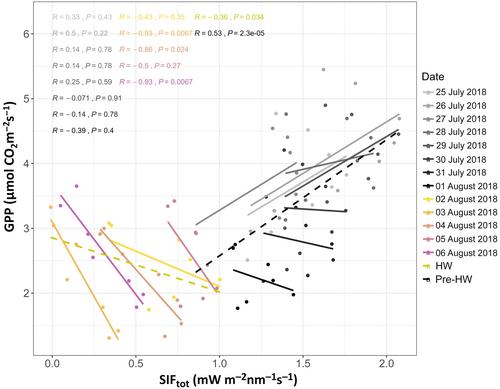
Despite the title of Martini et al. (2022) suggests that the heatwave (HW) which occurred at the beginning of August 2018 caused the broken correlation of SIF and GPP, a look at the time series of the used data suggests that the correlation was also broken in the ‘normal’, pre-HW, conditions (Fig. 1). Before noon (9:00–12:00 h), SIF and GPP do not correlate as GPP is steadily decreasing from morning till afternoon, but SIF is increasing with increasing photosynthetically active radiation (PAR) and decreasing solar zenith angle (SZA) and peaking at noon. In the afternoon hours (14:00–16:00 h), when SIF decreases following PAR decrease and SZA increase, SIF and GPP may exhibit a positive correlation. During the HW and particularly on 3 and 6 August, SIF did not decrease in the afternoon but kept rising, which drives the negative correlation of SIF and GPP in HW. The positive correlation of pre-HW SIF and GPP is driven solely by differences among days. The within-day correlations are not significant for any of the 8 pre-HW days. The last 3 d in the pre-HW period even show a negative SIF vs GPP trend (Fig. 2). That, and decreasing SIF and GPP (Fig. 1), suggest that at least 31 July and 1 August were not pre-HW, but rather the beginning of HW days.
Modifications of xanthophylls, known as the xanthophyll cycle, are one of the major components of npq. As the xanthophyll pool of plants is not infinite and the other npq-related changes in photosynthetic apparatus (for a detailed description, see Ruban, 2016) cannot continue forever, the safe energy dissipation by npq may saturate under severe stress and high light intensity (Lazár, 2015; Ruban, 2016). However, despite the claims of Martini et al. (2022) about the role of NPQ in energy partitioning and SIF vs GPP correlation modulation making theoretical sense, the presented data do not support them. One of the main points of the publication is the NPQ saturation in the HW. Nevertheless, fig. 4 of Martini et al. (2022) does not support this idea when NPQ clearly does not saturate with decreasing GPP and also does not reach the saturation point with increasing VPD. The apparent saturation of SIF and NPQ is, paradoxically, driven by low values of NPQ. We would like to draw attention to the fact that the parameter NPQ is a ratio of the quantum yield of light-dependent heat dissipation (φNPQ) and the sum of the quantum yield of basal heat dissipation and quantum yield of fluorescence (Van Der Tol et al., 2014; Lazár, 2015; Kalaji et al., 2017). That means that NPQ also contains information about the fluorescence emission; therefore, it is not correct to use NPQ as an energy partitioning parameter explaining changes in SIF and GPP. Instead, φNPQ or, as the authors called it, NPQ yield, should be used to explain the use of absorbed energy for different pathways (Lazár, 2015; Kalaji et al., 2017). Correlating φNPQ with a quantum yield of photochemistry further supports no saturation of φNPQ in measured data and suggests that the excess energy was dissipated by npq also during HW (data not shown, but available at 10.5281/zenodo.5773208).
Martini et al. (2022) further argued that during the HW, there was a change in the energy allocation from NPQ towards SIF. This seems to be very unlikely not only for the reasons stated above but also because of the disproportionally high decrease in SIF described below.
If NPQ was not the cause of broken linearity between SIF and GPP, then the logical question is: what was causing the decoupling of SIF's and GPP's daily courses?
As mentioned earlier, in normal conditions, SIF and GPP correlate because the SIF intensity and amount of fixed carbon are both regulated by the amount of energy reaching RCs. Hence, they are both dependent on the absorbed PAR, which in turn largely depends on PAR reaching the top of the canopy (Van Der Tol et al., 2014; Magney et al., 2020). However, during heat and drought stress, photosynthesis is not limited by PAR but by water availability, which regulates the stomatas’ opening and closure (Farquhar et al., 1980). The limitation of gas exchange between the atmosphere and leaf interior induces a cascade of changes in photosynthetic apparatus activity, including upregulation of alternative electron sinks that can use the energy passed to p, causing a situation whereby SIF increases due to energy reaching RCs, but GPP does not increase because of electrons being used for alternative processes (Alric & Johnson, 2017).
The data from Martini et al. (2022) and the associated dataset (10.5281/zenodo.5773208) help us to understand the broken linearity of SIF and GPP. While SIF was strongly correlated with PAR, especially in the pre-HW period (Supporting Information Fig. S1B), GPP was not significantly correlated with PAR for any of the analysed days (Fig. S1A). However, GPP was negatively dependent on vapour pressure deficit (VPD, which is largely temperature-dependent) every day in pre-HW and HW periods (Fig. S1C). By contrast, SIF did not correlate significantly with VPD in the pre-HW period but correlated strongly in 3 of the 5 HW days (Fig. S1D). As high VPD is a main driver of stomata closure, these results indicate that stomatal limitation of photosynthesis was the main cause of the broken correlation between SIF and GPP during pre-HW, but stomatal conductance alone cannot explain the reverse relationship during HW (Grossiord et al., 2020). The below-discussed changes in SIF must be taken into account in severe heat conditions.
One of the strongest effects of HW reported by Martini et al. (2022) was a significant decrease in SIF. This decrease is undoubtedly caused by plant physiology; however, as seen in Fig. 1, the SIF retrieval stopped being reliable, as some of the reported values were negative. Negative SIF is a theoretical nonsense as negative emission of photons is impossible and practically had to result from lowering the signal-to-noise ratio to such an extent that even as simple a method as improved Fraunhofer line depth (iFLD) stopped yielding trustworthy results (Alonso et al., 2008). Correcting SIF by the near-infrared reflectance of vegetation (NIRv)-derived fluorescence escape ratio and absorbed PAR yielded even more negative values than top-of-canopy SIF itself. Such results point to our general lack of understanding of top-of-canopy SIF and top-of-canopy SIF-derived parameters during severe stress, such as temperatures above 40°C. Therefore, more attention should be paid to the impact of environmental and plant stress conditions on retrieved SIF reliability, which is an important outcome of the Martini et al. (2022) study that did not get enough attention in the publication.
The decrease in SIF in HW was disproportionally larger than the decrease in GPP or increase in NPQ. This would cause a large error in linear regression-based GPP estimation using either instantaneous or mid-day SIF. Moreover, such a large decrease in SIF due to severe stress is not well understood and should be further examined. One possible, although rather speculative, explanation for the observed large decrease in SIF is the temperature dependency of fluorescence emission after crossing the physiological threshold of plants (Kouřil et al., 2004). Kouřil et al. (2004) also reported an increase in fluorescence after leaves were heated to 40–45°C, similar to data presented in Fig. 1 and Fig. S1D during HW, especially on 3 and 6 August. Therefore, more consideration should be given to temperature as a factor influencing SIF in future studies performed in extreme heat conditions.
We believe that this Correspondence will induce a new way of thinking about the SIF : GPP : NPQ relationship, the absorbed energy partitioning between photochemical and nonphotochemical processes, the role of stomata in the SIF : GPP relationship and the changes in SIF emission under severe heat or other abiotic and biotic stress conditions.
None declared.
MA, RJ and AR developed the concept. MA prepared the figures and wrote the first draft. RJ and AR reviewed and edited the text.
These data were derived from the following resources available in the public domain: 10.5281/zenodo.5773208.
The New Phytologist Foundation remains neutral with regard to jurisdictional claims in maps and in any institutional affiliations.
期刊介绍:
New Phytologist is an international electronic journal published 24 times a year. It is owned by the New Phytologist Foundation, a non-profit-making charitable organization dedicated to promoting plant science. The journal publishes excellent, novel, rigorous, and timely research and scholarship in plant science and its applications. The articles cover topics in five sections: Physiology & Development, Environment, Interaction, Evolution, and Transformative Plant Biotechnology. These sections encompass intracellular processes, global environmental change, and encourage cross-disciplinary approaches. The journal recognizes the use of techniques from molecular and cell biology, functional genomics, modeling, and system-based approaches in plant science. Abstracting and Indexing Information for New Phytologist includes Academic Search, AgBiotech News & Information, Agroforestry Abstracts, Biochemistry & Biophysics Citation Index, Botanical Pesticides, CAB Abstracts®, Environment Index, Global Health, and Plant Breeding Abstracts, and others.







 京公网安备 11010802042870号
京ICP备2023020795号-1
京公网安备 11010802042870号
京ICP备2023020795号-1

 分享
分享
 求助内容:
求助内容: 应助结果提醒方式:
 扫码关注我们
