{"title":"纳米孔膜中电荷非均质性增强浓度驱动发电的扩散离子输运表征。","authors":"Dongwoo Seo, Sangjin Seo, Taesung Kim","doi":"10.1021/acsami.4c17498","DOIUrl":null,"url":null,"abstract":"<p><p>Nanoscopic mass/ion transport through heterogeneous nanostructures with various physicochemical environments occurs in both natural and artificial systems. Concentration gradient-driven mass/ion transport mechanisms, such as diffusioosmosis (DO), are primarily governed by the structural and electrical features of the nanostructures. However, these phenomena under various electrical and chemical conditions have not been adequately investigated. In this study, we fabricated a pervaporation-based particle-assembled membrane (PAM)-integrated micro-/nanofluidic device that facilitates easy tuning of the surface charge heterogeneity in nanopores/nanochannels. The nanochannels in the device consisted of two heterogeneous and in-series PAMs. The device was used to quantitatively measure electric signals generated by DO within the nanochannels with a single electrolyte or a combination of two electrolytes. Then, we characterized ion transport by changing surface charge heterogeneity and applying various electrolytic conditions, characterizing the concentration-driven power generation under these conditions. We found that not only does the charge heterogeneity provide additional resistance to ion transport but also the manipulation of the heterogeneity enables the effective modulation of ion transport and optimization of concentration-driven power generators regarding ion selectivity. In conjunction with the surface charge heterogeneity, the electrolytic conditions significantly affected the net flux of ion transport by enhancing or even negating the ion selectivity. Hence, we anticipate that both the platform and results will provide a deeper understanding of ion transport in nanostructures within complex environments by optimizing and improving practical concentration-driven applications, such as energy conversion/harvesting, molecular focusing/separation, and ionic diodes and memristors.</p>","PeriodicalId":5,"journal":{"name":"ACS Applied Materials & Interfaces","volume":" ","pages":"70119-70129"},"PeriodicalIF":7.8000,"publicationDate":"2024-12-18","publicationTypes":"Journal Article","fieldsOfStudy":null,"isOpenAccess":false,"openAccessPdf":"","citationCount":"0","resultStr":"{\"title\":\"Characterization of Diffusioosmotic Ion Transport for Enhanced Concentration-Driven Power Generation via Charge Heterogeneity in Nanoporous Membranes.\",\"authors\":\"Dongwoo Seo, Sangjin Seo, Taesung Kim\",\"doi\":\"10.1021/acsami.4c17498\",\"DOIUrl\":null,\"url\":null,\"abstract\":\"<p><p>Nanoscopic mass/ion transport through heterogeneous nanostructures with various physicochemical environments occurs in both natural and artificial systems. Concentration gradient-driven mass/ion transport mechanisms, such as diffusioosmosis (DO), are primarily governed by the structural and electrical features of the nanostructures. However, these phenomena under various electrical and chemical conditions have not been adequately investigated. In this study, we fabricated a pervaporation-based particle-assembled membrane (PAM)-integrated micro-/nanofluidic device that facilitates easy tuning of the surface charge heterogeneity in nanopores/nanochannels. The nanochannels in the device consisted of two heterogeneous and in-series PAMs. The device was used to quantitatively measure electric signals generated by DO within the nanochannels with a single electrolyte or a combination of two electrolytes. Then, we characterized ion transport by changing surface charge heterogeneity and applying various electrolytic conditions, characterizing the concentration-driven power generation under these conditions. We found that not only does the charge heterogeneity provide additional resistance to ion transport but also the manipulation of the heterogeneity enables the effective modulation of ion transport and optimization of concentration-driven power generators regarding ion selectivity. In conjunction with the surface charge heterogeneity, the electrolytic conditions significantly affected the net flux of ion transport by enhancing or even negating the ion selectivity. Hence, we anticipate that both the platform and results will provide a deeper understanding of ion transport in nanostructures within complex environments by optimizing and improving practical concentration-driven applications, such as energy conversion/harvesting, molecular focusing/separation, and ionic diodes and memristors.</p>\",\"PeriodicalId\":5,\"journal\":{\"name\":\"ACS Applied Materials & Interfaces\",\"volume\":\" \",\"pages\":\"70119-70129\"},\"PeriodicalIF\":7.8000,\"publicationDate\":\"2024-12-18\",\"publicationTypes\":\"Journal Article\",\"fieldsOfStudy\":null,\"isOpenAccess\":false,\"openAccessPdf\":\"\",\"citationCount\":\"0\",\"resultStr\":null,\"platform\":\"Semanticscholar\",\"paperid\":null,\"PeriodicalName\":\"ACS Applied Materials & Interfaces\",\"FirstCategoryId\":\"88\",\"ListUrlMain\":\"https://doi.org/10.1021/acsami.4c17498\",\"RegionNum\":2,\"RegionCategory\":\"材料科学\",\"ArticlePicture\":[],\"TitleCN\":null,\"AbstractTextCN\":null,\"PMCID\":null,\"EPubDate\":\"2024/12/8 0:00:00\",\"PubModel\":\"Epub\",\"JCR\":\"Q1\",\"JCRName\":\"MATERIALS SCIENCE, MULTIDISCIPLINARY\",\"Score\":null,\"Total\":0}","platform":"Semanticscholar","paperid":null,"PeriodicalName":"ACS Applied Materials & Interfaces","FirstCategoryId":"88","ListUrlMain":"https://doi.org/10.1021/acsami.4c17498","RegionNum":2,"RegionCategory":"材料科学","ArticlePicture":[],"TitleCN":null,"AbstractTextCN":null,"PMCID":null,"EPubDate":"2024/12/8 0:00:00","PubModel":"Epub","JCR":"Q1","JCRName":"MATERIALS SCIENCE, MULTIDISCIPLINARY","Score":null,"Total":0}
Characterization of Diffusioosmotic Ion Transport for Enhanced Concentration-Driven Power Generation via Charge Heterogeneity in Nanoporous Membranes.
Nanoscopic mass/ion transport through heterogeneous nanostructures with various physicochemical environments occurs in both natural and artificial systems. Concentration gradient-driven mass/ion transport mechanisms, such as diffusioosmosis (DO), are primarily governed by the structural and electrical features of the nanostructures. However, these phenomena under various electrical and chemical conditions have not been adequately investigated. In this study, we fabricated a pervaporation-based particle-assembled membrane (PAM)-integrated micro-/nanofluidic device that facilitates easy tuning of the surface charge heterogeneity in nanopores/nanochannels. The nanochannels in the device consisted of two heterogeneous and in-series PAMs. The device was used to quantitatively measure electric signals generated by DO within the nanochannels with a single electrolyte or a combination of two electrolytes. Then, we characterized ion transport by changing surface charge heterogeneity and applying various electrolytic conditions, characterizing the concentration-driven power generation under these conditions. We found that not only does the charge heterogeneity provide additional resistance to ion transport but also the manipulation of the heterogeneity enables the effective modulation of ion transport and optimization of concentration-driven power generators regarding ion selectivity. In conjunction with the surface charge heterogeneity, the electrolytic conditions significantly affected the net flux of ion transport by enhancing or even negating the ion selectivity. Hence, we anticipate that both the platform and results will provide a deeper understanding of ion transport in nanostructures within complex environments by optimizing and improving practical concentration-driven applications, such as energy conversion/harvesting, molecular focusing/separation, and ionic diodes and memristors.
期刊介绍:
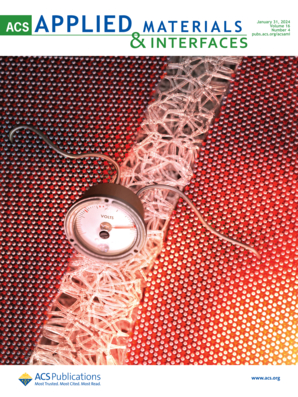
ACS Applied Materials & Interfaces is a leading interdisciplinary journal that brings together chemists, engineers, physicists, and biologists to explore the development and utilization of newly-discovered materials and interfacial processes for specific applications. Our journal has experienced remarkable growth since its establishment in 2009, both in terms of the number of articles published and the impact of the research showcased. We are proud to foster a truly global community, with the majority of published articles originating from outside the United States, reflecting the rapid growth of applied research worldwide.




 京公网安备 11010802042870号
京ICP备2023020795号-1
京公网安备 11010802042870号
京ICP备2023020795号-1

 分享
分享
 求助内容:
求助内容: 应助结果提醒方式:
 扫码关注我们
