{"title":"靶向花生四烯酸代谢提高arid1a缺陷结直肠癌的免疫治疗效果","authors":"Luying Cui, Ruiqi Liu, Shuling Han, Chunhui Zhang, Bojun Wang, Yuli Ruan, Xuefan Yu, Yien Li, Yuanfei Yao, Xin Guan, Yuanyu Liao, Dan Su, Yue Ma, Shuijie Li, Chao Liu, Yanqiao Zhang","doi":"10.1158/0008-5472.can-24-1611","DOIUrl":null,"url":null,"abstract":"ARID1A, a core constituent of SWI/SNF complex, is mutated in approximately 10% of colorectal cancers (CRC). While ARID1A deficiency corresponds to heightened immune activity in CRC, immune checkpoint inhibitors (ICIs) have shown limited efficacy in these tumors. The discovery of targetable vulnerabilities associated with ARID1A deficiency in CRC could expand treatment options for patients. In this study, we demonstrated that arachidonic acid metabolism inhibitors synergize with ICIs in ARID1A-deficient CRC by enhancing the activity of CD8+ T cells and inhibiting vasculogenic mimicry (VM). Epigenetic analysis using ATAC-seq and ChIP-qPCR revealed that the lack of ARID1A results in reduced levels of PTGS1 and PTGS2, the key enzymes that control the arachidonic acid pathway. Low PTGS1 and PTGS2 expression generated a reliance on the remaining functionality of the arachidonic acid pathway in ARID1A-deficient cells. The arachidonic acid pathway inhibitor aspirin selectively inhibited the growth of ARID1A-deficient CRC, and aspirin sensitized tumors lacking ARID1A to immunotherapy. Together, these findings suggest that blocking arachidonic acid metabolism can enhance immune responses against tumors by activating CD8+ T cells and inhibiting VM, which synergizes with ICIs to improve treatment of ARID1A-deficient CRC.","PeriodicalId":9441,"journal":{"name":"Cancer research","volume":"212 1","pages":""},"PeriodicalIF":22.6000,"publicationDate":"2024-12-09","publicationTypes":"Journal Article","fieldsOfStudy":null,"isOpenAccess":false,"openAccessPdf":"","citationCount":"0","resultStr":"{\"title\":\"Targeting Arachidonic Acid Metabolism Enhances Immunotherapy Efficacy in ARID1A-Deficient Colorectal Cancer\",\"authors\":\"Luying Cui, Ruiqi Liu, Shuling Han, Chunhui Zhang, Bojun Wang, Yuli Ruan, Xuefan Yu, Yien Li, Yuanfei Yao, Xin Guan, Yuanyu Liao, Dan Su, Yue Ma, Shuijie Li, Chao Liu, Yanqiao Zhang\",\"doi\":\"10.1158/0008-5472.can-24-1611\",\"DOIUrl\":null,\"url\":null,\"abstract\":\"ARID1A, a core constituent of SWI/SNF complex, is mutated in approximately 10% of colorectal cancers (CRC). While ARID1A deficiency corresponds to heightened immune activity in CRC, immune checkpoint inhibitors (ICIs) have shown limited efficacy in these tumors. The discovery of targetable vulnerabilities associated with ARID1A deficiency in CRC could expand treatment options for patients. In this study, we demonstrated that arachidonic acid metabolism inhibitors synergize with ICIs in ARID1A-deficient CRC by enhancing the activity of CD8+ T cells and inhibiting vasculogenic mimicry (VM). Epigenetic analysis using ATAC-seq and ChIP-qPCR revealed that the lack of ARID1A results in reduced levels of PTGS1 and PTGS2, the key enzymes that control the arachidonic acid pathway. Low PTGS1 and PTGS2 expression generated a reliance on the remaining functionality of the arachidonic acid pathway in ARID1A-deficient cells. The arachidonic acid pathway inhibitor aspirin selectively inhibited the growth of ARID1A-deficient CRC, and aspirin sensitized tumors lacking ARID1A to immunotherapy. Together, these findings suggest that blocking arachidonic acid metabolism can enhance immune responses against tumors by activating CD8+ T cells and inhibiting VM, which synergizes with ICIs to improve treatment of ARID1A-deficient CRC.\",\"PeriodicalId\":9441,\"journal\":{\"name\":\"Cancer research\",\"volume\":\"212 1\",\"pages\":\"\"},\"PeriodicalIF\":22.6000,\"publicationDate\":\"2024-12-09\",\"publicationTypes\":\"Journal Article\",\"fieldsOfStudy\":null,\"isOpenAccess\":false,\"openAccessPdf\":\"\",\"citationCount\":\"0\",\"resultStr\":null,\"platform\":\"Semanticscholar\",\"paperid\":null,\"PeriodicalName\":\"Cancer research\",\"FirstCategoryId\":\"3\",\"ListUrlMain\":\"https://doi.org/10.1158/0008-5472.can-24-1611\",\"RegionNum\":1,\"RegionCategory\":\"医学\",\"ArticlePicture\":[],\"TitleCN\":null,\"AbstractTextCN\":null,\"PMCID\":null,\"EPubDate\":\"\",\"PubModel\":\"\",\"JCR\":\"Q1\",\"JCRName\":\"ONCOLOGY\",\"Score\":null,\"Total\":0}","platform":"Semanticscholar","paperid":null,"PeriodicalName":"Cancer research","FirstCategoryId":"3","ListUrlMain":"https://doi.org/10.1158/0008-5472.can-24-1611","RegionNum":1,"RegionCategory":"医学","ArticlePicture":[],"TitleCN":null,"AbstractTextCN":null,"PMCID":null,"EPubDate":"","PubModel":"","JCR":"Q1","JCRName":"ONCOLOGY","Score":null,"Total":0}
Targeting Arachidonic Acid Metabolism Enhances Immunotherapy Efficacy in ARID1A-Deficient Colorectal Cancer
ARID1A, a core constituent of SWI/SNF complex, is mutated in approximately 10% of colorectal cancers (CRC). While ARID1A deficiency corresponds to heightened immune activity in CRC, immune checkpoint inhibitors (ICIs) have shown limited efficacy in these tumors. The discovery of targetable vulnerabilities associated with ARID1A deficiency in CRC could expand treatment options for patients. In this study, we demonstrated that arachidonic acid metabolism inhibitors synergize with ICIs in ARID1A-deficient CRC by enhancing the activity of CD8+ T cells and inhibiting vasculogenic mimicry (VM). Epigenetic analysis using ATAC-seq and ChIP-qPCR revealed that the lack of ARID1A results in reduced levels of PTGS1 and PTGS2, the key enzymes that control the arachidonic acid pathway. Low PTGS1 and PTGS2 expression generated a reliance on the remaining functionality of the arachidonic acid pathway in ARID1A-deficient cells. The arachidonic acid pathway inhibitor aspirin selectively inhibited the growth of ARID1A-deficient CRC, and aspirin sensitized tumors lacking ARID1A to immunotherapy. Together, these findings suggest that blocking arachidonic acid metabolism can enhance immune responses against tumors by activating CD8+ T cells and inhibiting VM, which synergizes with ICIs to improve treatment of ARID1A-deficient CRC.
期刊介绍:
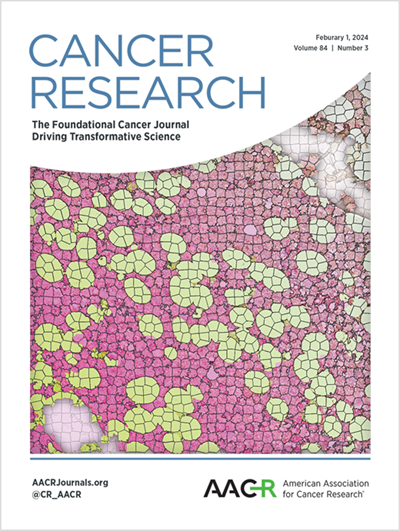
Cancer Research, published by the American Association for Cancer Research (AACR), is a journal that focuses on impactful original studies, reviews, and opinion pieces relevant to the broad cancer research community. Manuscripts that present conceptual or technological advances leading to insights into cancer biology are particularly sought after. The journal also places emphasis on convergence science, which involves bridging multiple distinct areas of cancer research.
With primary subsections including Cancer Biology, Cancer Immunology, Cancer Metabolism and Molecular Mechanisms, Translational Cancer Biology, Cancer Landscapes, and Convergence Science, Cancer Research has a comprehensive scope. It is published twice a month and has one volume per year, with a print ISSN of 0008-5472 and an online ISSN of 1538-7445.
Cancer Research is abstracted and/or indexed in various databases and platforms, including BIOSIS Previews (R) Database, MEDLINE, Current Contents/Life Sciences, Current Contents/Clinical Medicine, Science Citation Index, Scopus, and Web of Science.




 京公网安备 11010802042870号
京ICP备2023020795号-1
京公网安备 11010802042870号
京ICP备2023020795号-1

 分享
分享
 求助内容:
求助内容: 应助结果提醒方式:
 扫码关注我们
