Tomas Andri Axelsson, Filip Sydén, Jesper Eisfeldt, Ylva Eriksson, Gustav Göthner Lundberg, Georg Jaremko, Ollanta Cuba Gyllensten, Emma Tham, Marianne Brehmer
{"title":"上尿路上皮癌的诊断和预后基因组畸变可以在局灶性穿刺样本中确定","authors":"Tomas Andri Axelsson, Filip Sydén, Jesper Eisfeldt, Ylva Eriksson, Gustav Göthner Lundberg, Georg Jaremko, Ollanta Cuba Gyllensten, Emma Tham, Marianne Brehmer","doi":"10.1111/bju.16620","DOIUrl":null,"url":null,"abstract":"<div>\n \n <section>\n \n <h3> Objectives</h3>\n \n <p>To investigate whether genetic analysis of focal barbotage samples obtained at ureterorenoscopy (URS) is possible, and to identify genetic aberrations that might add prognostic information.</p>\n </section>\n \n <section>\n \n <h3> Methods</h3>\n \n <p>This prospective study included barbotage samples from 42 patients with upper urinary tract urothelial carcinoma (UTUC) confirmed at URS. At URS, focal barbotage specimens were collected for cytology and for gene sequencing. Tumour grades were determined from cytology and/or biopsy, or from radical nephroureterectomy samples. Next-generation sequencing using a 385-gene panel was performed and single nucleotide variants (SNVs), deletions/insertions (indels) and copy number aberrations (CNAs) were identified. Manual filtering of the SNVs/indels was performed to identify possible pathogenic mutations.</p>\n </section>\n \n <section>\n \n <h3> Results</h3>\n \n <p>Of the 42 samples, two failed quality control, therefore, 40 focal barbotage samples were sequenced. We identified known and suspected pathogenic mutations and other genomic aberrations in 36 samples. The most common variants were in <i>TERT</i> (78%), <i>FGFR3</i> (50%), <i>KMT2D</i> (42%), <i>KDM6A</i> (42%), <i>ARID1A</i> (39%), <i>TP53</i> (19%) and deletion of 9q (50%). Known pathogenic mutations in <i>FGFR3</i> were common in grade 1 and 2 tumours, but not present in any grade 3 tumour. No patients with an <i>FGFR3</i> mutation died during follow-up. <i>TP53</i> variants or deletions, as well as amplifications of <i>MDM2</i>, were only present in high-grade (HG) tumours or low-grade (LG) tumours in patients who had metastasis/died from urinary tract carcinoma. CNAs were detected in 36/40 barbotage samples, 91% of the HG samples and 69% of the LG samples, including those from all five patients with LG tumours with metastasis or who died from urinary tract cancer.</p>\n </section>\n \n <section>\n \n <h3> Conclusion</h3>\n \n <p>Focal barbotage samples enable identification of gene mutations and other genetic aberrations that may add important prognostic information to histopathology and cytology. Refined prognostication of UTUC patients already at diagnosis can guide treatment decisions and follow-up programmes.</p>\n </section>\n </div>","PeriodicalId":8985,"journal":{"name":"BJU International","volume":"135 5","pages":"792-801"},"PeriodicalIF":4.4000,"publicationDate":"2024-12-09","publicationTypes":"Journal Article","fieldsOfStudy":null,"isOpenAccess":false,"openAccessPdf":"https://onlinelibrary.wiley.com/doi/epdf/10.1111/bju.16620","citationCount":"0","resultStr":"{\"title\":\"Diagnostic and prognostic genomic aberrations in upper tract urothelial carcinoma can be identified in focal barbotage samples\",\"authors\":\"Tomas Andri Axelsson, Filip Sydén, Jesper Eisfeldt, Ylva Eriksson, Gustav Göthner Lundberg, Georg Jaremko, Ollanta Cuba Gyllensten, Emma Tham, Marianne Brehmer\",\"doi\":\"10.1111/bju.16620\",\"DOIUrl\":null,\"url\":null,\"abstract\":\"<div>\\n \\n <section>\\n \\n <h3> Objectives</h3>\\n \\n <p>To investigate whether genetic analysis of focal barbotage samples obtained at ureterorenoscopy (URS) is possible, and to identify genetic aberrations that might add prognostic information.</p>\\n </section>\\n \\n <section>\\n \\n <h3> Methods</h3>\\n \\n <p>This prospective study included barbotage samples from 42 patients with upper urinary tract urothelial carcinoma (UTUC) confirmed at URS. At URS, focal barbotage specimens were collected for cytology and for gene sequencing. Tumour grades were determined from cytology and/or biopsy, or from radical nephroureterectomy samples. Next-generation sequencing using a 385-gene panel was performed and single nucleotide variants (SNVs), deletions/insertions (indels) and copy number aberrations (CNAs) were identified. Manual filtering of the SNVs/indels was performed to identify possible pathogenic mutations.</p>\\n </section>\\n \\n <section>\\n \\n <h3> Results</h3>\\n \\n <p>Of the 42 samples, two failed quality control, therefore, 40 focal barbotage samples were sequenced. We identified known and suspected pathogenic mutations and other genomic aberrations in 36 samples. The most common variants were in <i>TERT</i> (78%), <i>FGFR3</i> (50%), <i>KMT2D</i> (42%), <i>KDM6A</i> (42%), <i>ARID1A</i> (39%), <i>TP53</i> (19%) and deletion of 9q (50%). Known pathogenic mutations in <i>FGFR3</i> were common in grade 1 and 2 tumours, but not present in any grade 3 tumour. No patients with an <i>FGFR3</i> mutation died during follow-up. <i>TP53</i> variants or deletions, as well as amplifications of <i>MDM2</i>, were only present in high-grade (HG) tumours or low-grade (LG) tumours in patients who had metastasis/died from urinary tract carcinoma. CNAs were detected in 36/40 barbotage samples, 91% of the HG samples and 69% of the LG samples, including those from all five patients with LG tumours with metastasis or who died from urinary tract cancer.</p>\\n </section>\\n \\n <section>\\n \\n <h3> Conclusion</h3>\\n \\n <p>Focal barbotage samples enable identification of gene mutations and other genetic aberrations that may add important prognostic information to histopathology and cytology. Refined prognostication of UTUC patients already at diagnosis can guide treatment decisions and follow-up programmes.</p>\\n </section>\\n </div>\",\"PeriodicalId\":8985,\"journal\":{\"name\":\"BJU International\",\"volume\":\"135 5\",\"pages\":\"792-801\"},\"PeriodicalIF\":4.4000,\"publicationDate\":\"2024-12-09\",\"publicationTypes\":\"Journal Article\",\"fieldsOfStudy\":null,\"isOpenAccess\":false,\"openAccessPdf\":\"https://onlinelibrary.wiley.com/doi/epdf/10.1111/bju.16620\",\"citationCount\":\"0\",\"resultStr\":null,\"platform\":\"Semanticscholar\",\"paperid\":null,\"PeriodicalName\":\"BJU International\",\"FirstCategoryId\":\"3\",\"ListUrlMain\":\"https://bjui-journals.onlinelibrary.wiley.com/doi/10.1111/bju.16620\",\"RegionNum\":2,\"RegionCategory\":\"医学\",\"ArticlePicture\":[],\"TitleCN\":null,\"AbstractTextCN\":null,\"PMCID\":null,\"EPubDate\":\"\",\"PubModel\":\"\",\"JCR\":\"Q1\",\"JCRName\":\"UROLOGY & NEPHROLOGY\",\"Score\":null,\"Total\":0}","platform":"Semanticscholar","paperid":null,"PeriodicalName":"BJU International","FirstCategoryId":"3","ListUrlMain":"https://bjui-journals.onlinelibrary.wiley.com/doi/10.1111/bju.16620","RegionNum":2,"RegionCategory":"医学","ArticlePicture":[],"TitleCN":null,"AbstractTextCN":null,"PMCID":null,"EPubDate":"","PubModel":"","JCR":"Q1","JCRName":"UROLOGY & NEPHROLOGY","Score":null,"Total":0}
Diagnostic and prognostic genomic aberrations in upper tract urothelial carcinoma can be identified in focal barbotage samples
Objectives
To investigate whether genetic analysis of focal barbotage samples obtained at ureterorenoscopy (URS) is possible, and to identify genetic aberrations that might add prognostic information.
Methods
This prospective study included barbotage samples from 42 patients with upper urinary tract urothelial carcinoma (UTUC) confirmed at URS. At URS, focal barbotage specimens were collected for cytology and for gene sequencing. Tumour grades were determined from cytology and/or biopsy, or from radical nephroureterectomy samples. Next-generation sequencing using a 385-gene panel was performed and single nucleotide variants (SNVs), deletions/insertions (indels) and copy number aberrations (CNAs) were identified. Manual filtering of the SNVs/indels was performed to identify possible pathogenic mutations.
Results
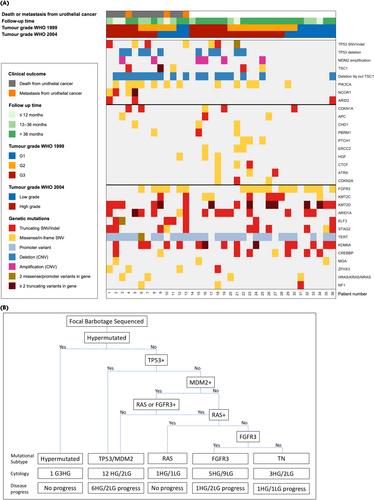
Of the 42 samples, two failed quality control, therefore, 40 focal barbotage samples were sequenced. We identified known and suspected pathogenic mutations and other genomic aberrations in 36 samples. The most common variants were in TERT (78%), FGFR3 (50%), KMT2D (42%), KDM6A (42%), ARID1A (39%), TP53 (19%) and deletion of 9q (50%). Known pathogenic mutations in FGFR3 were common in grade 1 and 2 tumours, but not present in any grade 3 tumour. No patients with an FGFR3 mutation died during follow-up. TP53 variants or deletions, as well as amplifications of MDM2, were only present in high-grade (HG) tumours or low-grade (LG) tumours in patients who had metastasis/died from urinary tract carcinoma. CNAs were detected in 36/40 barbotage samples, 91% of the HG samples and 69% of the LG samples, including those from all five patients with LG tumours with metastasis or who died from urinary tract cancer.
Conclusion
Focal barbotage samples enable identification of gene mutations and other genetic aberrations that may add important prognostic information to histopathology and cytology. Refined prognostication of UTUC patients already at diagnosis can guide treatment decisions and follow-up programmes.
期刊介绍:
BJUI is one of the most highly respected medical journals in the world, with a truly international range of published papers and appeal. Every issue gives invaluable practical information in the form of original articles, reviews, comments, surgical education articles, and translational science articles in the field of urology. BJUI employs topical sections, and is in full colour, making it easier to browse or search for something specific.







 京公网安备 11010802042870号
京ICP备2023020795号-1
京公网安备 11010802042870号
京ICP备2023020795号-1

 分享
分享
 求助内容:
求助内容: 应助结果提醒方式:
 扫码关注我们
