{"title":"干旱区豆科覆盖作物间种是否会抑制青贮玉米生长,降低水氮利用效率?","authors":"Meng Li, Shicheng Yan, Liubing Yin, Liang Sun, Weizhe Liu, Shu Zhang, Xinyu Xie, Xiaoxue Wang, Wenting Wang, Wanhe Zhu, Shenghua Chang, Fujiang Hou","doi":"10.1016/j.eja.2024.127443","DOIUrl":null,"url":null,"abstract":"<div><div>Silage maize (<em>Zea mays</em> L.) is a prominent forage crop in arid regions where water scarcity and the need for optimized nitrogen (N) fertilizer use pose significant challenges to agricultural productivity and sustainability. Interseeding leguminous cover crops with silage maize can enhance sustainable soil development and improve N management through biological N fixation. However, the competition interactions between silage maize and cover crops under constrained water-N conditions remains uncertain. This study conducted a three-year field experiment of interseeding leguminous cover crops with silage maize under varying drip fertigation conditions. The treatments included three types of leguminous cover crops-red clover (TP, <em>Trifolium pretense</em> L.), common vetch (VS, <em>Vicia sativa</em> L.), and hairy vetch (VV, <em>Vicia villosa</em> Roth)-combined with two N application rates (N1: 120 kg N ha<sup>−1</sup> and N2: 180 kg N ha<sup>−1</sup> and two irrigation levels (W1: 75 % of ET<sub>c</sub> and W2: 100 % ET<sub>c</sub>). The results showed that interseeding did not significantly inhabit plant height, stem diameter, and relative leaf chlorophyll content of silage maize compared to no covers (<em>P</em>>0.05). Under identical water and N conditions, the hay yield of maize interseeded with VV was significantly higher by 15.3 %-21.9 % compared to no covers (<em>P</em><0.05), and the hay yield of the interseeding system vetch was significantly higher by 22.7 %-28.4 % (<em>P</em><0.05). Specifically, under VV, W2N1 decreased actual evapotranspiration (ET<sub>a</sub>) by 2.1 %-12.9 % (<em>P</em> >0.05), and increased water use efficiency (WUE) by 8.6 %-12.5 % (<em>P</em>>0.05) and nitrogen partial factor productivity (PFPN) by 24.1 %-43.3 % (<em>P</em><0.05) compared to W2N2. Dry matter of cover crops, which contributed to the increases in PFPN and WUE, ranged from 0.8 to1.2 Mg ha<sup>−1</sup>. Structural equation modeling indicated that the N application was the most important influencing the interseeding system. In conclusion, a 100 % ET<sub>c</sub> irrigation amount and a 120 kg N ha<sup>−1</sup> N application rate in a silage maize-hairy vetch interseeding system can effectively increase forage yield and enhance water and N utilization efficiencies in the arid region.</div></div>","PeriodicalId":51045,"journal":{"name":"European Journal of Agronomy","volume":"164 ","pages":"Article 127443"},"PeriodicalIF":6.7000,"publicationDate":"2025-03-01","publicationTypes":"Journal Article","fieldsOfStudy":null,"isOpenAccess":false,"openAccessPdf":"","citationCount":"0","resultStr":"{\"title\":\"Can interseeding leguminous cover crops inhibit silage maize growth and reduce water-nitrogen use efficiency in arid region?\",\"authors\":\"Meng Li, Shicheng Yan, Liubing Yin, Liang Sun, Weizhe Liu, Shu Zhang, Xinyu Xie, Xiaoxue Wang, Wenting Wang, Wanhe Zhu, Shenghua Chang, Fujiang Hou\",\"doi\":\"10.1016/j.eja.2024.127443\",\"DOIUrl\":null,\"url\":null,\"abstract\":\"<div><div>Silage maize (<em>Zea mays</em> L.) is a prominent forage crop in arid regions where water scarcity and the need for optimized nitrogen (N) fertilizer use pose significant challenges to agricultural productivity and sustainability. Interseeding leguminous cover crops with silage maize can enhance sustainable soil development and improve N management through biological N fixation. However, the competition interactions between silage maize and cover crops under constrained water-N conditions remains uncertain. This study conducted a three-year field experiment of interseeding leguminous cover crops with silage maize under varying drip fertigation conditions. The treatments included three types of leguminous cover crops-red clover (TP, <em>Trifolium pretense</em> L.), common vetch (VS, <em>Vicia sativa</em> L.), and hairy vetch (VV, <em>Vicia villosa</em> Roth)-combined with two N application rates (N1: 120 kg N ha<sup>−1</sup> and N2: 180 kg N ha<sup>−1</sup> and two irrigation levels (W1: 75 % of ET<sub>c</sub> and W2: 100 % ET<sub>c</sub>). The results showed that interseeding did not significantly inhabit plant height, stem diameter, and relative leaf chlorophyll content of silage maize compared to no covers (<em>P</em>>0.05). Under identical water and N conditions, the hay yield of maize interseeded with VV was significantly higher by 15.3 %-21.9 % compared to no covers (<em>P</em><0.05), and the hay yield of the interseeding system vetch was significantly higher by 22.7 %-28.4 % (<em>P</em><0.05). Specifically, under VV, W2N1 decreased actual evapotranspiration (ET<sub>a</sub>) by 2.1 %-12.9 % (<em>P</em> >0.05), and increased water use efficiency (WUE) by 8.6 %-12.5 % (<em>P</em>>0.05) and nitrogen partial factor productivity (PFPN) by 24.1 %-43.3 % (<em>P</em><0.05) compared to W2N2. Dry matter of cover crops, which contributed to the increases in PFPN and WUE, ranged from 0.8 to1.2 Mg ha<sup>−1</sup>. Structural equation modeling indicated that the N application was the most important influencing the interseeding system. In conclusion, a 100 % ET<sub>c</sub> irrigation amount and a 120 kg N ha<sup>−1</sup> N application rate in a silage maize-hairy vetch interseeding system can effectively increase forage yield and enhance water and N utilization efficiencies in the arid region.</div></div>\",\"PeriodicalId\":51045,\"journal\":{\"name\":\"European Journal of Agronomy\",\"volume\":\"164 \",\"pages\":\"Article 127443\"},\"PeriodicalIF\":6.7000,\"publicationDate\":\"2025-03-01\",\"publicationTypes\":\"Journal Article\",\"fieldsOfStudy\":null,\"isOpenAccess\":false,\"openAccessPdf\":\"\",\"citationCount\":\"0\",\"resultStr\":null,\"platform\":\"Semanticscholar\",\"paperid\":null,\"PeriodicalName\":\"European Journal of Agronomy\",\"FirstCategoryId\":\"97\",\"ListUrlMain\":\"https://www.sciencedirect.com/science/article/pii/S1161030124003642\",\"RegionNum\":1,\"RegionCategory\":\"农林科学\",\"ArticlePicture\":[],\"TitleCN\":null,\"AbstractTextCN\":null,\"PMCID\":null,\"EPubDate\":\"2024/12/4 0:00:00\",\"PubModel\":\"Epub\",\"JCR\":\"Q1\",\"JCRName\":\"AGRONOMY\",\"Score\":null,\"Total\":0}","platform":"Semanticscholar","paperid":null,"PeriodicalName":"European Journal of Agronomy","FirstCategoryId":"97","ListUrlMain":"https://www.sciencedirect.com/science/article/pii/S1161030124003642","RegionNum":1,"RegionCategory":"农林科学","ArticlePicture":[],"TitleCN":null,"AbstractTextCN":null,"PMCID":null,"EPubDate":"2024/12/4 0:00:00","PubModel":"Epub","JCR":"Q1","JCRName":"AGRONOMY","Score":null,"Total":0}
引用次数: 0
摘要
青贮玉米(Zea mays L.)是干旱地区重要的饲料作物,在干旱地区,水资源短缺和优化氮肥使用的需求对农业生产力和可持续性构成重大挑战。青贮玉米间种豆科覆盖作物可促进土壤可持续发展,通过生物固氮改善氮素管理。然而,在有限的水氮条件下,青贮玉米与覆盖作物之间的竞争相互作用仍然不确定。在不同的滴灌施肥条件下,进行了豆科覆盖作物与青贮玉米间种的3年田间试验。处理包括3种豆科覆盖作物——红三叶草(TP, Trifolium pretense L.)、野豌豆(VS, Vicia sativa L.)和毛豌豆(VV, Vicia villosa Roth),配以2种施氮量(N1: 120 kg N ha - 1和N2: 180 kg N ha - 1)和2种灌溉量(W1: 75 % ETc和W2: 100 % ETc)。结果表明:与不覆盖相比,间播对青贮玉米株高、茎粗和叶片相对叶绿素含量的影响不显著(P>0.05)。在相同的水氮条件下,间种玉米的干草产量比未覆盖玉米显著提高了15.3 % ~ 21.9 % (P<0.05),间种系统豌豆的干草产量显著提高了22.7 % ~ 28.4 % (P<0.05)。具体而言,在VV条件下,与W2N2相比,W2N1使实际蒸散量(ETa)降低了2.1 % ~ 12.9 % (P>0.05),水分利用效率(WUE)提高了8.6 % ~ 12.5 % (P>0.05),氮偏因子生产率(PFPN)提高了24.1 % ~ 43.3 % (P<0.05)。覆盖作物的干物质在0.8 ~ 1.2 Mg ha−1之间,对PFPN和WUE的增加有贡献。结构方程模型表明,施氮量是影响间播系统的最主要因素。综上所述,青贮玉米-毛叶茅间播系统ETc灌水量为100 %,施氮量为120 kg N ha−1,可有效提高干旱区饲草产量,提高水分和氮利用效率。
Can interseeding leguminous cover crops inhibit silage maize growth and reduce water-nitrogen use efficiency in arid region?
Silage maize (Zea mays L.) is a prominent forage crop in arid regions where water scarcity and the need for optimized nitrogen (N) fertilizer use pose significant challenges to agricultural productivity and sustainability. Interseeding leguminous cover crops with silage maize can enhance sustainable soil development and improve N management through biological N fixation. However, the competition interactions between silage maize and cover crops under constrained water-N conditions remains uncertain. This study conducted a three-year field experiment of interseeding leguminous cover crops with silage maize under varying drip fertigation conditions. The treatments included three types of leguminous cover crops-red clover (TP, Trifolium pretense L.), common vetch (VS, Vicia sativa L.), and hairy vetch (VV, Vicia villosa Roth)-combined with two N application rates (N1: 120 kg N ha−1 and N2: 180 kg N ha−1 and two irrigation levels (W1: 75 % of ETc and W2: 100 % ETc). The results showed that interseeding did not significantly inhabit plant height, stem diameter, and relative leaf chlorophyll content of silage maize compared to no covers (P>0.05). Under identical water and N conditions, the hay yield of maize interseeded with VV was significantly higher by 15.3 %-21.9 % compared to no covers (P<0.05), and the hay yield of the interseeding system vetch was significantly higher by 22.7 %-28.4 % (P<0.05). Specifically, under VV, W2N1 decreased actual evapotranspiration (ETa) by 2.1 %-12.9 % (P >0.05), and increased water use efficiency (WUE) by 8.6 %-12.5 % (P>0.05) and nitrogen partial factor productivity (PFPN) by 24.1 %-43.3 % (P<0.05) compared to W2N2. Dry matter of cover crops, which contributed to the increases in PFPN and WUE, ranged from 0.8 to1.2 Mg ha−1. Structural equation modeling indicated that the N application was the most important influencing the interseeding system. In conclusion, a 100 % ETc irrigation amount and a 120 kg N ha−1 N application rate in a silage maize-hairy vetch interseeding system can effectively increase forage yield and enhance water and N utilization efficiencies in the arid region.
期刊介绍:
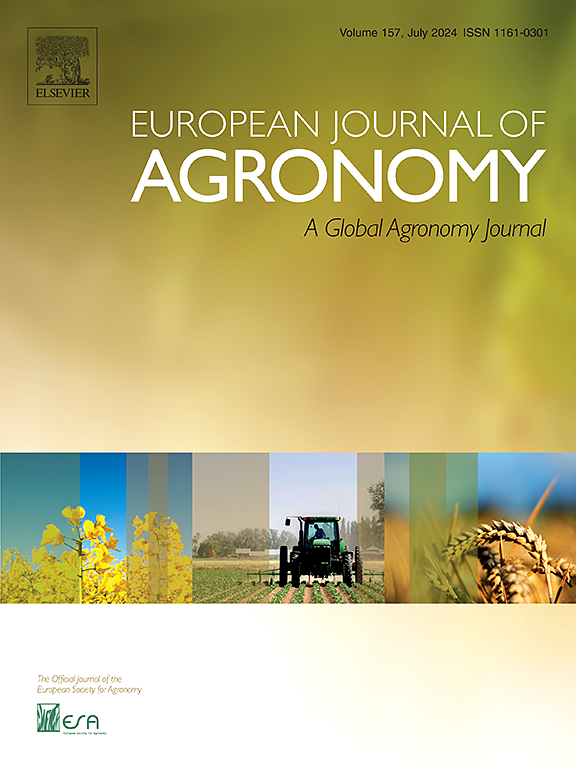
The European Journal of Agronomy, the official journal of the European Society for Agronomy, publishes original research papers reporting experimental and theoretical contributions to field-based agronomy and crop science. The journal will consider research at the field level for agricultural, horticultural and tree crops, that uses comprehensive and explanatory approaches. The EJA covers the following topics:
crop physiology
crop production and management including irrigation, fertilization and soil management
agroclimatology and modelling
plant-soil relationships
crop quality and post-harvest physiology
farming and cropping systems
agroecosystems and the environment
crop-weed interactions and management
organic farming
horticultural crops
papers from the European Society for Agronomy bi-annual meetings
In determining the suitability of submitted articles for publication, particular scrutiny is placed on the degree of novelty and significance of the research and the extent to which it adds to existing knowledge in agronomy.




 京公网安备 11010802042870号
京ICP备2023020795号-1
京公网安备 11010802042870号
京ICP备2023020795号-1

 分享
分享
 求助内容:
求助内容: 应助结果提醒方式:
 扫码关注我们
