Bruna K P Sousa, Melina Mottin, Donald Seanego, Christopher D Jurisch, Beatriz S A Rodrigues, Verônica L S da Silva, Milene Aparecida Andrade, Gilberto S Morais, Diogo F Boerin, Thamires Q Froes, Flávia Nader Motta, M Cristina Nonato, Izabela D M Bastos, Kelly Chibale, Richard K Gessner, Carolina Horta Andrade
{"title":"SARS-CoV-2 PLpro非共价抑制剂的发现:整合虚拟筛选、合成和实验验证","authors":"Bruna K P Sousa, Melina Mottin, Donald Seanego, Christopher D Jurisch, Beatriz S A Rodrigues, Verônica L S da Silva, Milene Aparecida Andrade, Gilberto S Morais, Diogo F Boerin, Thamires Q Froes, Flávia Nader Motta, M Cristina Nonato, Izabela D M Bastos, Kelly Chibale, Richard K Gessner, Carolina Horta Andrade","doi":"10.1021/acsmedchemlett.4c00420","DOIUrl":null,"url":null,"abstract":"<p><p>The SARS-CoV-2 pandemic has significantly challenged global public health, highlighting the need for effective therapeutic options. This study focuses on the papain-like protease (PLpro) of SARS-CoV-2, which is a critical enzyme for viral polyprotein processing, maturation, and immune evasion. We employed a combined approach that began with computational models in a virtual screening campaign, prioritizing compounds from our in-house chemical library against PLpro. Out of 81 virtual hits evaluated through enzymatic and biophysical assays, we identified a modest inhibitor featuring a naphthyridine core with an IC<sub>50</sub> of 73.61 μM and a <i>K</i> <sub>i</sub> of 22 μM. Expanding our exploration, we synthesized and assessed 30 naphthyridine analogues, three of which emerged as promising noncovalent, nonpeptidomimetic inhibitors with IC<sub>50</sub> values between 15.06 and 51.81 μM. Furthermore, <i>in vitro</i> ADMET assays revealed these compounds to possess moderate aqueous solubility, low cytotoxicity, and high microsomal stability, making them excellent candidates for further development targeting SARS-CoV-2 PLpro.</p>","PeriodicalId":20,"journal":{"name":"ACS Medicinal Chemistry Letters","volume":"15 12","pages":"2140-2149"},"PeriodicalIF":4.0000,"publicationDate":"2024-12-02","publicationTypes":"Journal Article","fieldsOfStudy":null,"isOpenAccess":false,"openAccessPdf":"https://www.ncbi.nlm.nih.gov/pmc/articles/PMC11647681/pdf/","citationCount":"0","resultStr":"{\"title\":\"Discovery of Non-Covalent Inhibitors for SARS-CoV-2 PLpro: Integrating Virtual Screening, Synthesis, and Experimental Validation.\",\"authors\":\"Bruna K P Sousa, Melina Mottin, Donald Seanego, Christopher D Jurisch, Beatriz S A Rodrigues, Verônica L S da Silva, Milene Aparecida Andrade, Gilberto S Morais, Diogo F Boerin, Thamires Q Froes, Flávia Nader Motta, M Cristina Nonato, Izabela D M Bastos, Kelly Chibale, Richard K Gessner, Carolina Horta Andrade\",\"doi\":\"10.1021/acsmedchemlett.4c00420\",\"DOIUrl\":null,\"url\":null,\"abstract\":\"<p><p>The SARS-CoV-2 pandemic has significantly challenged global public health, highlighting the need for effective therapeutic options. This study focuses on the papain-like protease (PLpro) of SARS-CoV-2, which is a critical enzyme for viral polyprotein processing, maturation, and immune evasion. We employed a combined approach that began with computational models in a virtual screening campaign, prioritizing compounds from our in-house chemical library against PLpro. Out of 81 virtual hits evaluated through enzymatic and biophysical assays, we identified a modest inhibitor featuring a naphthyridine core with an IC<sub>50</sub> of 73.61 μM and a <i>K</i> <sub>i</sub> of 22 μM. Expanding our exploration, we synthesized and assessed 30 naphthyridine analogues, three of which emerged as promising noncovalent, nonpeptidomimetic inhibitors with IC<sub>50</sub> values between 15.06 and 51.81 μM. Furthermore, <i>in vitro</i> ADMET assays revealed these compounds to possess moderate aqueous solubility, low cytotoxicity, and high microsomal stability, making them excellent candidates for further development targeting SARS-CoV-2 PLpro.</p>\",\"PeriodicalId\":20,\"journal\":{\"name\":\"ACS Medicinal Chemistry Letters\",\"volume\":\"15 12\",\"pages\":\"2140-2149\"},\"PeriodicalIF\":4.0000,\"publicationDate\":\"2024-12-02\",\"publicationTypes\":\"Journal Article\",\"fieldsOfStudy\":null,\"isOpenAccess\":false,\"openAccessPdf\":\"https://www.ncbi.nlm.nih.gov/pmc/articles/PMC11647681/pdf/\",\"citationCount\":\"0\",\"resultStr\":null,\"platform\":\"Semanticscholar\",\"paperid\":null,\"PeriodicalName\":\"ACS Medicinal Chemistry Letters\",\"FirstCategoryId\":\"3\",\"ListUrlMain\":\"https://doi.org/10.1021/acsmedchemlett.4c00420\",\"RegionNum\":3,\"RegionCategory\":\"医学\",\"ArticlePicture\":[],\"TitleCN\":null,\"AbstractTextCN\":null,\"PMCID\":null,\"EPubDate\":\"2024/12/12 0:00:00\",\"PubModel\":\"eCollection\",\"JCR\":\"Q2\",\"JCRName\":\"CHEMISTRY, MEDICINAL\",\"Score\":null,\"Total\":0}","platform":"Semanticscholar","paperid":null,"PeriodicalName":"ACS Medicinal Chemistry Letters","FirstCategoryId":"3","ListUrlMain":"https://doi.org/10.1021/acsmedchemlett.4c00420","RegionNum":3,"RegionCategory":"医学","ArticlePicture":[],"TitleCN":null,"AbstractTextCN":null,"PMCID":null,"EPubDate":"2024/12/12 0:00:00","PubModel":"eCollection","JCR":"Q2","JCRName":"CHEMISTRY, MEDICINAL","Score":null,"Total":0}
引用次数: 0
摘要
SARS-CoV-2大流行给全球公共卫生带来了重大挑战,突出表明需要有效的治疗方案。这项研究的重点是SARS-CoV-2的木瓜蛋白酶(PLpro),它是病毒多蛋白加工、成熟和免疫逃避的关键酶。我们采用了一种结合的方法,从虚拟筛选活动的计算模型开始,优先考虑我们内部化学库中的化合物,以对抗PLpro。在通过酶和生物物理分析评估的81个虚拟命中中,我们确定了一个具有萘啶核心的适度抑制剂,IC50为73.61 μM, K i为22 μM。为了扩大我们的研究范围,我们合成并评估了30种萘嘧啶类似物,其中3种是非共价的、非拟肽抑制剂,IC50值在15.06 ~ 51.81 μM之间。此外,体外ADMET试验显示,这些化合物具有中等水溶性、低细胞毒性和高微粒体稳定性,使其成为进一步开发针对SARS-CoV-2 PLpro的优秀候选者。
Discovery of Non-Covalent Inhibitors for SARS-CoV-2 PLpro: Integrating Virtual Screening, Synthesis, and Experimental Validation.
The SARS-CoV-2 pandemic has significantly challenged global public health, highlighting the need for effective therapeutic options. This study focuses on the papain-like protease (PLpro) of SARS-CoV-2, which is a critical enzyme for viral polyprotein processing, maturation, and immune evasion. We employed a combined approach that began with computational models in a virtual screening campaign, prioritizing compounds from our in-house chemical library against PLpro. Out of 81 virtual hits evaluated through enzymatic and biophysical assays, we identified a modest inhibitor featuring a naphthyridine core with an IC50 of 73.61 μM and a Ki of 22 μM. Expanding our exploration, we synthesized and assessed 30 naphthyridine analogues, three of which emerged as promising noncovalent, nonpeptidomimetic inhibitors with IC50 values between 15.06 and 51.81 μM. Furthermore, in vitro ADMET assays revealed these compounds to possess moderate aqueous solubility, low cytotoxicity, and high microsomal stability, making them excellent candidates for further development targeting SARS-CoV-2 PLpro.
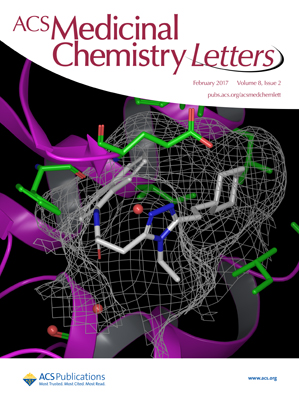
期刊介绍:
ACS Medicinal Chemistry Letters is interested in receiving manuscripts that discuss various aspects of medicinal chemistry. The journal will publish studies that pertain to a broad range of subject matter, including compound design and optimization, biological evaluation, drug delivery, imaging agents, and pharmacology of both small and large bioactive molecules. Specific areas include but are not limited to:
Identification, synthesis, and optimization of lead biologically active molecules and drugs (small molecules and biologics)
Biological characterization of new molecular entities in the context of drug discovery
Computational, cheminformatics, and structural studies for the identification or SAR analysis of bioactive molecules, ligands and their targets, etc.
Novel and improved methodologies, including radiation biochemistry, with broad application to medicinal chemistry
Discovery technologies for biologically active molecules from both synthetic and natural (plant and other) sources
Pharmacokinetic/pharmacodynamic studies that address mechanisms underlying drug disposition and response
Pharmacogenetic and pharmacogenomic studies used to enhance drug design and the translation of medicinal chemistry into the clinic
Mechanistic drug metabolism and regulation of metabolic enzyme gene expression
Chemistry patents relevant to the medicinal chemistry field.




 京公网安备 11010802042870号
京ICP备2023020795号-1
京公网安备 11010802042870号
京ICP备2023020795号-1

 分享
分享
 求助内容:
求助内容: 应助结果提醒方式:
 扫码关注我们
