Jing-Jing Zhang, Ya-Meng Liu, Ya-Wei Li, Zheng-Quan Han
{"title":"结肠癌患者术后复发风险个性化评估风险预测模型的建立。","authors":"Jing-Jing Zhang, Ya-Meng Liu, Ya-Wei Li, Zheng-Quan Han","doi":"10.21037/tcr-24-948","DOIUrl":null,"url":null,"abstract":"<p><strong>Background: </strong>Colon cancer, a significant contributor to cancer-related mortality worldwide, exhibits a high recurrence rate in patients following surgical intervention, particularly when the disease has progressed to intermediate or advanced stages. This study undertakes a comprehensive analysis of the risk factors influencing postoperative recurrence in patients with middle- to late-stage colon cancer and subsequently develops a columnar graphical prediction model based on these findings. This model seeks to enhance the capability of identifying the risk of postoperative recurrence in patients with intermediate and advanced colon cancer, thereby providing a scientific foundation for the development of more personalized and effective prevention and management strategies.</p><p><strong>Methods: </strong>An analysis was conducted on a cohort of 209 patients diagnosed with colon cancer and treated at our hospital between 2020 and 2021. Clinical data were gathered to compare recurrence rates of postoperative colon cancer among patients with different influencing factors. Logistic regression analysis was utilized to determine independent factors affecting the recurrence rate of postoperative colon cancer. A nomogram risk prediction model was developed and assessed for its effectiveness.</p><p><strong>Results: </strong>The results of the regression analysis indicated that \"Tumor stage\" (stage IV), \"Lymph node metastasis\" (presence), \"the level of C-reactive protein\", and \"the level of carcinoembryonic antigen\" were identified as independent risk factors for postoperative colon cancer recurrence in patients. Additionally, \"Differentiation degree\" (medium/high), \"Chemotherapy (have)\", and \"the level of serum albumin\" were found to be associated with a decreased risk of recurrence. A nomogram prediction model was created using the mentioned risk factors, showing a link between higher scores and higher postoperative colon cancer recurrence rates. The model had a C-index of 0.834 [95% confidence interval (CI): 0.776-0.892] and was internally validated for strong and consistent performance.</p><p><strong>Conclusions: </strong>This study developed a nomogram prediction model to forecast the recurrence rate of postoperative colon cancer by identifying independent influencing factors. The model demonstrates strong discrimination and consistency, offering valuable guidance in promptly assessing the likelihood of postoperative colon cancer recurrence in patients and implementing timely and effective preventive measures.</p>","PeriodicalId":23216,"journal":{"name":"Translational cancer research","volume":"13 11","pages":"5873-5882"},"PeriodicalIF":1.7000,"publicationDate":"2024-11-30","publicationTypes":"Journal Article","fieldsOfStudy":null,"isOpenAccess":false,"openAccessPdf":"https://www.ncbi.nlm.nih.gov/pmc/articles/PMC11651794/pdf/","citationCount":"0","resultStr":"{\"title\":\"Development of a risk prediction model for personalized assessment of postoperative recurrence risk in colon cancer patients.\",\"authors\":\"Jing-Jing Zhang, Ya-Meng Liu, Ya-Wei Li, Zheng-Quan Han\",\"doi\":\"10.21037/tcr-24-948\",\"DOIUrl\":null,\"url\":null,\"abstract\":\"<p><strong>Background: </strong>Colon cancer, a significant contributor to cancer-related mortality worldwide, exhibits a high recurrence rate in patients following surgical intervention, particularly when the disease has progressed to intermediate or advanced stages. This study undertakes a comprehensive analysis of the risk factors influencing postoperative recurrence in patients with middle- to late-stage colon cancer and subsequently develops a columnar graphical prediction model based on these findings. This model seeks to enhance the capability of identifying the risk of postoperative recurrence in patients with intermediate and advanced colon cancer, thereby providing a scientific foundation for the development of more personalized and effective prevention and management strategies.</p><p><strong>Methods: </strong>An analysis was conducted on a cohort of 209 patients diagnosed with colon cancer and treated at our hospital between 2020 and 2021. Clinical data were gathered to compare recurrence rates of postoperative colon cancer among patients with different influencing factors. Logistic regression analysis was utilized to determine independent factors affecting the recurrence rate of postoperative colon cancer. A nomogram risk prediction model was developed and assessed for its effectiveness.</p><p><strong>Results: </strong>The results of the regression analysis indicated that \\\"Tumor stage\\\" (stage IV), \\\"Lymph node metastasis\\\" (presence), \\\"the level of C-reactive protein\\\", and \\\"the level of carcinoembryonic antigen\\\" were identified as independent risk factors for postoperative colon cancer recurrence in patients. Additionally, \\\"Differentiation degree\\\" (medium/high), \\\"Chemotherapy (have)\\\", and \\\"the level of serum albumin\\\" were found to be associated with a decreased risk of recurrence. A nomogram prediction model was created using the mentioned risk factors, showing a link between higher scores and higher postoperative colon cancer recurrence rates. The model had a C-index of 0.834 [95% confidence interval (CI): 0.776-0.892] and was internally validated for strong and consistent performance.</p><p><strong>Conclusions: </strong>This study developed a nomogram prediction model to forecast the recurrence rate of postoperative colon cancer by identifying independent influencing factors. The model demonstrates strong discrimination and consistency, offering valuable guidance in promptly assessing the likelihood of postoperative colon cancer recurrence in patients and implementing timely and effective preventive measures.</p>\",\"PeriodicalId\":23216,\"journal\":{\"name\":\"Translational cancer research\",\"volume\":\"13 11\",\"pages\":\"5873-5882\"},\"PeriodicalIF\":1.7000,\"publicationDate\":\"2024-11-30\",\"publicationTypes\":\"Journal Article\",\"fieldsOfStudy\":null,\"isOpenAccess\":false,\"openAccessPdf\":\"https://www.ncbi.nlm.nih.gov/pmc/articles/PMC11651794/pdf/\",\"citationCount\":\"0\",\"resultStr\":null,\"platform\":\"Semanticscholar\",\"paperid\":null,\"PeriodicalName\":\"Translational cancer research\",\"FirstCategoryId\":\"3\",\"ListUrlMain\":\"https://doi.org/10.21037/tcr-24-948\",\"RegionNum\":4,\"RegionCategory\":\"医学\",\"ArticlePicture\":[],\"TitleCN\":null,\"AbstractTextCN\":null,\"PMCID\":null,\"EPubDate\":\"2024/11/27 0:00:00\",\"PubModel\":\"Epub\",\"JCR\":\"Q4\",\"JCRName\":\"ONCOLOGY\",\"Score\":null,\"Total\":0}","platform":"Semanticscholar","paperid":null,"PeriodicalName":"Translational cancer research","FirstCategoryId":"3","ListUrlMain":"https://doi.org/10.21037/tcr-24-948","RegionNum":4,"RegionCategory":"医学","ArticlePicture":[],"TitleCN":null,"AbstractTextCN":null,"PMCID":null,"EPubDate":"2024/11/27 0:00:00","PubModel":"Epub","JCR":"Q4","JCRName":"ONCOLOGY","Score":null,"Total":0}
Development of a risk prediction model for personalized assessment of postoperative recurrence risk in colon cancer patients.
Background: Colon cancer, a significant contributor to cancer-related mortality worldwide, exhibits a high recurrence rate in patients following surgical intervention, particularly when the disease has progressed to intermediate or advanced stages. This study undertakes a comprehensive analysis of the risk factors influencing postoperative recurrence in patients with middle- to late-stage colon cancer and subsequently develops a columnar graphical prediction model based on these findings. This model seeks to enhance the capability of identifying the risk of postoperative recurrence in patients with intermediate and advanced colon cancer, thereby providing a scientific foundation for the development of more personalized and effective prevention and management strategies.
Methods: An analysis was conducted on a cohort of 209 patients diagnosed with colon cancer and treated at our hospital between 2020 and 2021. Clinical data were gathered to compare recurrence rates of postoperative colon cancer among patients with different influencing factors. Logistic regression analysis was utilized to determine independent factors affecting the recurrence rate of postoperative colon cancer. A nomogram risk prediction model was developed and assessed for its effectiveness.
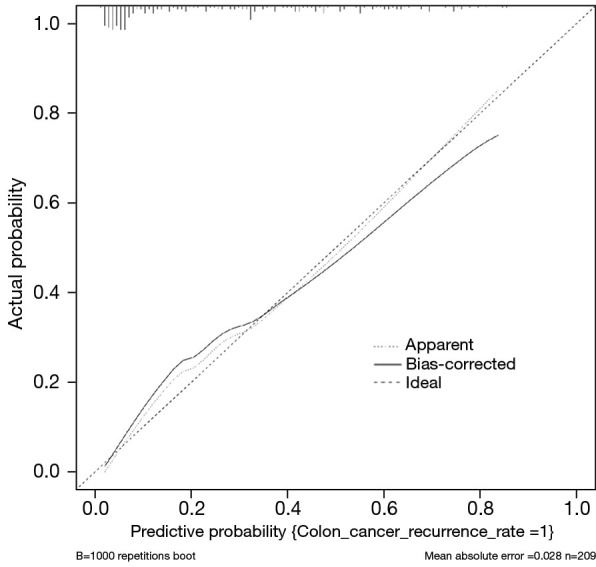
Results: The results of the regression analysis indicated that "Tumor stage" (stage IV), "Lymph node metastasis" (presence), "the level of C-reactive protein", and "the level of carcinoembryonic antigen" were identified as independent risk factors for postoperative colon cancer recurrence in patients. Additionally, "Differentiation degree" (medium/high), "Chemotherapy (have)", and "the level of serum albumin" were found to be associated with a decreased risk of recurrence. A nomogram prediction model was created using the mentioned risk factors, showing a link between higher scores and higher postoperative colon cancer recurrence rates. The model had a C-index of 0.834 [95% confidence interval (CI): 0.776-0.892] and was internally validated for strong and consistent performance.
Conclusions: This study developed a nomogram prediction model to forecast the recurrence rate of postoperative colon cancer by identifying independent influencing factors. The model demonstrates strong discrimination and consistency, offering valuable guidance in promptly assessing the likelihood of postoperative colon cancer recurrence in patients and implementing timely and effective preventive measures.
期刊介绍:
Translational Cancer Research (Transl Cancer Res TCR; Print ISSN: 2218-676X; Online ISSN 2219-6803; http://tcr.amegroups.com/) is an Open Access, peer-reviewed journal, indexed in Science Citation Index Expanded (SCIE). TCR publishes laboratory studies of novel therapeutic interventions as well as clinical trials which evaluate new treatment paradigms for cancer; results of novel research investigations which bridge the laboratory and clinical settings including risk assessment, cellular and molecular characterization, prevention, detection, diagnosis and treatment of human cancers with the overall goal of improving the clinical care of cancer patients. The focus of TCR is original, peer-reviewed, science-based research that successfully advances clinical medicine toward the goal of improving patients'' quality of life. The editors and an international advisory group of scientists and clinician-scientists as well as other experts will hold TCR articles to the high-quality standards. We accept Original Articles as well as Review Articles, Editorials and Brief Articles.






 京公网安备 11010802042870号
京ICP备2023020795号-1
京公网安备 11010802042870号
京ICP备2023020795号-1

 分享
分享
 求助内容:
求助内容: 应助结果提醒方式:
 扫码关注我们
