Wenming Wei, Xin Qi, Bolun Cheng, Na Zhang, Yijing Zhao, Xiaoyue Qin, Dan He, Xiaoge Chu, Sirong Shi, Qingqing Cai, Xuena Yang, Shiqiang Cheng, Peilin Meng, Jingni Hui, Chuyu Pan, Li Liu, Yan Wen, Huan Liu, Yumeng Jia, Feng Zhang
{"title":"加速生物老化与20种肌肉骨骼疾病之间关系的前瞻性研究。","authors":"Wenming Wei, Xin Qi, Bolun Cheng, Na Zhang, Yijing Zhao, Xiaoyue Qin, Dan He, Xiaoge Chu, Sirong Shi, Qingqing Cai, Xuena Yang, Shiqiang Cheng, Peilin Meng, Jingni Hui, Chuyu Pan, Li Liu, Yan Wen, Huan Liu, Yumeng Jia, Feng Zhang","doi":"10.1038/s43856-024-00706-5","DOIUrl":null,"url":null,"abstract":"Musculoskeletal disorders pose major public health challenges, and accelerated biological aging may increase their risk. This study investigates the association between biological aging and musculoskeletal disorders, with a focus on sex-related differences. We analyzed data from 172,332 UK Biobank participants (mean age of 56.03 ± 8.10 years). Biological age was calculated using the KDM-BA and PhenoAge algorithms based on blood biomarkers. Musculoskeletal disorders were diagnosed using the ICD-10 criteria, with sample sizes ranging from 1,182 to 23,668. Logistic regression assessed cross-sectional associations between age acceleration (AA) metrics and musculoskeletal disorders. Accelerated Failure Time (AFT) model was used for survival analysis to evaluate the relationships between AAs and musculoskeletal disorders onset. Models were adjusted for demographic, lifestyle, and socio-economic covariates. The threshold of P-values were set by the Holm-Bonferroni correction. Cross-sectional analyses reveal significant associations between AAs and fourteen musculoskeletal disorders. Survival analyses indicate that AAs significantly accelerate the onset of nine musculoskeletal disorders, including inflammatory polyarthropathies (RTKDM-BA = 0.993; RTPhenoAge = 0.983), systemic connective tissue disorders (RTKDM-BA = 0.987; RTPhenoAge = 0.980), spondylopathies (RTPhenoAge= 0.994), disorders of bone density and structure (RTPhenoAge= 0.991), gout (RTPhenoAge= 0.968), arthritis (RTPhenoAge= 0.991), pain in joint (RTPhenoAge= 0.989), low back pain (RTPhenoAge= 0.986), and osteoporosis (RTPhenoAge= 0.994). Sensitivity analyses are consistent with the primary findings. Sex-specific variations are observed, with AAs accelerating spondylopathies, arthritis, and low back pain in females, while osteoporosis is accelerated in males. Accelerated biological aging is significantly associated with the incidence of several musculoskeletal disorders. These insights highlight the importance of biological age assessments in gauging musculoskeletal disorder risk, aiding early detection, prevention, and management. As we age, our bodies experience changes that can lead to health problems, including musculoskeletal disorders such as arthritis and back pain. This study explores how biological aging, a measure of how old our bodies seem based on biomarkers, affects the risk of developing these disorders. Using data from over 170,000 people, we found that faster biological aging is linked to an increased risk of several musculoskeletal disorders, and that these risks can vary between men and women. These findings could help identify people at risk earlier, leading to better prevention and treatment strategies. Wei et al. investigate the link between accelerated biological aging and the risk of musculoskeletal disorders, highlighting sex-related disparities. Age acceleration significantly increases the risk and onset of nine musculoskeletal disorders, with notable differences between males and females.","PeriodicalId":72646,"journal":{"name":"Communications medicine","volume":" ","pages":"1-8"},"PeriodicalIF":5.4000,"publicationDate":"2024-12-18","publicationTypes":"Journal Article","fieldsOfStudy":null,"isOpenAccess":false,"openAccessPdf":"https://www.nature.com/articles/s43856-024-00706-5.pdf","citationCount":"0","resultStr":"{\"title\":\"A prospective study of associations between accelerated biological aging and twenty musculoskeletal disorders\",\"authors\":\"Wenming Wei, Xin Qi, Bolun Cheng, Na Zhang, Yijing Zhao, Xiaoyue Qin, Dan He, Xiaoge Chu, Sirong Shi, Qingqing Cai, Xuena Yang, Shiqiang Cheng, Peilin Meng, Jingni Hui, Chuyu Pan, Li Liu, Yan Wen, Huan Liu, Yumeng Jia, Feng Zhang\",\"doi\":\"10.1038/s43856-024-00706-5\",\"DOIUrl\":null,\"url\":null,\"abstract\":\"Musculoskeletal disorders pose major public health challenges, and accelerated biological aging may increase their risk. This study investigates the association between biological aging and musculoskeletal disorders, with a focus on sex-related differences. We analyzed data from 172,332 UK Biobank participants (mean age of 56.03 ± 8.10 years). Biological age was calculated using the KDM-BA and PhenoAge algorithms based on blood biomarkers. Musculoskeletal disorders were diagnosed using the ICD-10 criteria, with sample sizes ranging from 1,182 to 23,668. Logistic regression assessed cross-sectional associations between age acceleration (AA) metrics and musculoskeletal disorders. Accelerated Failure Time (AFT) model was used for survival analysis to evaluate the relationships between AAs and musculoskeletal disorders onset. Models were adjusted for demographic, lifestyle, and socio-economic covariates. The threshold of P-values were set by the Holm-Bonferroni correction. Cross-sectional analyses reveal significant associations between AAs and fourteen musculoskeletal disorders. Survival analyses indicate that AAs significantly accelerate the onset of nine musculoskeletal disorders, including inflammatory polyarthropathies (RTKDM-BA = 0.993; RTPhenoAge = 0.983), systemic connective tissue disorders (RTKDM-BA = 0.987; RTPhenoAge = 0.980), spondylopathies (RTPhenoAge= 0.994), disorders of bone density and structure (RTPhenoAge= 0.991), gout (RTPhenoAge= 0.968), arthritis (RTPhenoAge= 0.991), pain in joint (RTPhenoAge= 0.989), low back pain (RTPhenoAge= 0.986), and osteoporosis (RTPhenoAge= 0.994). Sensitivity analyses are consistent with the primary findings. Sex-specific variations are observed, with AAs accelerating spondylopathies, arthritis, and low back pain in females, while osteoporosis is accelerated in males. Accelerated biological aging is significantly associated with the incidence of several musculoskeletal disorders. These insights highlight the importance of biological age assessments in gauging musculoskeletal disorder risk, aiding early detection, prevention, and management. As we age, our bodies experience changes that can lead to health problems, including musculoskeletal disorders such as arthritis and back pain. This study explores how biological aging, a measure of how old our bodies seem based on biomarkers, affects the risk of developing these disorders. Using data from over 170,000 people, we found that faster biological aging is linked to an increased risk of several musculoskeletal disorders, and that these risks can vary between men and women. These findings could help identify people at risk earlier, leading to better prevention and treatment strategies. Wei et al. investigate the link between accelerated biological aging and the risk of musculoskeletal disorders, highlighting sex-related disparities. Age acceleration significantly increases the risk and onset of nine musculoskeletal disorders, with notable differences between males and females.\",\"PeriodicalId\":72646,\"journal\":{\"name\":\"Communications medicine\",\"volume\":\" \",\"pages\":\"1-8\"},\"PeriodicalIF\":5.4000,\"publicationDate\":\"2024-12-18\",\"publicationTypes\":\"Journal Article\",\"fieldsOfStudy\":null,\"isOpenAccess\":false,\"openAccessPdf\":\"https://www.nature.com/articles/s43856-024-00706-5.pdf\",\"citationCount\":\"0\",\"resultStr\":null,\"platform\":\"Semanticscholar\",\"paperid\":null,\"PeriodicalName\":\"Communications medicine\",\"FirstCategoryId\":\"1085\",\"ListUrlMain\":\"https://www.nature.com/articles/s43856-024-00706-5\",\"RegionNum\":0,\"RegionCategory\":null,\"ArticlePicture\":[],\"TitleCN\":null,\"AbstractTextCN\":null,\"PMCID\":null,\"EPubDate\":\"\",\"PubModel\":\"\",\"JCR\":\"Q1\",\"JCRName\":\"MEDICINE, RESEARCH & EXPERIMENTAL\",\"Score\":null,\"Total\":0}","platform":"Semanticscholar","paperid":null,"PeriodicalName":"Communications medicine","FirstCategoryId":"1085","ListUrlMain":"https://www.nature.com/articles/s43856-024-00706-5","RegionNum":0,"RegionCategory":null,"ArticlePicture":[],"TitleCN":null,"AbstractTextCN":null,"PMCID":null,"EPubDate":"","PubModel":"","JCR":"Q1","JCRName":"MEDICINE, RESEARCH & EXPERIMENTAL","Score":null,"Total":0}
A prospective study of associations between accelerated biological aging and twenty musculoskeletal disorders
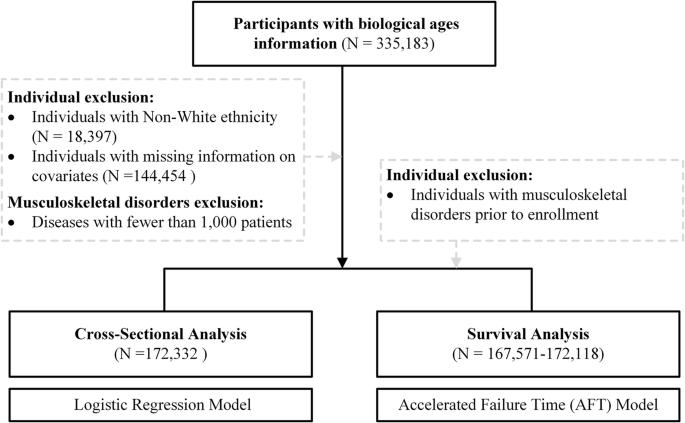
Musculoskeletal disorders pose major public health challenges, and accelerated biological aging may increase their risk. This study investigates the association between biological aging and musculoskeletal disorders, with a focus on sex-related differences. We analyzed data from 172,332 UK Biobank participants (mean age of 56.03 ± 8.10 years). Biological age was calculated using the KDM-BA and PhenoAge algorithms based on blood biomarkers. Musculoskeletal disorders were diagnosed using the ICD-10 criteria, with sample sizes ranging from 1,182 to 23,668. Logistic regression assessed cross-sectional associations between age acceleration (AA) metrics and musculoskeletal disorders. Accelerated Failure Time (AFT) model was used for survival analysis to evaluate the relationships between AAs and musculoskeletal disorders onset. Models were adjusted for demographic, lifestyle, and socio-economic covariates. The threshold of P-values were set by the Holm-Bonferroni correction. Cross-sectional analyses reveal significant associations between AAs and fourteen musculoskeletal disorders. Survival analyses indicate that AAs significantly accelerate the onset of nine musculoskeletal disorders, including inflammatory polyarthropathies (RTKDM-BA = 0.993; RTPhenoAge = 0.983), systemic connective tissue disorders (RTKDM-BA = 0.987; RTPhenoAge = 0.980), spondylopathies (RTPhenoAge= 0.994), disorders of bone density and structure (RTPhenoAge= 0.991), gout (RTPhenoAge= 0.968), arthritis (RTPhenoAge= 0.991), pain in joint (RTPhenoAge= 0.989), low back pain (RTPhenoAge= 0.986), and osteoporosis (RTPhenoAge= 0.994). Sensitivity analyses are consistent with the primary findings. Sex-specific variations are observed, with AAs accelerating spondylopathies, arthritis, and low back pain in females, while osteoporosis is accelerated in males. Accelerated biological aging is significantly associated with the incidence of several musculoskeletal disorders. These insights highlight the importance of biological age assessments in gauging musculoskeletal disorder risk, aiding early detection, prevention, and management. As we age, our bodies experience changes that can lead to health problems, including musculoskeletal disorders such as arthritis and back pain. This study explores how biological aging, a measure of how old our bodies seem based on biomarkers, affects the risk of developing these disorders. Using data from over 170,000 people, we found that faster biological aging is linked to an increased risk of several musculoskeletal disorders, and that these risks can vary between men and women. These findings could help identify people at risk earlier, leading to better prevention and treatment strategies. Wei et al. investigate the link between accelerated biological aging and the risk of musculoskeletal disorders, highlighting sex-related disparities. Age acceleration significantly increases the risk and onset of nine musculoskeletal disorders, with notable differences between males and females.




 京公网安备 11010802042870号
京ICP备2023020795号-1
京公网安备 11010802042870号
京ICP备2023020795号-1

 分享
分享

 求助内容:
求助内容: 应助结果提醒方式:
 扫码关注我们
