Jacky Yong , Yung-Chung Chen , Shujahadeen B. Aziz , Mayeen Uddin Khandaker , Haw Jiunn Woo
{"title":"聚乙烯醇生物聚合物基固体聚合物电解质中Na+离子的相关垒跳动力学:电学和结构分析","authors":"Jacky Yong , Yung-Chung Chen , Shujahadeen B. Aziz , Mayeen Uddin Khandaker , Haw Jiunn Woo","doi":"10.1016/j.electacta.2024.145610","DOIUrl":null,"url":null,"abstract":"<div><div>In recent years, the use of sodium-ion based solid polymer electrolyte (SPE) in energy storage applications has been attracting attention in research. However, SPEs are still suffering from lower ionic conductivity in room temperature, and sodium-ion based SPEs are not yet on par with lithium-ion based SPEs in terms of the overall performance. Therefore, understanding the conduction mechanism of a sodium-ion based SPE is crucial to design and optimize the performance of a sodium-ion based device. Herein, partially hydrolyzed PVA-based SPE was prepared with NaPF<sub>6</sub>. From the power law region of the plotted AC conductivity graph, the frequency exponent value, <em>s</em> is calculated to be <em>s <</em> 1. The decreasing of <em>s</em> value when temperature increases also suggests that the SPE system follows the Correlated Barrier Hopping (CBH) model where ions conduct through correlated hopping between sites by overcoming barrier heights or potential wells, with conductivity being dependent on both temperature and frequency. The SPE with PVA:NaPF<sub>6</sub> ratio of 60:40 (PVA60) exhibits the highest room temperature ionic conductivity of 3.65 × 10<sup>−5</sup> S/cm, and has the lowest calculated activation energy of 0.149 eV. FTIR spectra confirmed the complexation of PVA and NaPF<sub>6</sub> at certain functional groups, and deconvolution at the 800–900 cm<sup>-1</sup> region was done to find out the free-ions and ion-pairs percentage. The degree of crystallinity is also determined from the XRD data where PVA60 exhibits the lowest degree of crystallinity. The TGA and LSV results are also analyzed to provide an overall insight into the thermal and electrochemical stability of the samples.</div></div>","PeriodicalId":305,"journal":{"name":"Electrochimica Acta","volume":"513 ","pages":"Article 145610"},"PeriodicalIF":5.8000,"publicationDate":"2025-02-10","publicationTypes":"Journal Article","fieldsOfStudy":null,"isOpenAccess":false,"openAccessPdf":"","citationCount":"0","resultStr":"{\"title\":\"Correlated barrier hopping dynamics of Na+ ions in poly(vinyl alcohol) biopolymer-based solid polymer electrolytes: Electrical and structural analysis\",\"authors\":\"Jacky Yong , Yung-Chung Chen , Shujahadeen B. Aziz , Mayeen Uddin Khandaker , Haw Jiunn Woo\",\"doi\":\"10.1016/j.electacta.2024.145610\",\"DOIUrl\":null,\"url\":null,\"abstract\":\"<div><div>In recent years, the use of sodium-ion based solid polymer electrolyte (SPE) in energy storage applications has been attracting attention in research. However, SPEs are still suffering from lower ionic conductivity in room temperature, and sodium-ion based SPEs are not yet on par with lithium-ion based SPEs in terms of the overall performance. Therefore, understanding the conduction mechanism of a sodium-ion based SPE is crucial to design and optimize the performance of a sodium-ion based device. Herein, partially hydrolyzed PVA-based SPE was prepared with NaPF<sub>6</sub>. From the power law region of the plotted AC conductivity graph, the frequency exponent value, <em>s</em> is calculated to be <em>s <</em> 1. The decreasing of <em>s</em> value when temperature increases also suggests that the SPE system follows the Correlated Barrier Hopping (CBH) model where ions conduct through correlated hopping between sites by overcoming barrier heights or potential wells, with conductivity being dependent on both temperature and frequency. The SPE with PVA:NaPF<sub>6</sub> ratio of 60:40 (PVA60) exhibits the highest room temperature ionic conductivity of 3.65 × 10<sup>−5</sup> S/cm, and has the lowest calculated activation energy of 0.149 eV. FTIR spectra confirmed the complexation of PVA and NaPF<sub>6</sub> at certain functional groups, and deconvolution at the 800–900 cm<sup>-1</sup> region was done to find out the free-ions and ion-pairs percentage. The degree of crystallinity is also determined from the XRD data where PVA60 exhibits the lowest degree of crystallinity. The TGA and LSV results are also analyzed to provide an overall insight into the thermal and electrochemical stability of the samples.</div></div>\",\"PeriodicalId\":305,\"journal\":{\"name\":\"Electrochimica Acta\",\"volume\":\"513 \",\"pages\":\"Article 145610\"},\"PeriodicalIF\":5.8000,\"publicationDate\":\"2025-02-10\",\"publicationTypes\":\"Journal Article\",\"fieldsOfStudy\":null,\"isOpenAccess\":false,\"openAccessPdf\":\"\",\"citationCount\":\"0\",\"resultStr\":null,\"platform\":\"Semanticscholar\",\"paperid\":null,\"PeriodicalName\":\"Electrochimica Acta\",\"FirstCategoryId\":\"88\",\"ListUrlMain\":\"https://www.sciencedirect.com/science/article/pii/S0013468624018462\",\"RegionNum\":3,\"RegionCategory\":\"材料科学\",\"ArticlePicture\":[],\"TitleCN\":null,\"AbstractTextCN\":null,\"PMCID\":null,\"EPubDate\":\"2024/12/29 0:00:00\",\"PubModel\":\"Epub\",\"JCR\":\"Q1\",\"JCRName\":\"ELECTROCHEMISTRY\",\"Score\":null,\"Total\":0}","platform":"Semanticscholar","paperid":null,"PeriodicalName":"Electrochimica Acta","FirstCategoryId":"88","ListUrlMain":"https://www.sciencedirect.com/science/article/pii/S0013468624018462","RegionNum":3,"RegionCategory":"材料科学","ArticlePicture":[],"TitleCN":null,"AbstractTextCN":null,"PMCID":null,"EPubDate":"2024/12/29 0:00:00","PubModel":"Epub","JCR":"Q1","JCRName":"ELECTROCHEMISTRY","Score":null,"Total":0}
Correlated barrier hopping dynamics of Na+ ions in poly(vinyl alcohol) biopolymer-based solid polymer electrolytes: Electrical and structural analysis
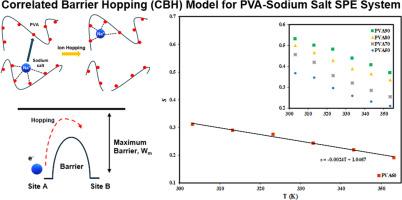
In recent years, the use of sodium-ion based solid polymer electrolyte (SPE) in energy storage applications has been attracting attention in research. However, SPEs are still suffering from lower ionic conductivity in room temperature, and sodium-ion based SPEs are not yet on par with lithium-ion based SPEs in terms of the overall performance. Therefore, understanding the conduction mechanism of a sodium-ion based SPE is crucial to design and optimize the performance of a sodium-ion based device. Herein, partially hydrolyzed PVA-based SPE was prepared with NaPF6. From the power law region of the plotted AC conductivity graph, the frequency exponent value, s is calculated to be s < 1. The decreasing of s value when temperature increases also suggests that the SPE system follows the Correlated Barrier Hopping (CBH) model where ions conduct through correlated hopping between sites by overcoming barrier heights or potential wells, with conductivity being dependent on both temperature and frequency. The SPE with PVA:NaPF6 ratio of 60:40 (PVA60) exhibits the highest room temperature ionic conductivity of 3.65 × 10⁻⁵ S/cm, and has the lowest calculated activation energy of 0.149 eV. FTIR spectra confirmed the complexation of PVA and NaPF6 at certain functional groups, and deconvolution at the 800–900 cm-1 region was done to find out the free-ions and ion-pairs percentage. The degree of crystallinity is also determined from the XRD data where PVA60 exhibits the lowest degree of crystallinity. The TGA and LSV results are also analyzed to provide an overall insight into the thermal and electrochemical stability of the samples.
期刊介绍:
Electrochimica Acta is an international journal. It is intended for the publication of both original work and reviews in the field of electrochemistry. Electrochemistry should be interpreted to mean any of the research fields covered by the Divisions of the International Society of Electrochemistry listed below, as well as emerging scientific domains covered by ISE New Topics Committee.




 京公网安备 11010802042870号
京ICP备2023020795号-1
京公网安备 11010802042870号
京ICP备2023020795号-1

 分享
分享
 求助内容:
求助内容: 应助结果提醒方式:
 扫码关注我们
