Yanqiu Yu , Chenhan Xiong , Wang Li , Xinming Lian , Huahao Sun , Nan Chen , Guoping Du
{"title":"三维花状球形氧化锌无枝晶稳定镍锌二次电池负极材料定向设计","authors":"Yanqiu Yu , Chenhan Xiong , Wang Li , Xinming Lian , Huahao Sun , Nan Chen , Guoping Du","doi":"10.1016/j.electacta.2024.145626","DOIUrl":null,"url":null,"abstract":"<div><div>Nickel-zinc batteries are emerging as the potential alternative to lithium-ion and lead-acid batteries owing to the high open-circuit voltage, affordability, and eco-friendliness. Nevertheless, the problems of zinc dendrite growth, hydrogen evolution and dissolution passivation in the zinc electrode seriously hinder the commercial application of nickel-zinc batteries. To address these issues, three-dimensional flower-like spherical zinc oxide with exceptional electrochemical performance is successfully synthesized by using a facial solvothermal and calcination method. The three-dimensional flower-like structure provides more reactive sites for the negative active materials, reducing local current density and inhibiting zinc dendrite formation. As a result, three-dimensional flower-like spherical ZnO demonstrates superior electrochemical performance compared to pure ZnO and other spherical ZnO. Even after 1200 cycles, the discharge capacity still remains 500 mAh g<sup>-1</sup> at 12C, representing 87% of the initial capacity (570 mAh g<sup>-1</sup>). Furthermore, the material maintains a relatively flat surface throughout the cycle, preventing the formation of dendrite.</div></div>","PeriodicalId":305,"journal":{"name":"Electrochimica Acta","volume":"514 ","pages":"Article 145626"},"PeriodicalIF":5.8000,"publicationDate":"2025-02-20","publicationTypes":"Journal Article","fieldsOfStudy":null,"isOpenAccess":false,"openAccessPdf":"","citationCount":"0","resultStr":"{\"title\":\"Oriented design of three-dimensional flower-like spherical zinc oxide as negative material for dendrite-free and superior stable nickel-zinc secondary batteries\",\"authors\":\"Yanqiu Yu , Chenhan Xiong , Wang Li , Xinming Lian , Huahao Sun , Nan Chen , Guoping Du\",\"doi\":\"10.1016/j.electacta.2024.145626\",\"DOIUrl\":null,\"url\":null,\"abstract\":\"<div><div>Nickel-zinc batteries are emerging as the potential alternative to lithium-ion and lead-acid batteries owing to the high open-circuit voltage, affordability, and eco-friendliness. Nevertheless, the problems of zinc dendrite growth, hydrogen evolution and dissolution passivation in the zinc electrode seriously hinder the commercial application of nickel-zinc batteries. To address these issues, three-dimensional flower-like spherical zinc oxide with exceptional electrochemical performance is successfully synthesized by using a facial solvothermal and calcination method. The three-dimensional flower-like structure provides more reactive sites for the negative active materials, reducing local current density and inhibiting zinc dendrite formation. As a result, three-dimensional flower-like spherical ZnO demonstrates superior electrochemical performance compared to pure ZnO and other spherical ZnO. Even after 1200 cycles, the discharge capacity still remains 500 mAh g<sup>-1</sup> at 12C, representing 87% of the initial capacity (570 mAh g<sup>-1</sup>). Furthermore, the material maintains a relatively flat surface throughout the cycle, preventing the formation of dendrite.</div></div>\",\"PeriodicalId\":305,\"journal\":{\"name\":\"Electrochimica Acta\",\"volume\":\"514 \",\"pages\":\"Article 145626\"},\"PeriodicalIF\":5.8000,\"publicationDate\":\"2025-02-20\",\"publicationTypes\":\"Journal Article\",\"fieldsOfStudy\":null,\"isOpenAccess\":false,\"openAccessPdf\":\"\",\"citationCount\":\"0\",\"resultStr\":null,\"platform\":\"Semanticscholar\",\"paperid\":null,\"PeriodicalName\":\"Electrochimica Acta\",\"FirstCategoryId\":\"88\",\"ListUrlMain\":\"https://www.sciencedirect.com/science/article/pii/S0013468624018619\",\"RegionNum\":3,\"RegionCategory\":\"材料科学\",\"ArticlePicture\":[],\"TitleCN\":null,\"AbstractTextCN\":null,\"PMCID\":null,\"EPubDate\":\"2024/12/31 0:00:00\",\"PubModel\":\"Epub\",\"JCR\":\"Q1\",\"JCRName\":\"ELECTROCHEMISTRY\",\"Score\":null,\"Total\":0}","platform":"Semanticscholar","paperid":null,"PeriodicalName":"Electrochimica Acta","FirstCategoryId":"88","ListUrlMain":"https://www.sciencedirect.com/science/article/pii/S0013468624018619","RegionNum":3,"RegionCategory":"材料科学","ArticlePicture":[],"TitleCN":null,"AbstractTextCN":null,"PMCID":null,"EPubDate":"2024/12/31 0:00:00","PubModel":"Epub","JCR":"Q1","JCRName":"ELECTROCHEMISTRY","Score":null,"Total":0}
Oriented design of three-dimensional flower-like spherical zinc oxide as negative material for dendrite-free and superior stable nickel-zinc secondary batteries
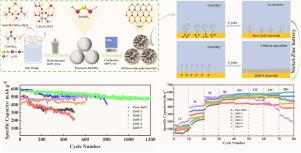
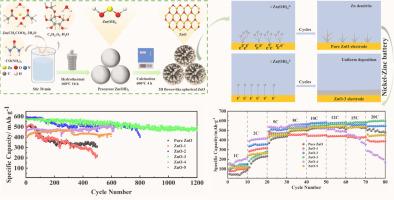
Nickel-zinc batteries are emerging as the potential alternative to lithium-ion and lead-acid batteries owing to the high open-circuit voltage, affordability, and eco-friendliness. Nevertheless, the problems of zinc dendrite growth, hydrogen evolution and dissolution passivation in the zinc electrode seriously hinder the commercial application of nickel-zinc batteries. To address these issues, three-dimensional flower-like spherical zinc oxide with exceptional electrochemical performance is successfully synthesized by using a facial solvothermal and calcination method. The three-dimensional flower-like structure provides more reactive sites for the negative active materials, reducing local current density and inhibiting zinc dendrite formation. As a result, three-dimensional flower-like spherical ZnO demonstrates superior electrochemical performance compared to pure ZnO and other spherical ZnO. Even after 1200 cycles, the discharge capacity still remains 500 mAh g-1 at 12C, representing 87% of the initial capacity (570 mAh g-1). Furthermore, the material maintains a relatively flat surface throughout the cycle, preventing the formation of dendrite.
期刊介绍:
Electrochimica Acta is an international journal. It is intended for the publication of both original work and reviews in the field of electrochemistry. Electrochemistry should be interpreted to mean any of the research fields covered by the Divisions of the International Society of Electrochemistry listed below, as well as emerging scientific domains covered by ISE New Topics Committee.




 京公网安备 11010802042870号
京ICP备2023020795号-1
京公网安备 11010802042870号
京ICP备2023020795号-1

 分享
分享
 求助内容:
求助内容: 应助结果提醒方式:
 扫码关注我们
