Luiz Ricardo G. Silva , Raquel G. Rocha , Diego P. Rocha , Edson Nossol , Bruno C. Janegitz , Eduardo M. Richter , Rodrigo A.A. Munoz , Jessica S. Stefano
{"title":"激光诱导钴氧化物包裹在3d打印的碳电极安培传感","authors":"Luiz Ricardo G. Silva , Raquel G. Rocha , Diego P. Rocha , Edson Nossol , Bruno C. Janegitz , Eduardo M. Richter , Rodrigo A.A. Munoz , Jessica S. Stefano","doi":"10.1016/j.electacta.2024.145635","DOIUrl":null,"url":null,"abstract":"<div><div>The 3D printing technology has the ability to manufacture electrochemical sensors in complex three-dimensional shapes with high efficiency and precision. In parallel, laser scribing technology has been employed to manufacture low-cost and disposable electrochemical sensors. Hence, the combination of both technologies can bring numerous possibilities in the field of electrochemical sensors. The present work addresses the possibility of modifying the surface of 3D printed electrodes through a highly sustainable, practical, and inexpensive route using laser irradiation. For this, a surface modification of a carbon black-based 3D printed electrode was performed using a cobalt chloride solution dropped onto the electrode surface, followed by blue laser irradiation. With this, it was possible to provide an improved electrochemical sensor modified in situ with cobalt oxides, as further attested by physicochemical and electrochemical characterizations. The modified sensor was employed for glucose (GLU) determination using a Batch Injection Analysis (BIA) system. From the modification, the cobalt oxides upon the electrode surface allowed the sensitive detection of GLU in a linear range from 50.0 to 400.0 µmol L<sup>−1</sup> and LOD of 6.3 µmol L<sup>−1</sup>. The GLU analysis in the biological samples yielded recovery values close to 100 %, demonstrating good applicability of the sensor. Thus, the combination of 3D printing and laser scribing technology enabled the production of modified sensors that are highly robust and capable of performing the selective detection of GLU in an easy and simple way.</div></div>","PeriodicalId":305,"journal":{"name":"Electrochimica Acta","volume":"514 ","pages":"Article 145635"},"PeriodicalIF":5.8000,"publicationDate":"2025-02-20","publicationTypes":"Journal Article","fieldsOfStudy":null,"isOpenAccess":false,"openAccessPdf":"","citationCount":"0","resultStr":"{\"title\":\"Laser-induced cobalt oxide entrapment within 3D-printed carbon electrodes for amperometric sensing\",\"authors\":\"Luiz Ricardo G. Silva , Raquel G. Rocha , Diego P. Rocha , Edson Nossol , Bruno C. Janegitz , Eduardo M. Richter , Rodrigo A.A. Munoz , Jessica S. Stefano\",\"doi\":\"10.1016/j.electacta.2024.145635\",\"DOIUrl\":null,\"url\":null,\"abstract\":\"<div><div>The 3D printing technology has the ability to manufacture electrochemical sensors in complex three-dimensional shapes with high efficiency and precision. In parallel, laser scribing technology has been employed to manufacture low-cost and disposable electrochemical sensors. Hence, the combination of both technologies can bring numerous possibilities in the field of electrochemical sensors. The present work addresses the possibility of modifying the surface of 3D printed electrodes through a highly sustainable, practical, and inexpensive route using laser irradiation. For this, a surface modification of a carbon black-based 3D printed electrode was performed using a cobalt chloride solution dropped onto the electrode surface, followed by blue laser irradiation. With this, it was possible to provide an improved electrochemical sensor modified in situ with cobalt oxides, as further attested by physicochemical and electrochemical characterizations. The modified sensor was employed for glucose (GLU) determination using a Batch Injection Analysis (BIA) system. From the modification, the cobalt oxides upon the electrode surface allowed the sensitive detection of GLU in a linear range from 50.0 to 400.0 µmol L<sup>−1</sup> and LOD of 6.3 µmol L<sup>−1</sup>. The GLU analysis in the biological samples yielded recovery values close to 100 %, demonstrating good applicability of the sensor. Thus, the combination of 3D printing and laser scribing technology enabled the production of modified sensors that are highly robust and capable of performing the selective detection of GLU in an easy and simple way.</div></div>\",\"PeriodicalId\":305,\"journal\":{\"name\":\"Electrochimica Acta\",\"volume\":\"514 \",\"pages\":\"Article 145635\"},\"PeriodicalIF\":5.8000,\"publicationDate\":\"2025-02-20\",\"publicationTypes\":\"Journal Article\",\"fieldsOfStudy\":null,\"isOpenAccess\":false,\"openAccessPdf\":\"\",\"citationCount\":\"0\",\"resultStr\":null,\"platform\":\"Semanticscholar\",\"paperid\":null,\"PeriodicalName\":\"Electrochimica Acta\",\"FirstCategoryId\":\"88\",\"ListUrlMain\":\"https://www.sciencedirect.com/science/article/pii/S001346862401870X\",\"RegionNum\":3,\"RegionCategory\":\"材料科学\",\"ArticlePicture\":[],\"TitleCN\":null,\"AbstractTextCN\":null,\"PMCID\":null,\"EPubDate\":\"2025/1/1 0:00:00\",\"PubModel\":\"Epub\",\"JCR\":\"Q1\",\"JCRName\":\"ELECTROCHEMISTRY\",\"Score\":null,\"Total\":0}","platform":"Semanticscholar","paperid":null,"PeriodicalName":"Electrochimica Acta","FirstCategoryId":"88","ListUrlMain":"https://www.sciencedirect.com/science/article/pii/S001346862401870X","RegionNum":3,"RegionCategory":"材料科学","ArticlePicture":[],"TitleCN":null,"AbstractTextCN":null,"PMCID":null,"EPubDate":"2025/1/1 0:00:00","PubModel":"Epub","JCR":"Q1","JCRName":"ELECTROCHEMISTRY","Score":null,"Total":0}
Laser-induced cobalt oxide entrapment within 3D-printed carbon electrodes for amperometric sensing
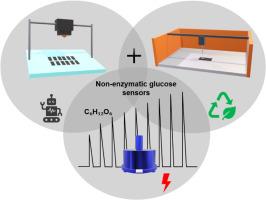
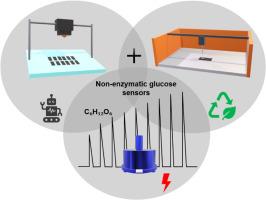
The 3D printing technology has the ability to manufacture electrochemical sensors in complex three-dimensional shapes with high efficiency and precision. In parallel, laser scribing technology has been employed to manufacture low-cost and disposable electrochemical sensors. Hence, the combination of both technologies can bring numerous possibilities in the field of electrochemical sensors. The present work addresses the possibility of modifying the surface of 3D printed electrodes through a highly sustainable, practical, and inexpensive route using laser irradiation. For this, a surface modification of a carbon black-based 3D printed electrode was performed using a cobalt chloride solution dropped onto the electrode surface, followed by blue laser irradiation. With this, it was possible to provide an improved electrochemical sensor modified in situ with cobalt oxides, as further attested by physicochemical and electrochemical characterizations. The modified sensor was employed for glucose (GLU) determination using a Batch Injection Analysis (BIA) system. From the modification, the cobalt oxides upon the electrode surface allowed the sensitive detection of GLU in a linear range from 50.0 to 400.0 µmol L−1 and LOD of 6.3 µmol L−1. The GLU analysis in the biological samples yielded recovery values close to 100 %, demonstrating good applicability of the sensor. Thus, the combination of 3D printing and laser scribing technology enabled the production of modified sensors that are highly robust and capable of performing the selective detection of GLU in an easy and simple way.
期刊介绍:
Electrochimica Acta is an international journal. It is intended for the publication of both original work and reviews in the field of electrochemistry. Electrochemistry should be interpreted to mean any of the research fields covered by the Divisions of the International Society of Electrochemistry listed below, as well as emerging scientific domains covered by ISE New Topics Committee.




 京公网安备 11010802042870号
京ICP备2023020795号-1
京公网安备 11010802042870号
京ICP备2023020795号-1

 分享
分享
 求助内容:
求助内容: 应助结果提醒方式:
 扫码关注我们
