{"title":"癌症免疫逃避、免疫编辑和肿瘤内异质性","authors":"Malte Roerden, Stefani Spranger","doi":"10.1038/s41577-024-01111-8","DOIUrl":null,"url":null,"abstract":"Cancers can avoid immune-mediated elimination by acquiring traits that disrupt antitumour immunity. These mechanisms of immune evasion are selected and reinforced during tumour evolution under immune pressure. Some immunogenic subclones are effectively eliminated by antitumour T cell responses (a process known as immunoediting), which results in a clonally selected tumour. Other cancer cells arise to resist immunoediting, which leads to a tumour that includes several distinct cancer cell populations (referred to as intratumour heterogeneity (ITH)). Tumours with high ITH are associated with poor patient outcomes and a lack of responsiveness to immune checkpoint blockade therapy. In this Review, we discuss the different ways that cancer cells evade the immune system and how these mechanisms impact immunoediting and tumour evolution. We also describe how subclonal antigen presentation in tumours with high ITH can result in immune evasion. Here the authors describe the different ways that cancer cells evade the immune system and how these mechanisms impact immunoediting and tumour clonality. They suggest that in tumours that become highly heterogeneous, presentation of subclonal antigens can result in immune evasion and may explain their poor prognosis and response to immunotherapy.","PeriodicalId":19049,"journal":{"name":"Nature Reviews Immunology","volume":"25 5","pages":"353-369"},"PeriodicalIF":47.1000,"publicationDate":"2025-01-02","publicationTypes":"Journal Article","fieldsOfStudy":null,"isOpenAccess":false,"openAccessPdf":"","citationCount":"0","resultStr":"{\"title\":\"Cancer immune evasion, immunoediting and intratumour heterogeneity\",\"authors\":\"Malte Roerden, Stefani Spranger\",\"doi\":\"10.1038/s41577-024-01111-8\",\"DOIUrl\":null,\"url\":null,\"abstract\":\"Cancers can avoid immune-mediated elimination by acquiring traits that disrupt antitumour immunity. These mechanisms of immune evasion are selected and reinforced during tumour evolution under immune pressure. Some immunogenic subclones are effectively eliminated by antitumour T cell responses (a process known as immunoediting), which results in a clonally selected tumour. Other cancer cells arise to resist immunoediting, which leads to a tumour that includes several distinct cancer cell populations (referred to as intratumour heterogeneity (ITH)). Tumours with high ITH are associated with poor patient outcomes and a lack of responsiveness to immune checkpoint blockade therapy. In this Review, we discuss the different ways that cancer cells evade the immune system and how these mechanisms impact immunoediting and tumour evolution. We also describe how subclonal antigen presentation in tumours with high ITH can result in immune evasion. Here the authors describe the different ways that cancer cells evade the immune system and how these mechanisms impact immunoediting and tumour clonality. They suggest that in tumours that become highly heterogeneous, presentation of subclonal antigens can result in immune evasion and may explain their poor prognosis and response to immunotherapy.\",\"PeriodicalId\":19049,\"journal\":{\"name\":\"Nature Reviews Immunology\",\"volume\":\"25 5\",\"pages\":\"353-369\"},\"PeriodicalIF\":47.1000,\"publicationDate\":\"2025-01-02\",\"publicationTypes\":\"Journal Article\",\"fieldsOfStudy\":null,\"isOpenAccess\":false,\"openAccessPdf\":\"\",\"citationCount\":\"0\",\"resultStr\":null,\"platform\":\"Semanticscholar\",\"paperid\":null,\"PeriodicalName\":\"Nature Reviews Immunology\",\"FirstCategoryId\":\"3\",\"ListUrlMain\":\"https://www.nature.com/articles/s41577-024-01111-8\",\"RegionNum\":1,\"RegionCategory\":\"医学\",\"ArticlePicture\":[],\"TitleCN\":null,\"AbstractTextCN\":null,\"PMCID\":null,\"EPubDate\":\"\",\"PubModel\":\"\",\"JCR\":\"Q1\",\"JCRName\":\"IMMUNOLOGY\",\"Score\":null,\"Total\":0}","platform":"Semanticscholar","paperid":null,"PeriodicalName":"Nature Reviews Immunology","FirstCategoryId":"3","ListUrlMain":"https://www.nature.com/articles/s41577-024-01111-8","RegionNum":1,"RegionCategory":"医学","ArticlePicture":[],"TitleCN":null,"AbstractTextCN":null,"PMCID":null,"EPubDate":"","PubModel":"","JCR":"Q1","JCRName":"IMMUNOLOGY","Score":null,"Total":0}
Cancer immune evasion, immunoediting and intratumour heterogeneity
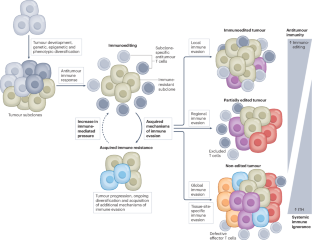
Cancers can avoid immune-mediated elimination by acquiring traits that disrupt antitumour immunity. These mechanisms of immune evasion are selected and reinforced during tumour evolution under immune pressure. Some immunogenic subclones are effectively eliminated by antitumour T cell responses (a process known as immunoediting), which results in a clonally selected tumour. Other cancer cells arise to resist immunoediting, which leads to a tumour that includes several distinct cancer cell populations (referred to as intratumour heterogeneity (ITH)). Tumours with high ITH are associated with poor patient outcomes and a lack of responsiveness to immune checkpoint blockade therapy. In this Review, we discuss the different ways that cancer cells evade the immune system and how these mechanisms impact immunoediting and tumour evolution. We also describe how subclonal antigen presentation in tumours with high ITH can result in immune evasion. Here the authors describe the different ways that cancer cells evade the immune system and how these mechanisms impact immunoediting and tumour clonality. They suggest that in tumours that become highly heterogeneous, presentation of subclonal antigens can result in immune evasion and may explain their poor prognosis and response to immunotherapy.
期刊介绍:
Nature Reviews Immunology is a journal that provides comprehensive coverage of all areas of immunology, including fundamental mechanisms and applied aspects. It has two international standard serial numbers (ISSN): 1474-1733 for print and 1474-1741 for online. In addition to review articles, the journal also features recent developments and new primary papers in the field, as well as reflections on influential people, papers, and events in the development of immunology. The subjects covered by Nature Reviews Immunology include allergy and asthma, autoimmunity, antigen processing and presentation, apoptosis and cell death, chemokines and chemokine receptors, cytokines and cytokine receptors, development and function of cells of the immune system, haematopoiesis, infection and immunity, immunotherapy, innate immunity, mucosal immunology and the microbiota, regulation of the immune response, signalling in the immune system, transplantation, tumour immunology and immunotherapy, and vaccine development.






 京公网安备 11010802042870号
京ICP备2023020795号-1
京公网安备 11010802042870号
京ICP备2023020795号-1

 分享
分享
 求助内容:
求助内容: 应助结果提醒方式:
 扫码关注我们
