M. Varun Karthik, Sruthy Subash, K. Kamala Bharathi
{"title":"超薄Li-Nb-O薄膜作为锂离子微电池负极的高速率性能研究","authors":"M. Varun Karthik, Sruthy Subash, K. Kamala Bharathi","doi":"10.1016/j.electacta.2024.145618","DOIUrl":null,"url":null,"abstract":"<div><div>Research and development in Li-ion micro-batteries are focusing on improving their performance, energy density, and cost-effectiveness. These batteries continue to be an area of interest for applications where traditional battery technologies may not be as suitable due to size and weight constraints. In the present work, we report on the electrochemical properties, Li-ion dynamics, various contributions to charge storage, and the ability to glow a light-emitting diode (LED) using Li<img>Nb<img>O thin film electrodes deposited via the RF magnetron sputtering technique. X-ray diffraction and Raman spectra analysis identified mixed phases of the thin film of tetragonal Nb<sub>2</sub>O<sub>5</sub> and monoclinic LiNb<sub>3</sub>O<sub>8</sub>, both phases displaying the Nb<sup>5+</sup> oxidation state, as verified by X-ray photoelectron spectroscopy. The cyclic voltammogram and dQ/dV plots demonstrated the two-electron transfers from each phase of the film and the kinetic property of the mixed phase is significantly contributed by both intercalation and pseudocapacitance behavior. The Li<img>Nb<img>O ultra-thin film of 19 nm delivers an initial discharge capacity of 9.9 µAh/cm<sup>2</sup> at a current density of 20 µA/cm<sup>2</sup> and attained capacity retention of 75.75 % after 300 cycles, indicating improved lithium storage. Additionally, impedance measurements are conducted to assess the reduction in charge transfer resistance before and after cycling, and to determine the Li-ion diffusion coefficient, which ranged from 10<sup>−17</sup> to 10<sup>−20</sup> cm²/s in the thin film. Thus, the Li<img>Nb<img>O thin films can be suitable as a negative electrode in all-solid thin film micro-batteries applications.</div></div>","PeriodicalId":305,"journal":{"name":"Electrochimica Acta","volume":"514 ","pages":"Article 145618"},"PeriodicalIF":5.6000,"publicationDate":"2025-02-20","publicationTypes":"Journal Article","fieldsOfStudy":null,"isOpenAccess":false,"openAccessPdf":"","citationCount":"0","resultStr":"{\"title\":\"High-rate performance of ultra-thin LiNbO thin films as an anode for Li-ion micro-battery applications\",\"authors\":\"M. Varun Karthik, Sruthy Subash, K. Kamala Bharathi\",\"doi\":\"10.1016/j.electacta.2024.145618\",\"DOIUrl\":null,\"url\":null,\"abstract\":\"<div><div>Research and development in Li-ion micro-batteries are focusing on improving their performance, energy density, and cost-effectiveness. These batteries continue to be an area of interest for applications where traditional battery technologies may not be as suitable due to size and weight constraints. In the present work, we report on the electrochemical properties, Li-ion dynamics, various contributions to charge storage, and the ability to glow a light-emitting diode (LED) using Li<img>Nb<img>O thin film electrodes deposited via the RF magnetron sputtering technique. X-ray diffraction and Raman spectra analysis identified mixed phases of the thin film of tetragonal Nb<sub>2</sub>O<sub>5</sub> and monoclinic LiNb<sub>3</sub>O<sub>8</sub>, both phases displaying the Nb<sup>5+</sup> oxidation state, as verified by X-ray photoelectron spectroscopy. The cyclic voltammogram and dQ/dV plots demonstrated the two-electron transfers from each phase of the film and the kinetic property of the mixed phase is significantly contributed by both intercalation and pseudocapacitance behavior. The Li<img>Nb<img>O ultra-thin film of 19 nm delivers an initial discharge capacity of 9.9 µAh/cm<sup>2</sup> at a current density of 20 µA/cm<sup>2</sup> and attained capacity retention of 75.75 % after 300 cycles, indicating improved lithium storage. Additionally, impedance measurements are conducted to assess the reduction in charge transfer resistance before and after cycling, and to determine the Li-ion diffusion coefficient, which ranged from 10<sup>−17</sup> to 10<sup>−20</sup> cm²/s in the thin film. Thus, the Li<img>Nb<img>O thin films can be suitable as a negative electrode in all-solid thin film micro-batteries applications.</div></div>\",\"PeriodicalId\":305,\"journal\":{\"name\":\"Electrochimica Acta\",\"volume\":\"514 \",\"pages\":\"Article 145618\"},\"PeriodicalIF\":5.6000,\"publicationDate\":\"2025-02-20\",\"publicationTypes\":\"Journal Article\",\"fieldsOfStudy\":null,\"isOpenAccess\":false,\"openAccessPdf\":\"\",\"citationCount\":\"0\",\"resultStr\":null,\"platform\":\"Semanticscholar\",\"paperid\":null,\"PeriodicalName\":\"Electrochimica Acta\",\"FirstCategoryId\":\"88\",\"ListUrlMain\":\"https://www.sciencedirect.com/science/article/pii/S001346862401853X\",\"RegionNum\":3,\"RegionCategory\":\"材料科学\",\"ArticlePicture\":[],\"TitleCN\":null,\"AbstractTextCN\":null,\"PMCID\":null,\"EPubDate\":\"2025/1/1 0:00:00\",\"PubModel\":\"Epub\",\"JCR\":\"Q1\",\"JCRName\":\"ELECTROCHEMISTRY\",\"Score\":null,\"Total\":0}","platform":"Semanticscholar","paperid":null,"PeriodicalName":"Electrochimica Acta","FirstCategoryId":"88","ListUrlMain":"https://www.sciencedirect.com/science/article/pii/S001346862401853X","RegionNum":3,"RegionCategory":"材料科学","ArticlePicture":[],"TitleCN":null,"AbstractTextCN":null,"PMCID":null,"EPubDate":"2025/1/1 0:00:00","PubModel":"Epub","JCR":"Q1","JCRName":"ELECTROCHEMISTRY","Score":null,"Total":0}
引用次数: 0
摘要
锂离子微型电池的研究和发展重点是提高其性能、能量密度和成本效益。由于尺寸和重量的限制,传统电池技术可能不适合这些应用,这些电池仍然是一个令人感兴趣的领域。在本工作中,我们报告了电化学性能,锂离子动力学,电荷存储的各种贡献,以及使用通过射频磁控溅射技术沉积的Li-Nb-O薄膜电极发光发光二极管(LED)的能力。x射线衍射和拉曼光谱分析发现了四方Nb₂O₅和单斜LiNb₃O₈薄膜的混合相,经x射线光电子能谱验证,这两相都显示出Nb 5⁺的氧化态。循环伏安图和dQ/dV图表明,膜的每一相都有两个电子转移,插层和赝电容行为对混合相的动力学性质有显著影响。在电流密度为20 μ a /cm²时,19nm的Li-Nb-O超薄膜的初始放电容量为9.9 μ Ah/cm²,在300次循环后容量保持率为75.75%,表明锂的存储性能得到了改善。此外,进行阻抗测量以评估循环前后电荷转移电阻的减少,并确定锂离子扩散系数,其范围从10⁻¹⁷到10⁻²⁰cm²/s。因此,Li-Nb-O薄膜可以作为全固态薄膜微电池的负极。
High-rate performance of ultra-thin LiNbO thin films as an anode for Li-ion micro-battery applications
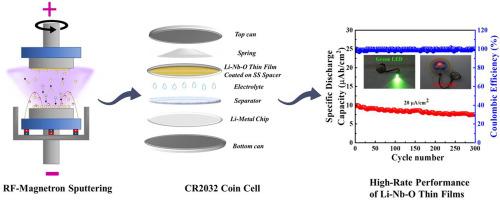
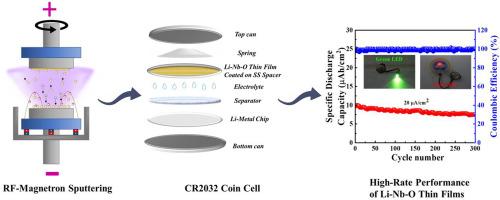
Research and development in Li-ion micro-batteries are focusing on improving their performance, energy density, and cost-effectiveness. These batteries continue to be an area of interest for applications where traditional battery technologies may not be as suitable due to size and weight constraints. In the present work, we report on the electrochemical properties, Li-ion dynamics, various contributions to charge storage, and the ability to glow a light-emitting diode (LED) using LiNbO thin film electrodes deposited via the RF magnetron sputtering technique. X-ray diffraction and Raman spectra analysis identified mixed phases of the thin film of tetragonal Nb2O5 and monoclinic LiNb3O8, both phases displaying the Nb5+ oxidation state, as verified by X-ray photoelectron spectroscopy. The cyclic voltammogram and dQ/dV plots demonstrated the two-electron transfers from each phase of the film and the kinetic property of the mixed phase is significantly contributed by both intercalation and pseudocapacitance behavior. The LiNbO ultra-thin film of 19 nm delivers an initial discharge capacity of 9.9 µAh/cm2 at a current density of 20 µA/cm2 and attained capacity retention of 75.75 % after 300 cycles, indicating improved lithium storage. Additionally, impedance measurements are conducted to assess the reduction in charge transfer resistance before and after cycling, and to determine the Li-ion diffusion coefficient, which ranged from 10−17 to 10−20 cm²/s in the thin film. Thus, the LiNbO thin films can be suitable as a negative electrode in all-solid thin film micro-batteries applications.
期刊介绍:
Electrochimica Acta is an international journal. It is intended for the publication of both original work and reviews in the field of electrochemistry. Electrochemistry should be interpreted to mean any of the research fields covered by the Divisions of the International Society of Electrochemistry listed below, as well as emerging scientific domains covered by ISE New Topics Committee.




 京公网安备 11010802042870号
京ICP备2023020795号-1
京公网安备 11010802042870号
京ICP备2023020795号-1

 分享
分享
 求助内容:
求助内容: 应助结果提醒方式:
 扫码关注我们
