Sant-Rayn Pasricha, Ernest Moya, Ricardo Ataíde, Glory Mzembe, Rebecca Harding, Martin N. Mwangi, Truwah Zinenani, Khic-Houy Prang, Justina Kaunda, Owen P. L. Mtambo, Maclean Vokhiwa, Gomezgani Mhango, Elisabeth Mamani-Mategula, Katherine Fielding, Ayşe Demir, Naomi Von Dinklage, Hans Verhoef, Alistair RD McLean, Lucinda Manda-Taylor, Sabine Braat, Kamija S. Phiri
{"title":"羧麦芽糖铁治疗妊娠晚期贫血:一项随机对照试验","authors":"Sant-Rayn Pasricha, Ernest Moya, Ricardo Ataíde, Glory Mzembe, Rebecca Harding, Martin N. Mwangi, Truwah Zinenani, Khic-Houy Prang, Justina Kaunda, Owen P. L. Mtambo, Maclean Vokhiwa, Gomezgani Mhango, Elisabeth Mamani-Mategula, Katherine Fielding, Ayşe Demir, Naomi Von Dinklage, Hans Verhoef, Alistair RD McLean, Lucinda Manda-Taylor, Sabine Braat, Kamija S. Phiri","doi":"10.1038/s41591-024-03385-w","DOIUrl":null,"url":null,"abstract":"Over 46% of African pregnant women are anemic. Oral iron is recommended but often suboptimal, particularly late in pregnancy. Intravenous ferric carboxymaltose (FCM) could treat anemia in women in the third trimester in sub-Saharan Africa. In an open-label, individually randomized trial in antenatal clinics in southern Malawi, we randomized 590 women at 27–35 weeks of gestation with capillary hemoglobin <10.0 g dl−1 to FCM (20 mg kg−1 up to 1,000 mg, once at enrollment) or standard of care (60 mg elemental iron, twice daily for 90 days). Participants and their infants were followed to 4 weeks postpartum. Primary outcomes were maternal anemia at 36 weeks’ gestation or delivery (whichever occurred first) and neonatal birthweight. At the primary timepoint, 126 of 270 (46.7%) of women in the FCM group were anemic, compared to 170 of 271 (67.3%) women in the standard-of-care group (PR, 0.74 (95% CI 0.64, 0.87); P = 0.0002). There was no difference between groups in birthweight (mean difference 10.9 g (−65.7, 87.5 g); P = 0.78). No serious infusion-related reactions occurred, and there were no differences in adverse events between groups. In Malawian women in late pregnancy, FCM effectively and safely reduced anemia before childbirth. Australia New Zealand Clinical Trial registration: ANZCTR12621001239853 A randomized controlled trial in the third trimester of pregnancy in Malawian women with anemia found a single dose of intravenous ferric carboxymaltose to be more effective than standard of care (that is, twice-daily oral iron) in reducing anemia rates before childbirth.","PeriodicalId":19037,"journal":{"name":"Nature Medicine","volume":"31 1","pages":"197-206"},"PeriodicalIF":50.0000,"publicationDate":"2025-01-06","publicationTypes":"Journal Article","fieldsOfStudy":null,"isOpenAccess":false,"openAccessPdf":"https://www.nature.com/articles/s41591-024-03385-w.pdf","citationCount":"0","resultStr":"{\"title\":\"Ferric carboxymaltose for anemia in late pregnancy: a randomized controlled trial\",\"authors\":\"Sant-Rayn Pasricha, Ernest Moya, Ricardo Ataíde, Glory Mzembe, Rebecca Harding, Martin N. Mwangi, Truwah Zinenani, Khic-Houy Prang, Justina Kaunda, Owen P. L. Mtambo, Maclean Vokhiwa, Gomezgani Mhango, Elisabeth Mamani-Mategula, Katherine Fielding, Ayşe Demir, Naomi Von Dinklage, Hans Verhoef, Alistair RD McLean, Lucinda Manda-Taylor, Sabine Braat, Kamija S. Phiri\",\"doi\":\"10.1038/s41591-024-03385-w\",\"DOIUrl\":null,\"url\":null,\"abstract\":\"Over 46% of African pregnant women are anemic. Oral iron is recommended but often suboptimal, particularly late in pregnancy. Intravenous ferric carboxymaltose (FCM) could treat anemia in women in the third trimester in sub-Saharan Africa. In an open-label, individually randomized trial in antenatal clinics in southern Malawi, we randomized 590 women at 27–35 weeks of gestation with capillary hemoglobin <10.0 g dl−1 to FCM (20 mg kg−1 up to 1,000 mg, once at enrollment) or standard of care (60 mg elemental iron, twice daily for 90 days). Participants and their infants were followed to 4 weeks postpartum. Primary outcomes were maternal anemia at 36 weeks’ gestation or delivery (whichever occurred first) and neonatal birthweight. At the primary timepoint, 126 of 270 (46.7%) of women in the FCM group were anemic, compared to 170 of 271 (67.3%) women in the standard-of-care group (PR, 0.74 (95% CI 0.64, 0.87); P = 0.0002). There was no difference between groups in birthweight (mean difference 10.9 g (−65.7, 87.5 g); P = 0.78). No serious infusion-related reactions occurred, and there were no differences in adverse events between groups. In Malawian women in late pregnancy, FCM effectively and safely reduced anemia before childbirth. Australia New Zealand Clinical Trial registration: ANZCTR12621001239853 A randomized controlled trial in the third trimester of pregnancy in Malawian women with anemia found a single dose of intravenous ferric carboxymaltose to be more effective than standard of care (that is, twice-daily oral iron) in reducing anemia rates before childbirth.\",\"PeriodicalId\":19037,\"journal\":{\"name\":\"Nature Medicine\",\"volume\":\"31 1\",\"pages\":\"197-206\"},\"PeriodicalIF\":50.0000,\"publicationDate\":\"2025-01-06\",\"publicationTypes\":\"Journal Article\",\"fieldsOfStudy\":null,\"isOpenAccess\":false,\"openAccessPdf\":\"https://www.nature.com/articles/s41591-024-03385-w.pdf\",\"citationCount\":\"0\",\"resultStr\":null,\"platform\":\"Semanticscholar\",\"paperid\":null,\"PeriodicalName\":\"Nature Medicine\",\"FirstCategoryId\":\"3\",\"ListUrlMain\":\"https://www.nature.com/articles/s41591-024-03385-w\",\"RegionNum\":1,\"RegionCategory\":\"医学\",\"ArticlePicture\":[],\"TitleCN\":null,\"AbstractTextCN\":null,\"PMCID\":null,\"EPubDate\":\"\",\"PubModel\":\"\",\"JCR\":\"Q1\",\"JCRName\":\"BIOCHEMISTRY & MOLECULAR BIOLOGY\",\"Score\":null,\"Total\":0}","platform":"Semanticscholar","paperid":null,"PeriodicalName":"Nature Medicine","FirstCategoryId":"3","ListUrlMain":"https://www.nature.com/articles/s41591-024-03385-w","RegionNum":1,"RegionCategory":"医学","ArticlePicture":[],"TitleCN":null,"AbstractTextCN":null,"PMCID":null,"EPubDate":"","PubModel":"","JCR":"Q1","JCRName":"BIOCHEMISTRY & MOLECULAR BIOLOGY","Score":null,"Total":0}
引用次数: 0
摘要
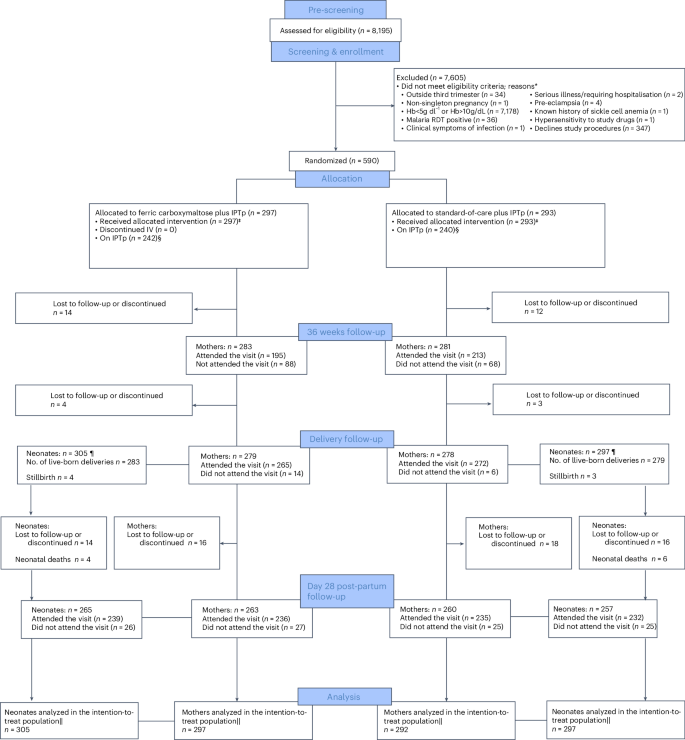
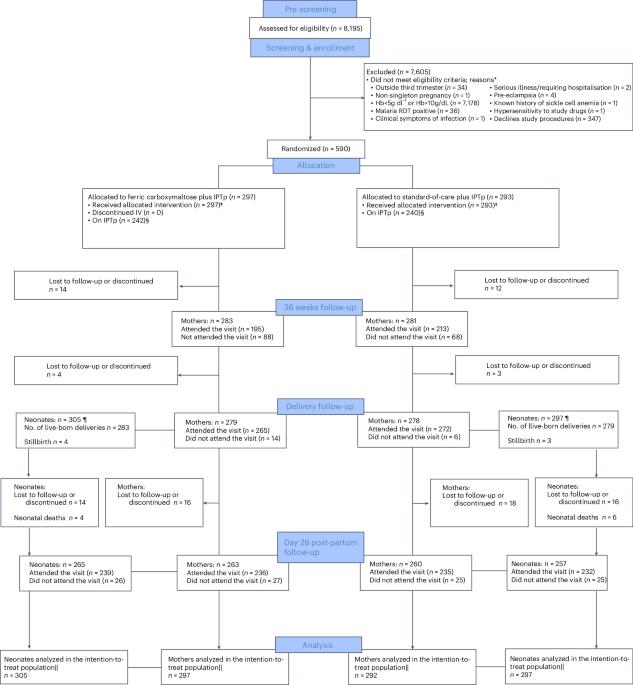
超过46%的非洲孕妇患有贫血。建议口服铁,但往往不是最理想的,特别是在怀孕后期。静脉注射羧基麦芽糖铁(FCM)可以治疗撒哈拉以南非洲妊娠晚期妇女的贫血。在马拉维南部产前诊所进行的一项开放标签、个体随机试验中,我们将590名妊娠27-35周、毛细血管血红蛋白10.0 g dl - 1的妇女随机分为FCM组(20 mg kg - 1至1000 mg,入组时一次)或标准护理组(60 mg元素铁,每天两次,持续90天)。随访参与者及其婴儿至产后4周。主要结局是妊娠36周或分娩时(以先发生者为准)母体贫血和新生儿出生体重。在最初的时间点,FCM组270名女性中有126名(46.7%)贫血,而标准治疗组271名女性中有170名(67.3%)贫血(PR, 0.74 (95% CI 0.64, 0.87);p = 0.0002)。各组间出生体重无差异(平均差10.9 g (- 65.7 g, 87.5 g);p = 0.78)。未发生严重的输液相关反应,组间不良事件发生率无差异。在怀孕后期的马拉维妇女中,FCM有效和安全地减少了分娩前的贫血。澳大利亚新西兰临床试验注册:ANZCTR12621001239853
Ferric carboxymaltose for anemia in late pregnancy: a randomized controlled trial
Over 46% of African pregnant women are anemic. Oral iron is recommended but often suboptimal, particularly late in pregnancy. Intravenous ferric carboxymaltose (FCM) could treat anemia in women in the third trimester in sub-Saharan Africa. In an open-label, individually randomized trial in antenatal clinics in southern Malawi, we randomized 590 women at 27–35 weeks of gestation with capillary hemoglobin <10.0 g dl−1 to FCM (20 mg kg−1 up to 1,000 mg, once at enrollment) or standard of care (60 mg elemental iron, twice daily for 90 days). Participants and their infants were followed to 4 weeks postpartum. Primary outcomes were maternal anemia at 36 weeks’ gestation or delivery (whichever occurred first) and neonatal birthweight. At the primary timepoint, 126 of 270 (46.7%) of women in the FCM group were anemic, compared to 170 of 271 (67.3%) women in the standard-of-care group (PR, 0.74 (95% CI 0.64, 0.87); P = 0.0002). There was no difference between groups in birthweight (mean difference 10.9 g (−65.7, 87.5 g); P = 0.78). No serious infusion-related reactions occurred, and there were no differences in adverse events between groups. In Malawian women in late pregnancy, FCM effectively and safely reduced anemia before childbirth. Australia New Zealand Clinical Trial registration: ANZCTR12621001239853 A randomized controlled trial in the third trimester of pregnancy in Malawian women with anemia found a single dose of intravenous ferric carboxymaltose to be more effective than standard of care (that is, twice-daily oral iron) in reducing anemia rates before childbirth.
期刊介绍:
Nature Medicine is a monthly journal publishing original peer-reviewed research in all areas of medicine. The publication focuses on originality, timeliness, interdisciplinary interest, and the impact on improving human health. In addition to research articles, Nature Medicine also publishes commissioned content such as News, Reviews, and Perspectives. This content aims to provide context for the latest advances in translational and clinical research, reaching a wide audience of M.D. and Ph.D. readers. All editorial decisions for the journal are made by a team of full-time professional editors.
Nature Medicine consider all types of clinical research, including:
-Case-reports and small case series
-Clinical trials, whether phase 1, 2, 3 or 4
-Observational studies
-Meta-analyses
-Biomarker studies
-Public and global health studies
Nature Medicine is also committed to facilitating communication between translational and clinical researchers. As such, we consider “hybrid” studies with preclinical and translational findings reported alongside data from clinical studies.




 京公网安备 11010802042870号
京ICP备2023020795号-1
京公网安备 11010802042870号
京ICP备2023020795号-1

 分享
分享
 求助内容:
求助内容: 应助结果提醒方式:
 扫码关注我们
