Bruno Ferreira , Robert D. Crapnell , Elena Bernalte , Thiago R.L.C. Paixão , Craig E. Banks
{"title":"用于在有机溶剂中使用添加剂制造电极的低成本导电聚丙烯","authors":"Bruno Ferreira , Robert D. Crapnell , Elena Bernalte , Thiago R.L.C. Paixão , Craig E. Banks","doi":"10.1016/j.electacta.2025.145680","DOIUrl":null,"url":null,"abstract":"<div><div>Additive manufacturing electrochemistry allows for the production of bespoke sensing devices, that can be produced rapidly on-site. Through the production of specialised filament, researchers have been able to begin to compete with the electroanalytical performance of classical electrodes, however, only aqueous systems have ever been viable for exploration. In this work, we report the first production of a low material cost poly(propylene) (PP) based conductive filament and its application toward electroanalysis within an organic medium, acetonitrile. By leveraging the chemical stability of PP, alongside the conductive properties of carbon black (CB) and the low-cost nature of graphite (G), high-performance electrodes could be printed at a material cost of less than £0.01 each. The filament containing 20 wt% CB, 20 wt% G and 60 wt% PP was electrochemically characterised, producing a <em>k<sup>0</sup></em> of 2.08 (± 0.22) x 10<sup>–3</sup> cm s<sup>-1</sup>. The additive manufactured electrodes were then applied to detect chlorpromazine in acetonitrile, producing a sensitivity of 51.8 nA μM<sup>-1</sup>, limit of detection of 80 μM and limit of quantification of 266 μM. This work shows how, through the production of bespoke filaments, additive manufacturing electrochemistry can explore new areas of electrochemical research that are currently untapped.</div></div>","PeriodicalId":305,"journal":{"name":"Electrochimica Acta","volume":"515 ","pages":"Article 145680"},"PeriodicalIF":5.6000,"publicationDate":"2025-03-01","publicationTypes":"Journal Article","fieldsOfStudy":null,"isOpenAccess":false,"openAccessPdf":"","citationCount":"0","resultStr":"{\"title\":\"Low-cost conductive polypropylene for electroanalysis in organic solvents using additively manufactured electrodes\",\"authors\":\"Bruno Ferreira , Robert D. Crapnell , Elena Bernalte , Thiago R.L.C. Paixão , Craig E. Banks\",\"doi\":\"10.1016/j.electacta.2025.145680\",\"DOIUrl\":null,\"url\":null,\"abstract\":\"<div><div>Additive manufacturing electrochemistry allows for the production of bespoke sensing devices, that can be produced rapidly on-site. Through the production of specialised filament, researchers have been able to begin to compete with the electroanalytical performance of classical electrodes, however, only aqueous systems have ever been viable for exploration. In this work, we report the first production of a low material cost poly(propylene) (PP) based conductive filament and its application toward electroanalysis within an organic medium, acetonitrile. By leveraging the chemical stability of PP, alongside the conductive properties of carbon black (CB) and the low-cost nature of graphite (G), high-performance electrodes could be printed at a material cost of less than £0.01 each. The filament containing 20 wt% CB, 20 wt% G and 60 wt% PP was electrochemically characterised, producing a <em>k<sup>0</sup></em> of 2.08 (± 0.22) x 10<sup>–3</sup> cm s<sup>-1</sup>. The additive manufactured electrodes were then applied to detect chlorpromazine in acetonitrile, producing a sensitivity of 51.8 nA μM<sup>-1</sup>, limit of detection of 80 μM and limit of quantification of 266 μM. This work shows how, through the production of bespoke filaments, additive manufacturing electrochemistry can explore new areas of electrochemical research that are currently untapped.</div></div>\",\"PeriodicalId\":305,\"journal\":{\"name\":\"Electrochimica Acta\",\"volume\":\"515 \",\"pages\":\"Article 145680\"},\"PeriodicalIF\":5.6000,\"publicationDate\":\"2025-03-01\",\"publicationTypes\":\"Journal Article\",\"fieldsOfStudy\":null,\"isOpenAccess\":false,\"openAccessPdf\":\"\",\"citationCount\":\"0\",\"resultStr\":null,\"platform\":\"Semanticscholar\",\"paperid\":null,\"PeriodicalName\":\"Electrochimica Acta\",\"FirstCategoryId\":\"88\",\"ListUrlMain\":\"https://www.sciencedirect.com/science/article/pii/S001346862500043X\",\"RegionNum\":3,\"RegionCategory\":\"材料科学\",\"ArticlePicture\":[],\"TitleCN\":null,\"AbstractTextCN\":null,\"PMCID\":null,\"EPubDate\":\"2025/1/9 0:00:00\",\"PubModel\":\"Epub\",\"JCR\":\"Q1\",\"JCRName\":\"ELECTROCHEMISTRY\",\"Score\":null,\"Total\":0}","platform":"Semanticscholar","paperid":null,"PeriodicalName":"Electrochimica Acta","FirstCategoryId":"88","ListUrlMain":"https://www.sciencedirect.com/science/article/pii/S001346862500043X","RegionNum":3,"RegionCategory":"材料科学","ArticlePicture":[],"TitleCN":null,"AbstractTextCN":null,"PMCID":null,"EPubDate":"2025/1/9 0:00:00","PubModel":"Epub","JCR":"Q1","JCRName":"ELECTROCHEMISTRY","Score":null,"Total":0}
引用次数: 0
摘要
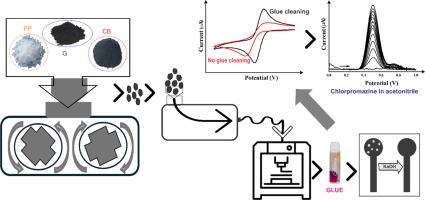
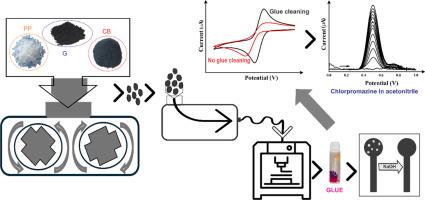
增材制造电化学允许生产定制的传感设备,可以在现场快速生产。通过生产专门的灯丝,研究人员已经能够开始与传统电极的电分析性能竞争,然而,只有水系统才有可能进行探索。在这项工作中,我们报告了低材料成本的聚丙烯(PP)基导电丝的首次生产及其在有机介质乙腈中的电化学应用。通过利用PP的化学稳定性、炭黑(CB)的导电性能和石墨(G)的低成本特性,高性能电极可以以低于0.01英镑的材料成本打印出来。含有20 wt% CB, 20 wt% G和60 wt% PP的长丝进行了电化学表征,产生的k0为2.08(±0.22)x 10-3 cm s-1。将所制备的电极用于乙腈中氯丙嗪的检测,灵敏度为51.8 nA μM-1,检测限为80 μM,定量限为266 μM。这项工作表明,通过生产定制细丝,增材制造电化学可以探索目前尚未开发的电化学研究新领域。
Low-cost conductive polypropylene for electroanalysis in organic solvents using additively manufactured electrodes
Additive manufacturing electrochemistry allows for the production of bespoke sensing devices, that can be produced rapidly on-site. Through the production of specialised filament, researchers have been able to begin to compete with the electroanalytical performance of classical electrodes, however, only aqueous systems have ever been viable for exploration. In this work, we report the first production of a low material cost poly(propylene) (PP) based conductive filament and its application toward electroanalysis within an organic medium, acetonitrile. By leveraging the chemical stability of PP, alongside the conductive properties of carbon black (CB) and the low-cost nature of graphite (G), high-performance electrodes could be printed at a material cost of less than £0.01 each. The filament containing 20 wt% CB, 20 wt% G and 60 wt% PP was electrochemically characterised, producing a k0 of 2.08 (± 0.22) x 10–3 cm s-1. The additive manufactured electrodes were then applied to detect chlorpromazine in acetonitrile, producing a sensitivity of 51.8 nA μM-1, limit of detection of 80 μM and limit of quantification of 266 μM. This work shows how, through the production of bespoke filaments, additive manufacturing electrochemistry can explore new areas of electrochemical research that are currently untapped.
期刊介绍:
Electrochimica Acta is an international journal. It is intended for the publication of both original work and reviews in the field of electrochemistry. Electrochemistry should be interpreted to mean any of the research fields covered by the Divisions of the International Society of Electrochemistry listed below, as well as emerging scientific domains covered by ISE New Topics Committee.




 京公网安备 11010802042870号
京ICP备2023020795号-1
京公网安备 11010802042870号
京ICP备2023020795号-1

 分享
分享
 求助内容:
求助内容: 应助结果提醒方式:
 扫码关注我们
