{"title":"大规模超亲水性tio2 -石墨碳氮包覆Ni(OH)2和Ni2P纳米结构阵列作为高效电催化剂促进制氢","authors":"Zahed Shami, Seyed Arad Derakhshan, Rezgar Ahmadi","doi":"10.1021/acs.langmuir.4c03236","DOIUrl":null,"url":null,"abstract":"Water splitting by an electrochemical method to generate hydrogen gas is an economic and green approach to resolve the looming energy and environmental crisis. Designing a composite electrocatalyst having integrated multichannel charge separation, robust stability, and low-cost facile scalability could be considered to address the issue of electrochemical hydrogen evolution. Herein, we report a superhydrophilic, noble-metal-free bimetallic nanostructure TiO<sub>2</sub>/Ni<sub>2</sub>P coated on graphitic polyacrylonitrile carbon fibers (g-C/TiO<sub>2</sub>/Ni<sub>2</sub>P) using a facile hydrothermal method followed by phosphorylation. In an aqueous-based route, PAN is dissolved in water in the presence of ZnCl<sub>2</sub>, followed by wet-spinning to prepare scalable PAN/ZnCl<sub>2</sub> fibers. The nitrogen-contained porous graphitic carbon fibers are prepared via the pyrolysis of PAN/ZnCl<sub>2</sub> fibers; now ZnCl<sub>2</sub> acts as a volatile porogen to form porous matrix structures. Finally, the as-prepared graphitic carbon fibers are electrochemically activated by incorporating TiO<sub>2</sub>/Ni<sub>2</sub>P active sites. The materials formed in this work show excellent electrocatalytic activity for the hydrogen evolution reaction. The as-synthesized g-C/TiO<sub>2</sub>/Ni<sub>2</sub>P catalyst shows a low overpotential, its electrocatalytic activity is improved, and its efficiency is better than that of the commercial Pt/C catalyst. At a current density of −10 mA/cm<sup>2</sup>, the g-C/TiO<sub>2</sub>/Ni<sub>2</sub>P catalyst shows an overpotential of 55 mV, while the commercial Pt/C catalyst shows an overpotential of 77 mV. Our work provides a facile aqueous scalable route with no need for noble metals that can be considered as a potential alternative for the commercial Pt/C catalyst.","PeriodicalId":50,"journal":{"name":"Langmuir","volume":"3 1","pages":""},"PeriodicalIF":3.9000,"publicationDate":"2025-01-09","publicationTypes":"Journal Article","fieldsOfStudy":null,"isOpenAccess":false,"openAccessPdf":"","citationCount":"0","resultStr":"{\"title\":\"Facile Aqueous Route to Large-Scale Superhydrophilic TiO2-Incorporated Graphitic Carbon Nitride-Coated Ni(OH)2 and Ni2P Nano-Architecture Arrays as Efficient Electrocatalysts for Enhanced Hydrogen Production\",\"authors\":\"Zahed Shami, Seyed Arad Derakhshan, Rezgar Ahmadi\",\"doi\":\"10.1021/acs.langmuir.4c03236\",\"DOIUrl\":null,\"url\":null,\"abstract\":\"Water splitting by an electrochemical method to generate hydrogen gas is an economic and green approach to resolve the looming energy and environmental crisis. Designing a composite electrocatalyst having integrated multichannel charge separation, robust stability, and low-cost facile scalability could be considered to address the issue of electrochemical hydrogen evolution. Herein, we report a superhydrophilic, noble-metal-free bimetallic nanostructure TiO<sub>2</sub>/Ni<sub>2</sub>P coated on graphitic polyacrylonitrile carbon fibers (g-C/TiO<sub>2</sub>/Ni<sub>2</sub>P) using a facile hydrothermal method followed by phosphorylation. In an aqueous-based route, PAN is dissolved in water in the presence of ZnCl<sub>2</sub>, followed by wet-spinning to prepare scalable PAN/ZnCl<sub>2</sub> fibers. The nitrogen-contained porous graphitic carbon fibers are prepared via the pyrolysis of PAN/ZnCl<sub>2</sub> fibers; now ZnCl<sub>2</sub> acts as a volatile porogen to form porous matrix structures. Finally, the as-prepared graphitic carbon fibers are electrochemically activated by incorporating TiO<sub>2</sub>/Ni<sub>2</sub>P active sites. The materials formed in this work show excellent electrocatalytic activity for the hydrogen evolution reaction. The as-synthesized g-C/TiO<sub>2</sub>/Ni<sub>2</sub>P catalyst shows a low overpotential, its electrocatalytic activity is improved, and its efficiency is better than that of the commercial Pt/C catalyst. At a current density of −10 mA/cm<sup>2</sup>, the g-C/TiO<sub>2</sub>/Ni<sub>2</sub>P catalyst shows an overpotential of 55 mV, while the commercial Pt/C catalyst shows an overpotential of 77 mV. Our work provides a facile aqueous scalable route with no need for noble metals that can be considered as a potential alternative for the commercial Pt/C catalyst.\",\"PeriodicalId\":50,\"journal\":{\"name\":\"Langmuir\",\"volume\":\"3 1\",\"pages\":\"\"},\"PeriodicalIF\":3.9000,\"publicationDate\":\"2025-01-09\",\"publicationTypes\":\"Journal Article\",\"fieldsOfStudy\":null,\"isOpenAccess\":false,\"openAccessPdf\":\"\",\"citationCount\":\"0\",\"resultStr\":null,\"platform\":\"Semanticscholar\",\"paperid\":null,\"PeriodicalName\":\"Langmuir\",\"FirstCategoryId\":\"92\",\"ListUrlMain\":\"https://doi.org/10.1021/acs.langmuir.4c03236\",\"RegionNum\":2,\"RegionCategory\":\"化学\",\"ArticlePicture\":[],\"TitleCN\":null,\"AbstractTextCN\":null,\"PMCID\":null,\"EPubDate\":\"\",\"PubModel\":\"\",\"JCR\":\"Q2\",\"JCRName\":\"CHEMISTRY, MULTIDISCIPLINARY\",\"Score\":null,\"Total\":0}","platform":"Semanticscholar","paperid":null,"PeriodicalName":"Langmuir","FirstCategoryId":"92","ListUrlMain":"https://doi.org/10.1021/acs.langmuir.4c03236","RegionNum":2,"RegionCategory":"化学","ArticlePicture":[],"TitleCN":null,"AbstractTextCN":null,"PMCID":null,"EPubDate":"","PubModel":"","JCR":"Q2","JCRName":"CHEMISTRY, MULTIDISCIPLINARY","Score":null,"Total":0}
Facile Aqueous Route to Large-Scale Superhydrophilic TiO2-Incorporated Graphitic Carbon Nitride-Coated Ni(OH)2 and Ni2P Nano-Architecture Arrays as Efficient Electrocatalysts for Enhanced Hydrogen Production
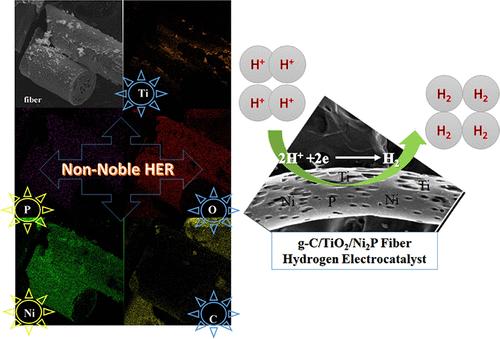
Water splitting by an electrochemical method to generate hydrogen gas is an economic and green approach to resolve the looming energy and environmental crisis. Designing a composite electrocatalyst having integrated multichannel charge separation, robust stability, and low-cost facile scalability could be considered to address the issue of electrochemical hydrogen evolution. Herein, we report a superhydrophilic, noble-metal-free bimetallic nanostructure TiO2/Ni2P coated on graphitic polyacrylonitrile carbon fibers (g-C/TiO2/Ni2P) using a facile hydrothermal method followed by phosphorylation. In an aqueous-based route, PAN is dissolved in water in the presence of ZnCl2, followed by wet-spinning to prepare scalable PAN/ZnCl2 fibers. The nitrogen-contained porous graphitic carbon fibers are prepared via the pyrolysis of PAN/ZnCl2 fibers; now ZnCl2 acts as a volatile porogen to form porous matrix structures. Finally, the as-prepared graphitic carbon fibers are electrochemically activated by incorporating TiO2/Ni2P active sites. The materials formed in this work show excellent electrocatalytic activity for the hydrogen evolution reaction. The as-synthesized g-C/TiO2/Ni2P catalyst shows a low overpotential, its electrocatalytic activity is improved, and its efficiency is better than that of the commercial Pt/C catalyst. At a current density of −10 mA/cm2, the g-C/TiO2/Ni2P catalyst shows an overpotential of 55 mV, while the commercial Pt/C catalyst shows an overpotential of 77 mV. Our work provides a facile aqueous scalable route with no need for noble metals that can be considered as a potential alternative for the commercial Pt/C catalyst.
期刊介绍:
Langmuir is an interdisciplinary journal publishing articles in the following subject categories:
Colloids: surfactants and self-assembly, dispersions, emulsions, foams
Interfaces: adsorption, reactions, films, forces
Biological Interfaces: biocolloids, biomolecular and biomimetic materials
Materials: nano- and mesostructured materials, polymers, gels, liquid crystals
Electrochemistry: interfacial charge transfer, charge transport, electrocatalysis, electrokinetic phenomena, bioelectrochemistry
Devices and Applications: sensors, fluidics, patterning, catalysis, photonic crystals
However, when high-impact, original work is submitted that does not fit within the above categories, decisions to accept or decline such papers will be based on one criteria: What Would Irving Do?
Langmuir ranks #2 in citations out of 136 journals in the category of Physical Chemistry with 113,157 total citations. The journal received an Impact Factor of 4.384*.
This journal is also indexed in the categories of Materials Science (ranked #1) and Multidisciplinary Chemistry (ranked #5).




 京公网安备 11010802042870号
京ICP备2023020795号-1
京公网安备 11010802042870号
京ICP备2023020795号-1

 分享
分享
 求助内容:
求助内容: 应助结果提醒方式:
 扫码关注我们
