T Brock Wooldridge, Sarah M Ford, Holland C Conwell, John Hyde, Kelley Harris, Beth Shapiro
{"title":"一种极度濒危软体动物突变率的直接测量及其进化后果。","authors":"T Brock Wooldridge, Sarah M Ford, Holland C Conwell, John Hyde, Kelley Harris, Beth Shapiro","doi":"10.1093/molbev/msae266","DOIUrl":null,"url":null,"abstract":"<p><p>The rate at which mutations arise is a fundamental parameter of biology. Despite progress in measuring germline mutation rates across diverse taxa, such estimates are missing for much of Earth's biodiversity. Here, we present the first estimate of a germline mutation rate from the phylum Mollusca. We sequenced three pedigreed families of the white abalone Haliotis sorenseni, a long-lived, large-bodied, and critically endangered mollusk, and estimated a de novo mutation rate of 8.60 × 10⁻⁹ single nucleotide mutations per site per generation. This mutation rate is similar to rates measured in vertebrates with comparable generation times and longevity to abalone, and higher than mutation rates measured in faster-reproducing invertebrates. The spectrum of de novo mutations is also similar to that seen in vertebrate species, although an excess of rare C > A polymorphisms in wild individuals suggests that a modifier allele or environmental exposure may have once increased C > A mutation rates. We use our rate to infer baseline effective population sizes (Ne) across multiple Pacific abalone and find that abalone persisted over most of their evolutionary history as large and stable populations, in contrast to extreme fluctuations over recent history and small census sizes in the present day. We then use our mutation rate to infer the timing and pattern of evolution of the abalone genus Haliotis, which was previously unknown due to few fossil calibrations. Our findings are an important step toward understanding mutation rate evolution and they establish a key parameter for conservation and evolutionary genomics research in mollusks.</p>","PeriodicalId":18730,"journal":{"name":"Molecular biology and evolution","volume":"42 1","pages":""},"PeriodicalIF":6.4000,"publicationDate":"2025-01-06","publicationTypes":"Journal Article","fieldsOfStudy":null,"isOpenAccess":false,"openAccessPdf":"https://www.ncbi.nlm.nih.gov/pmc/articles/PMC11704959/pdf/","citationCount":"0","resultStr":"{\"title\":\"Direct Measurement of the Mutation Rate and Its Evolutionary Consequences in a Critically Endangered Mollusk.\",\"authors\":\"T Brock Wooldridge, Sarah M Ford, Holland C Conwell, John Hyde, Kelley Harris, Beth Shapiro\",\"doi\":\"10.1093/molbev/msae266\",\"DOIUrl\":null,\"url\":null,\"abstract\":\"<p><p>The rate at which mutations arise is a fundamental parameter of biology. Despite progress in measuring germline mutation rates across diverse taxa, such estimates are missing for much of Earth's biodiversity. Here, we present the first estimate of a germline mutation rate from the phylum Mollusca. We sequenced three pedigreed families of the white abalone Haliotis sorenseni, a long-lived, large-bodied, and critically endangered mollusk, and estimated a de novo mutation rate of 8.60 × 10⁻⁹ single nucleotide mutations per site per generation. This mutation rate is similar to rates measured in vertebrates with comparable generation times and longevity to abalone, and higher than mutation rates measured in faster-reproducing invertebrates. The spectrum of de novo mutations is also similar to that seen in vertebrate species, although an excess of rare C > A polymorphisms in wild individuals suggests that a modifier allele or environmental exposure may have once increased C > A mutation rates. We use our rate to infer baseline effective population sizes (Ne) across multiple Pacific abalone and find that abalone persisted over most of their evolutionary history as large and stable populations, in contrast to extreme fluctuations over recent history and small census sizes in the present day. We then use our mutation rate to infer the timing and pattern of evolution of the abalone genus Haliotis, which was previously unknown due to few fossil calibrations. Our findings are an important step toward understanding mutation rate evolution and they establish a key parameter for conservation and evolutionary genomics research in mollusks.</p>\",\"PeriodicalId\":18730,\"journal\":{\"name\":\"Molecular biology and evolution\",\"volume\":\"42 1\",\"pages\":\"\"},\"PeriodicalIF\":6.4000,\"publicationDate\":\"2025-01-06\",\"publicationTypes\":\"Journal Article\",\"fieldsOfStudy\":null,\"isOpenAccess\":false,\"openAccessPdf\":\"https://www.ncbi.nlm.nih.gov/pmc/articles/PMC11704959/pdf/\",\"citationCount\":\"0\",\"resultStr\":null,\"platform\":\"Semanticscholar\",\"paperid\":null,\"PeriodicalName\":\"Molecular biology and evolution\",\"FirstCategoryId\":\"99\",\"ListUrlMain\":\"https://doi.org/10.1093/molbev/msae266\",\"RegionNum\":1,\"RegionCategory\":\"生物学\",\"ArticlePicture\":[],\"TitleCN\":null,\"AbstractTextCN\":null,\"PMCID\":null,\"EPubDate\":\"\",\"PubModel\":\"\",\"JCR\":\"Q1\",\"JCRName\":\"BIOCHEMISTRY & MOLECULAR BIOLOGY\",\"Score\":null,\"Total\":0}","platform":"Semanticscholar","paperid":null,"PeriodicalName":"Molecular biology and evolution","FirstCategoryId":"99","ListUrlMain":"https://doi.org/10.1093/molbev/msae266","RegionNum":1,"RegionCategory":"生物学","ArticlePicture":[],"TitleCN":null,"AbstractTextCN":null,"PMCID":null,"EPubDate":"","PubModel":"","JCR":"Q1","JCRName":"BIOCHEMISTRY & MOLECULAR BIOLOGY","Score":null,"Total":0}
Direct Measurement of the Mutation Rate and Its Evolutionary Consequences in a Critically Endangered Mollusk.
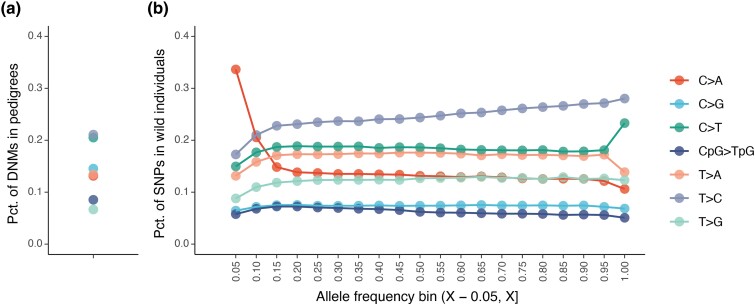
The rate at which mutations arise is a fundamental parameter of biology. Despite progress in measuring germline mutation rates across diverse taxa, such estimates are missing for much of Earth's biodiversity. Here, we present the first estimate of a germline mutation rate from the phylum Mollusca. We sequenced three pedigreed families of the white abalone Haliotis sorenseni, a long-lived, large-bodied, and critically endangered mollusk, and estimated a de novo mutation rate of 8.60 × 10⁻⁹ single nucleotide mutations per site per generation. This mutation rate is similar to rates measured in vertebrates with comparable generation times and longevity to abalone, and higher than mutation rates measured in faster-reproducing invertebrates. The spectrum of de novo mutations is also similar to that seen in vertebrate species, although an excess of rare C > A polymorphisms in wild individuals suggests that a modifier allele or environmental exposure may have once increased C > A mutation rates. We use our rate to infer baseline effective population sizes (Ne) across multiple Pacific abalone and find that abalone persisted over most of their evolutionary history as large and stable populations, in contrast to extreme fluctuations over recent history and small census sizes in the present day. We then use our mutation rate to infer the timing and pattern of evolution of the abalone genus Haliotis, which was previously unknown due to few fossil calibrations. Our findings are an important step toward understanding mutation rate evolution and they establish a key parameter for conservation and evolutionary genomics research in mollusks.
期刊介绍:
Molecular Biology and Evolution
Journal Overview:
Publishes research at the interface of molecular (including genomics) and evolutionary biology
Considers manuscripts containing patterns, processes, and predictions at all levels of organization: population, taxonomic, functional, and phenotypic
Interested in fundamental discoveries, new and improved methods, resources, technologies, and theories advancing evolutionary research
Publishes balanced reviews of recent developments in genome evolution and forward-looking perspectives suggesting future directions in molecular evolution applications.






 京公网安备 11010802042870号
京ICP备2023020795号-1
京公网安备 11010802042870号
京ICP备2023020795号-1

 分享
分享
 求助内容:
求助内容: 应助结果提醒方式:
 扫码关注我们
