Jiajun Li, Sihui Wu, Xueran Shi, Yingbo Cao, Han Hao, Jing Wang, Qian Han
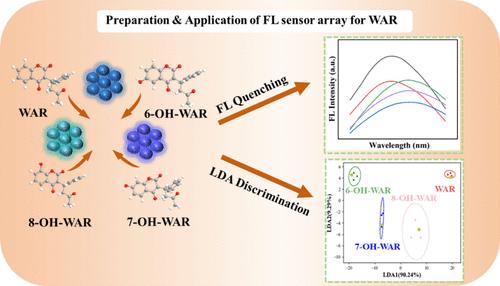
{"title":"机器学习辅助生物质衍生碳点荧光传感器阵列用于华法林及其代谢物的鉴别","authors":"Jiajun Li, Sihui Wu, Xueran Shi, Yingbo Cao, Han Hao, Jing Wang, Qian Han","doi":"10.1021/acs.langmuir.4c03945","DOIUrl":null,"url":null,"abstract":"Warfarin (WAR), an effective oral anticoagulant, is of utmost importance in treating many diseases. Despite its significance, rapid and precise discrimination of WAR remains a formidable challenge, especially facing its structural analogs of metabolites. Here, three kinds of herb-derived N-doped carbon dots (NCDs) were greenly synthesized via a fast and simple microwave-assisted method. Three NCDs showcased respectable blue fluorescent (FL) properties and sensing capabilities for the discrimination of WAR and its metabolites. To improve accuracy in identifying WAR and its metabolites, a sensor array composed of three unique herb-derived NCDs was meticulously designed. Combined with the machine learning model, the sensor array displayed a strong immunity to interference in the discrimination of the WAR, even in unknown samples. Meanwhile, the FL sensing mechanism is deeply expounded. The methodology proffers broad prospects for biomass-derived nanomaterials and provides an effective and feasible project for pharmaceutical analysis by capitalizing on machine learning.","PeriodicalId":50,"journal":{"name":"Langmuir","volume":"84 1","pages":""},"PeriodicalIF":4.4000,"publicationDate":"2025-01-11","publicationTypes":"Journal Article","fieldsOfStudy":null,"isOpenAccess":false,"openAccessPdf":"","citationCount":"0","resultStr":"{\"title\":\"Machine Learning-Assisted Biomass-Derived Carbon Dots as Fluorescent Sensor Array for Discrimination of Warfarin and Its Metabolites\",\"authors\":\"Jiajun Li, Sihui Wu, Xueran Shi, Yingbo Cao, Han Hao, Jing Wang, Qian Han\",\"doi\":\"10.1021/acs.langmuir.4c03945\",\"DOIUrl\":null,\"url\":null,\"abstract\":\"Warfarin (WAR), an effective oral anticoagulant, is of utmost importance in treating many diseases. Despite its significance, rapid and precise discrimination of WAR remains a formidable challenge, especially facing its structural analogs of metabolites. Here, three kinds of herb-derived N-doped carbon dots (NCDs) were greenly synthesized via a fast and simple microwave-assisted method. Three NCDs showcased respectable blue fluorescent (FL) properties and sensing capabilities for the discrimination of WAR and its metabolites. To improve accuracy in identifying WAR and its metabolites, a sensor array composed of three unique herb-derived NCDs was meticulously designed. Combined with the machine learning model, the sensor array displayed a strong immunity to interference in the discrimination of the WAR, even in unknown samples. Meanwhile, the FL sensing mechanism is deeply expounded. The methodology proffers broad prospects for biomass-derived nanomaterials and provides an effective and feasible project for pharmaceutical analysis by capitalizing on machine learning.\",\"PeriodicalId\":50,\"journal\":{\"name\":\"Langmuir\",\"volume\":\"84 1\",\"pages\":\"\"},\"PeriodicalIF\":4.4000,\"publicationDate\":\"2025-01-11\",\"publicationTypes\":\"Journal Article\",\"fieldsOfStudy\":null,\"isOpenAccess\":false,\"openAccessPdf\":\"\",\"citationCount\":\"0\",\"resultStr\":null,\"platform\":\"Semanticscholar\",\"paperid\":null,\"PeriodicalName\":\"Langmuir\",\"FirstCategoryId\":\"92\",\"ListUrlMain\":\"https://doi.org/10.1021/acs.langmuir.4c03945\",\"RegionNum\":2,\"RegionCategory\":\"化学\",\"ArticlePicture\":[],\"TitleCN\":null,\"AbstractTextCN\":null,\"PMCID\":null,\"EPubDate\":\"\",\"PubModel\":\"\",\"JCR\":\"Q2\",\"JCRName\":\"CHEMISTRY, MULTIDISCIPLINARY\",\"Score\":null,\"Total\":0}","platform":"Semanticscholar","paperid":null,"PeriodicalName":"Langmuir","FirstCategoryId":"92","ListUrlMain":"https://doi.org/10.1021/acs.langmuir.4c03945","RegionNum":2,"RegionCategory":"化学","ArticlePicture":[],"TitleCN":null,"AbstractTextCN":null,"PMCID":null,"EPubDate":"","PubModel":"","JCR":"Q2","JCRName":"CHEMISTRY, MULTIDISCIPLINARY","Score":null,"Total":0}
Machine Learning-Assisted Biomass-Derived Carbon Dots as Fluorescent Sensor Array for Discrimination of Warfarin and Its Metabolites
Warfarin (WAR), an effective oral anticoagulant, is of utmost importance in treating many diseases. Despite its significance, rapid and precise discrimination of WAR remains a formidable challenge, especially facing its structural analogs of metabolites. Here, three kinds of herb-derived N-doped carbon dots (NCDs) were greenly synthesized via a fast and simple microwave-assisted method. Three NCDs showcased respectable blue fluorescent (FL) properties and sensing capabilities for the discrimination of WAR and its metabolites. To improve accuracy in identifying WAR and its metabolites, a sensor array composed of three unique herb-derived NCDs was meticulously designed. Combined with the machine learning model, the sensor array displayed a strong immunity to interference in the discrimination of the WAR, even in unknown samples. Meanwhile, the FL sensing mechanism is deeply expounded. The methodology proffers broad prospects for biomass-derived nanomaterials and provides an effective and feasible project for pharmaceutical analysis by capitalizing on machine learning.
期刊介绍:
Langmuir is an interdisciplinary journal publishing articles in the following subject categories:
Colloids: surfactants and self-assembly, dispersions, emulsions, foams
Interfaces: adsorption, reactions, films, forces
Biological Interfaces: biocolloids, biomolecular and biomimetic materials
Materials: nano- and mesostructured materials, polymers, gels, liquid crystals
Electrochemistry: interfacial charge transfer, charge transport, electrocatalysis, electrokinetic phenomena, bioelectrochemistry
Devices and Applications: sensors, fluidics, patterning, catalysis, photonic crystals
However, when high-impact, original work is submitted that does not fit within the above categories, decisions to accept or decline such papers will be based on one criteria: What Would Irving Do?
Langmuir ranks #2 in citations out of 136 journals in the category of Physical Chemistry with 113,157 total citations. The journal received an Impact Factor of 4.384*.
This journal is also indexed in the categories of Materials Science (ranked #1) and Multidisciplinary Chemistry (ranked #5).




 京公网安备 11010802042870号
京ICP备2023020795号-1
京公网安备 11010802042870号
京ICP备2023020795号-1

 分享
分享
 求助内容:
求助内容: 应助结果提醒方式:
 扫码关注我们
