Jiefu Yang, Ruijia Sun, Xuan Bao, Juanjuan Liu, Jun Wen Ng, Bijun Tang, Zheng Liu
{"title":"增强二维材料气体传感器的选择性","authors":"Jiefu Yang, Ruijia Sun, Xuan Bao, Juanjuan Liu, Jun Wen Ng, Bijun Tang, Zheng Liu","doi":"10.1002/adfm.202420393","DOIUrl":null,"url":null,"abstract":"<p>Two-dimensional (2D) materials have emerged as promising candidates for gas sensing applications due to their exceptional electrical, structural, and chemical properties, which enable high sensitivity and rapid response to gas molecules. However, despite their potential, 2D material-based gas sensors face a significant challenge in achieving adequate selectivity, as many sensors respond similarly to multiple gases, leading to cross-sensitivity and inaccurate detection. This review provides a comprehensive overview of the recent advancements for improving the selectivity of 2D gas sensors. It explores material modification strategies, such as functionalizing the sensing components and tuning adsorption dynamics, to enhance selective gas interactions. Engineering approaches, including field-effect modulation and sensor array design, are also discussed as effective methods to fine-tune sensor performance. Additionally, the integration of machine learning (ML) algorithms is highlighted for their potential to differentiate among multiple analytes. Prospects for further improving selectivity through material optimization, sensor calibration, and drift compensation are explored, along with the incorporation of smart sensing systems into the Internet of Things (IoT). This review outlines key objectives and strategies that pave the way for next-generation gas sensors with enhanced selectivity, reliability, and versatility, poised to impact a wide range of applications from environmental monitoring to industrial safety.</p>","PeriodicalId":112,"journal":{"name":"Advanced Functional Materials","volume":"35 20","pages":""},"PeriodicalIF":19.9000,"publicationDate":"2025-01-12","publicationTypes":"Journal Article","fieldsOfStudy":null,"isOpenAccess":false,"openAccessPdf":"","citationCount":"0","resultStr":"{\"title\":\"Enhancing Selectivity of Two-Dimensional Materials-Based Gas Sensors\",\"authors\":\"Jiefu Yang, Ruijia Sun, Xuan Bao, Juanjuan Liu, Jun Wen Ng, Bijun Tang, Zheng Liu\",\"doi\":\"10.1002/adfm.202420393\",\"DOIUrl\":null,\"url\":null,\"abstract\":\"<p>Two-dimensional (2D) materials have emerged as promising candidates for gas sensing applications due to their exceptional electrical, structural, and chemical properties, which enable high sensitivity and rapid response to gas molecules. However, despite their potential, 2D material-based gas sensors face a significant challenge in achieving adequate selectivity, as many sensors respond similarly to multiple gases, leading to cross-sensitivity and inaccurate detection. This review provides a comprehensive overview of the recent advancements for improving the selectivity of 2D gas sensors. It explores material modification strategies, such as functionalizing the sensing components and tuning adsorption dynamics, to enhance selective gas interactions. Engineering approaches, including field-effect modulation and sensor array design, are also discussed as effective methods to fine-tune sensor performance. Additionally, the integration of machine learning (ML) algorithms is highlighted for their potential to differentiate among multiple analytes. Prospects for further improving selectivity through material optimization, sensor calibration, and drift compensation are explored, along with the incorporation of smart sensing systems into the Internet of Things (IoT). This review outlines key objectives and strategies that pave the way for next-generation gas sensors with enhanced selectivity, reliability, and versatility, poised to impact a wide range of applications from environmental monitoring to industrial safety.</p>\",\"PeriodicalId\":112,\"journal\":{\"name\":\"Advanced Functional Materials\",\"volume\":\"35 20\",\"pages\":\"\"},\"PeriodicalIF\":19.9000,\"publicationDate\":\"2025-01-12\",\"publicationTypes\":\"Journal Article\",\"fieldsOfStudy\":null,\"isOpenAccess\":false,\"openAccessPdf\":\"\",\"citationCount\":\"0\",\"resultStr\":null,\"platform\":\"Semanticscholar\",\"paperid\":null,\"PeriodicalName\":\"Advanced Functional Materials\",\"FirstCategoryId\":\"88\",\"ListUrlMain\":\"https://advanced.onlinelibrary.wiley.com/doi/10.1002/adfm.202420393\",\"RegionNum\":1,\"RegionCategory\":\"材料科学\",\"ArticlePicture\":[],\"TitleCN\":null,\"AbstractTextCN\":null,\"PMCID\":null,\"EPubDate\":\"\",\"PubModel\":\"\",\"JCR\":\"Q1\",\"JCRName\":\"CHEMISTRY, MULTIDISCIPLINARY\",\"Score\":null,\"Total\":0}","platform":"Semanticscholar","paperid":null,"PeriodicalName":"Advanced Functional Materials","FirstCategoryId":"88","ListUrlMain":"https://advanced.onlinelibrary.wiley.com/doi/10.1002/adfm.202420393","RegionNum":1,"RegionCategory":"材料科学","ArticlePicture":[],"TitleCN":null,"AbstractTextCN":null,"PMCID":null,"EPubDate":"","PubModel":"","JCR":"Q1","JCRName":"CHEMISTRY, MULTIDISCIPLINARY","Score":null,"Total":0}
Enhancing Selectivity of Two-Dimensional Materials-Based Gas Sensors
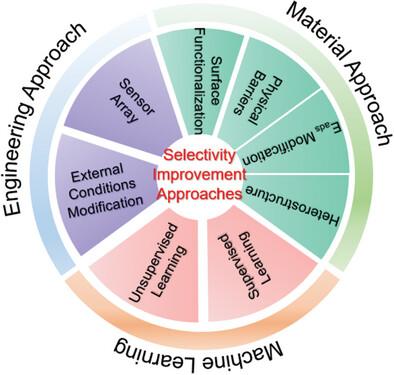
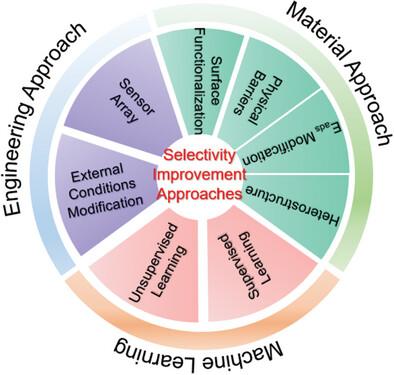
Two-dimensional (2D) materials have emerged as promising candidates for gas sensing applications due to their exceptional electrical, structural, and chemical properties, which enable high sensitivity and rapid response to gas molecules. However, despite their potential, 2D material-based gas sensors face a significant challenge in achieving adequate selectivity, as many sensors respond similarly to multiple gases, leading to cross-sensitivity and inaccurate detection. This review provides a comprehensive overview of the recent advancements for improving the selectivity of 2D gas sensors. It explores material modification strategies, such as functionalizing the sensing components and tuning adsorption dynamics, to enhance selective gas interactions. Engineering approaches, including field-effect modulation and sensor array design, are also discussed as effective methods to fine-tune sensor performance. Additionally, the integration of machine learning (ML) algorithms is highlighted for their potential to differentiate among multiple analytes. Prospects for further improving selectivity through material optimization, sensor calibration, and drift compensation are explored, along with the incorporation of smart sensing systems into the Internet of Things (IoT). This review outlines key objectives and strategies that pave the way for next-generation gas sensors with enhanced selectivity, reliability, and versatility, poised to impact a wide range of applications from environmental monitoring to industrial safety.
期刊介绍:
Firmly established as a top-tier materials science journal, Advanced Functional Materials reports breakthrough research in all aspects of materials science, including nanotechnology, chemistry, physics, and biology every week.
Advanced Functional Materials is known for its rapid and fair peer review, quality content, and high impact, making it the first choice of the international materials science community.







 京公网安备 11010802042870号
京ICP备2023020795号-1
京公网安备 11010802042870号
京ICP备2023020795号-1

 分享
分享
 求助内容:
求助内容: 应助结果提醒方式:
 扫码关注我们
