Xin Jin , Sumeng Wang , Yaping Gao , Qingsheng Qi , Quanfeng Liang
{"title":"从未经处理的甘蔗糖蜜中高效生产l -苏氨酸的大肠杆菌组合代谢工程。","authors":"Xin Jin , Sumeng Wang , Yaping Gao , Qingsheng Qi , Quanfeng Liang","doi":"10.1016/j.biortech.2025.132058","DOIUrl":null,"url":null,"abstract":"<div><h3>Background</h3><div>The industrial production of L-threonine faces challenges because of high production costs, especially those of substrates, meaning new production methods are needed.</div></div><div><h3>Methods</h3><div>Fur, a new global transcription factor related to L-threonine biosynthesis, was discovered in this study. Multidimensional regulation combined with global transcriptional machinery engineering was used to modify an <em>Escherichia coli</em> strain. Results: The most efficient mutant showed high titer (154.2 g/L), productivity (2.14 g/L/h), and yield (0.76 g/g) of L-threonine production. These three parameters indicated that these engineering strategies were economically feasible for developing high L-threonine-producing strains. We integrated the sucrose utilization gene cluster into the genome to further reduce the production cost of L-threonine. Using untreated cane molasses as the substrate, L-threonine was successfully produced with a titer of 92.46 g/L and a cost reduction of 48 %.</div></div><div><h3>Conclusion</h3><div>This research offers advantages for industrial scalability, and the resulting engineered bacterium holds significant industrial application potential.</div></div>","PeriodicalId":258,"journal":{"name":"Bioresource Technology","volume":"419 ","pages":"Article 132058"},"PeriodicalIF":8.2000,"publicationDate":"2025-03-01","publicationTypes":"Journal Article","fieldsOfStudy":null,"isOpenAccess":false,"openAccessPdf":"","citationCount":"0","resultStr":"{\"title\":\"Combinatorial metabolic engineering of Escherichia coli to efficiently produce L-threonine from untreated cane molasses\",\"authors\":\"Xin Jin , Sumeng Wang , Yaping Gao , Qingsheng Qi , Quanfeng Liang\",\"doi\":\"10.1016/j.biortech.2025.132058\",\"DOIUrl\":null,\"url\":null,\"abstract\":\"<div><h3>Background</h3><div>The industrial production of L-threonine faces challenges because of high production costs, especially those of substrates, meaning new production methods are needed.</div></div><div><h3>Methods</h3><div>Fur, a new global transcription factor related to L-threonine biosynthesis, was discovered in this study. Multidimensional regulation combined with global transcriptional machinery engineering was used to modify an <em>Escherichia coli</em> strain. Results: The most efficient mutant showed high titer (154.2 g/L), productivity (2.14 g/L/h), and yield (0.76 g/g) of L-threonine production. These three parameters indicated that these engineering strategies were economically feasible for developing high L-threonine-producing strains. We integrated the sucrose utilization gene cluster into the genome to further reduce the production cost of L-threonine. Using untreated cane molasses as the substrate, L-threonine was successfully produced with a titer of 92.46 g/L and a cost reduction of 48 %.</div></div><div><h3>Conclusion</h3><div>This research offers advantages for industrial scalability, and the resulting engineered bacterium holds significant industrial application potential.</div></div>\",\"PeriodicalId\":258,\"journal\":{\"name\":\"Bioresource Technology\",\"volume\":\"419 \",\"pages\":\"Article 132058\"},\"PeriodicalIF\":8.2000,\"publicationDate\":\"2025-03-01\",\"publicationTypes\":\"Journal Article\",\"fieldsOfStudy\":null,\"isOpenAccess\":false,\"openAccessPdf\":\"\",\"citationCount\":\"0\",\"resultStr\":null,\"platform\":\"Semanticscholar\",\"paperid\":null,\"PeriodicalName\":\"Bioresource Technology\",\"FirstCategoryId\":\"5\",\"ListUrlMain\":\"https://www.sciencedirect.com/science/article/pii/S0960852425000240\",\"RegionNum\":1,\"RegionCategory\":\"环境科学与生态学\",\"ArticlePicture\":[],\"TitleCN\":null,\"AbstractTextCN\":null,\"PMCID\":null,\"EPubDate\":\"2025/1/10 0:00:00\",\"PubModel\":\"Epub\",\"JCR\":\"Q1\",\"JCRName\":\"AGRICULTURAL ENGINEERING\",\"Score\":null,\"Total\":0}","platform":"Semanticscholar","paperid":null,"PeriodicalName":"Bioresource Technology","FirstCategoryId":"5","ListUrlMain":"https://www.sciencedirect.com/science/article/pii/S0960852425000240","RegionNum":1,"RegionCategory":"环境科学与生态学","ArticlePicture":[],"TitleCN":null,"AbstractTextCN":null,"PMCID":null,"EPubDate":"2025/1/10 0:00:00","PubModel":"Epub","JCR":"Q1","JCRName":"AGRICULTURAL ENGINEERING","Score":null,"Total":0}
Combinatorial metabolic engineering of Escherichia coli to efficiently produce L-threonine from untreated cane molasses
Background
The industrial production of L-threonine faces challenges because of high production costs, especially those of substrates, meaning new production methods are needed.
Methods
Fur, a new global transcription factor related to L-threonine biosynthesis, was discovered in this study. Multidimensional regulation combined with global transcriptional machinery engineering was used to modify an Escherichia coli strain. Results: The most efficient mutant showed high titer (154.2 g/L), productivity (2.14 g/L/h), and yield (0.76 g/g) of L-threonine production. These three parameters indicated that these engineering strategies were economically feasible for developing high L-threonine-producing strains. We integrated the sucrose utilization gene cluster into the genome to further reduce the production cost of L-threonine. Using untreated cane molasses as the substrate, L-threonine was successfully produced with a titer of 92.46 g/L and a cost reduction of 48 %.
Conclusion
This research offers advantages for industrial scalability, and the resulting engineered bacterium holds significant industrial application potential.
期刊介绍:
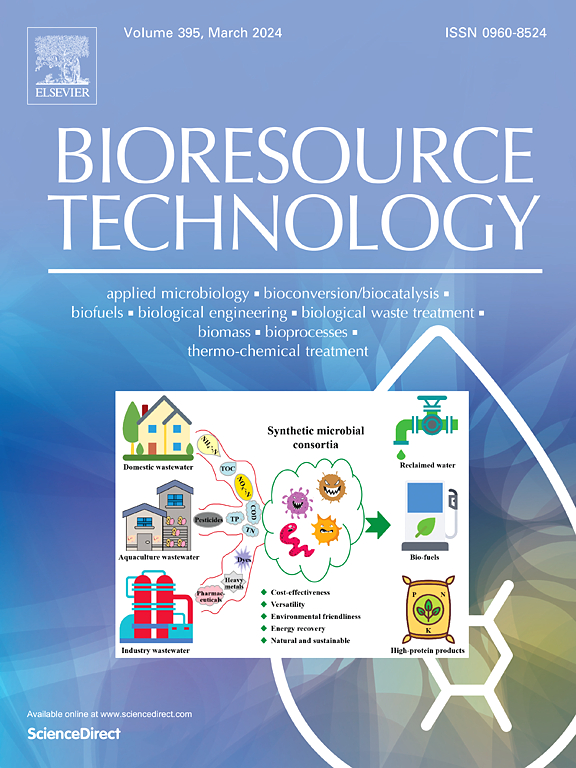
Bioresource Technology publishes original articles, review articles, case studies, and short communications covering the fundamentals, applications, and management of bioresource technology. The journal seeks to advance and disseminate knowledge across various areas related to biomass, biological waste treatment, bioenergy, biotransformations, bioresource systems analysis, and associated conversion or production technologies.
Topics include:
• Biofuels: liquid and gaseous biofuels production, modeling and economics
• Bioprocesses and bioproducts: biocatalysis and fermentations
• Biomass and feedstocks utilization: bioconversion of agro-industrial residues
• Environmental protection: biological waste treatment
• Thermochemical conversion of biomass: combustion, pyrolysis, gasification, catalysis.





 京公网安备 11010802042870号
京ICP备2023020795号-1
京公网安备 11010802042870号
京ICP备2023020795号-1

 分享
分享
 求助内容:
求助内容: 应助结果提醒方式:
 扫码关注我们
