Kuldashboy Avazov, Sanjar Mirzakhalilov, Sabina Umirzakova, Akmalbek Abdusalomov, Young Im Cho
{"title":"肿瘤边界的动态聚焦:用于MRI脑肿瘤分割的轻量级U-Net。","authors":"Kuldashboy Avazov, Sanjar Mirzakhalilov, Sabina Umirzakova, Akmalbek Abdusalomov, Young Im Cho","doi":"10.3390/bioengineering11121302","DOIUrl":null,"url":null,"abstract":"<p><p>Accurate segmentation of brain tumors in MRI scans is critical for diagnosis and treatment planning. Traditional segmentation models, such as U-Net, excel in capturing spatial information but often struggle with complex tumor boundaries and subtle variations in image contrast. These limitations can lead to inconsistencies in identifying critical regions, impacting the accuracy of clinical outcomes. To address these challenges, this paper proposes a novel modification to the U-Net architecture by integrating a spatial attention mechanism designed to dynamically focus on relevant regions within MRI scans. This innovation enhances the model's ability to delineate fine tumor boundaries and improves segmentation precision. Our model was evaluated on the Figshare dataset, which includes annotated MRI images of meningioma, glioma, and pituitary tumors. The proposed model achieved a Dice similarity coefficient (DSC) of 0.93, a recall of 0.95, and an AUC of 0.94, outperforming existing approaches such as V-Net, DeepLab V3+, and nnU-Net. These results demonstrate the effectiveness of our model in addressing key challenges like low-contrast boundaries, small tumor regions, and overlapping tumors. Furthermore, the lightweight design of the model ensures its suitability for real-time clinical applications, making it a robust tool for automated tumor segmentation. This study underscores the potential of spatial attention mechanisms to significantly enhance medical imaging models and paves the way for more effective diagnostic tools.</p>","PeriodicalId":8874,"journal":{"name":"Bioengineering","volume":"11 12","pages":""},"PeriodicalIF":3.7000,"publicationDate":"2024-12-23","publicationTypes":"Journal Article","fieldsOfStudy":null,"isOpenAccess":false,"openAccessPdf":"https://www.ncbi.nlm.nih.gov/pmc/articles/PMC11727338/pdf/","citationCount":"0","resultStr":"{\"title\":\"Dynamic Focus on Tumor Boundaries: A Lightweight U-Net for MRI Brain Tumor Segmentation.\",\"authors\":\"Kuldashboy Avazov, Sanjar Mirzakhalilov, Sabina Umirzakova, Akmalbek Abdusalomov, Young Im Cho\",\"doi\":\"10.3390/bioengineering11121302\",\"DOIUrl\":null,\"url\":null,\"abstract\":\"<p><p>Accurate segmentation of brain tumors in MRI scans is critical for diagnosis and treatment planning. Traditional segmentation models, such as U-Net, excel in capturing spatial information but often struggle with complex tumor boundaries and subtle variations in image contrast. These limitations can lead to inconsistencies in identifying critical regions, impacting the accuracy of clinical outcomes. To address these challenges, this paper proposes a novel modification to the U-Net architecture by integrating a spatial attention mechanism designed to dynamically focus on relevant regions within MRI scans. This innovation enhances the model's ability to delineate fine tumor boundaries and improves segmentation precision. Our model was evaluated on the Figshare dataset, which includes annotated MRI images of meningioma, glioma, and pituitary tumors. The proposed model achieved a Dice similarity coefficient (DSC) of 0.93, a recall of 0.95, and an AUC of 0.94, outperforming existing approaches such as V-Net, DeepLab V3+, and nnU-Net. These results demonstrate the effectiveness of our model in addressing key challenges like low-contrast boundaries, small tumor regions, and overlapping tumors. Furthermore, the lightweight design of the model ensures its suitability for real-time clinical applications, making it a robust tool for automated tumor segmentation. This study underscores the potential of spatial attention mechanisms to significantly enhance medical imaging models and paves the way for more effective diagnostic tools.</p>\",\"PeriodicalId\":8874,\"journal\":{\"name\":\"Bioengineering\",\"volume\":\"11 12\",\"pages\":\"\"},\"PeriodicalIF\":3.7000,\"publicationDate\":\"2024-12-23\",\"publicationTypes\":\"Journal Article\",\"fieldsOfStudy\":null,\"isOpenAccess\":false,\"openAccessPdf\":\"https://www.ncbi.nlm.nih.gov/pmc/articles/PMC11727338/pdf/\",\"citationCount\":\"0\",\"resultStr\":null,\"platform\":\"Semanticscholar\",\"paperid\":null,\"PeriodicalName\":\"Bioengineering\",\"FirstCategoryId\":\"5\",\"ListUrlMain\":\"https://doi.org/10.3390/bioengineering11121302\",\"RegionNum\":3,\"RegionCategory\":\"医学\",\"ArticlePicture\":[],\"TitleCN\":null,\"AbstractTextCN\":null,\"PMCID\":null,\"EPubDate\":\"\",\"PubModel\":\"\",\"JCR\":\"Q2\",\"JCRName\":\"ENGINEERING, BIOMEDICAL\",\"Score\":null,\"Total\":0}","platform":"Semanticscholar","paperid":null,"PeriodicalName":"Bioengineering","FirstCategoryId":"5","ListUrlMain":"https://doi.org/10.3390/bioengineering11121302","RegionNum":3,"RegionCategory":"医学","ArticlePicture":[],"TitleCN":null,"AbstractTextCN":null,"PMCID":null,"EPubDate":"","PubModel":"","JCR":"Q2","JCRName":"ENGINEERING, BIOMEDICAL","Score":null,"Total":0}
Dynamic Focus on Tumor Boundaries: A Lightweight U-Net for MRI Brain Tumor Segmentation.
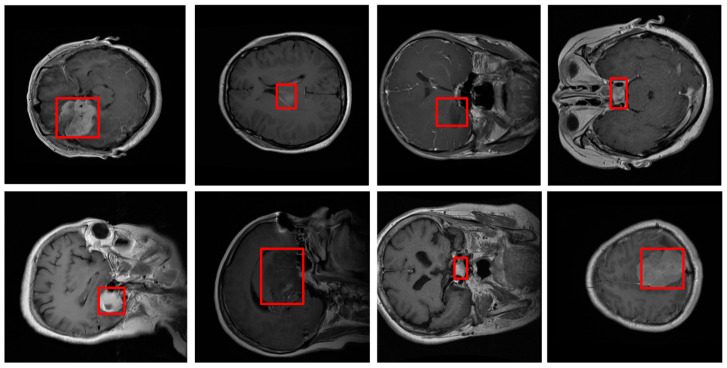
Accurate segmentation of brain tumors in MRI scans is critical for diagnosis and treatment planning. Traditional segmentation models, such as U-Net, excel in capturing spatial information but often struggle with complex tumor boundaries and subtle variations in image contrast. These limitations can lead to inconsistencies in identifying critical regions, impacting the accuracy of clinical outcomes. To address these challenges, this paper proposes a novel modification to the U-Net architecture by integrating a spatial attention mechanism designed to dynamically focus on relevant regions within MRI scans. This innovation enhances the model's ability to delineate fine tumor boundaries and improves segmentation precision. Our model was evaluated on the Figshare dataset, which includes annotated MRI images of meningioma, glioma, and pituitary tumors. The proposed model achieved a Dice similarity coefficient (DSC) of 0.93, a recall of 0.95, and an AUC of 0.94, outperforming existing approaches such as V-Net, DeepLab V3+, and nnU-Net. These results demonstrate the effectiveness of our model in addressing key challenges like low-contrast boundaries, small tumor regions, and overlapping tumors. Furthermore, the lightweight design of the model ensures its suitability for real-time clinical applications, making it a robust tool for automated tumor segmentation. This study underscores the potential of spatial attention mechanisms to significantly enhance medical imaging models and paves the way for more effective diagnostic tools.
期刊介绍:
Aims
Bioengineering (ISSN 2306-5354) provides an advanced forum for the science and technology of bioengineering. It publishes original research papers, comprehensive reviews, communications and case reports. Our aim is to encourage scientists to publish their experimental and theoretical results in as much detail as possible. All aspects of bioengineering are welcomed from theoretical concepts to education and applications. There is no restriction on the length of the papers. The full experimental details must be provided so that the results can be reproduced. There are, in addition, four key features of this Journal:
● We are introducing a new concept in scientific and technical publications “The Translational Case Report in Bioengineering”. It is a descriptive explanatory analysis of a transformative or translational event. Understanding that the goal of bioengineering scholarship is to advance towards a transformative or clinical solution to an identified transformative/clinical need, the translational case report is used to explore causation in order to find underlying principles that may guide other similar transformative/translational undertakings.
● Manuscripts regarding research proposals and research ideas will be particularly welcomed.
● Electronic files and software regarding the full details of the calculation and experimental procedure, if unable to be published in a normal way, can be deposited as supplementary material.
● We also accept manuscripts communicating to a broader audience with regard to research projects financed with public funds.
Scope
● Bionics and biological cybernetics: implantology; bio–abio interfaces
● Bioelectronics: wearable electronics; implantable electronics; “more than Moore” electronics; bioelectronics devices
● Bioprocess and biosystems engineering and applications: bioprocess design; biocatalysis; bioseparation and bioreactors; bioinformatics; bioenergy; etc.
● Biomolecular, cellular and tissue engineering and applications: tissue engineering; chromosome engineering; embryo engineering; cellular, molecular and synthetic biology; metabolic engineering; bio-nanotechnology; micro/nano technologies; genetic engineering; transgenic technology
● Biomedical engineering and applications: biomechatronics; biomedical electronics; biomechanics; biomaterials; biomimetics; biomedical diagnostics; biomedical therapy; biomedical devices; sensors and circuits; biomedical imaging and medical information systems; implants and regenerative medicine; neurotechnology; clinical engineering; rehabilitation engineering
● Biochemical engineering and applications: metabolic pathway engineering; modeling and simulation
● Translational bioengineering







 京公网安备 11010802042870号
京ICP备2023020795号-1
京公网安备 11010802042870号
京ICP备2023020795号-1

 分享
分享
 求助内容:
求助内容: 应助结果提醒方式:
 扫码关注我们
