Biao Wei, Zhibiao Qin, Hui Miao, Chaoqun Wang, Mengna Huang, Chenxu Liu, Cuibing Bai and Zheng Chen
{"title":"甲酰基氟酰亚胺配体衍生的烷基锌配合物:醛和酮的合成、表征和硼化氢催化","authors":"Biao Wei, Zhibiao Qin, Hui Miao, Chaoqun Wang, Mengna Huang, Chenxu Liu, Cuibing Bai and Zheng Chen","doi":"10.1039/D4DT03395G","DOIUrl":null,"url":null,"abstract":"<p >Five new alkyl zinc complexes supported by different formylfluorenimide ligands were prepared and characterized. Complex <strong>1</strong> was obtained by the reaction of 9-[N(CH<small><sub>3</sub></small>)<small><sub>2</sub></small>–Cy–N<img>CH]Fl (Cy = 2-cyclohexyl) (Fl = fluorenyl<strong>) (</strong><strong>L<small><sup>1</sup></small></strong><strong>)</strong> with diethylzinc (ZnEt<small><sub>2</sub></small>) in tetrahydrofuran. Reacting 9-[2-pyridyl–CH–N<img>CH]Fl <strong>(</strong><strong>L<small><sup>2</sup></small></strong><strong>)</strong> with ZnEt<small><sub>2</sub></small> in tetrahydrofuran yielded complex <strong>2</strong>. Under analogous conditions, complexes <strong>3</strong> and <strong>4</strong> were obtained through the reaction of 9-[2-pyridyl–CH(CH<small><sub>3</sub></small>)–N<img>CH]Fl <strong>(</strong><strong>L<small><sup>3</sup></small></strong><strong>)</strong> and 9-[8-quinoline–CH–N<img>CH]Fl <strong>(</strong><strong>L<small><sup>4</sup></small></strong><strong>)</strong> with ZnEt<small><sub>2</sub></small> in tetrahydrofuran, respectively. The above ligands formed a tridentate four-coordinate structure with the introduction of a THF molecule along with the elimination of one ethyl group during its coordination with zinc. Notably, the formylfluorenimide ligand 9-[2-phenoxy–Ph–N<img>CH]Fl (Ph = phenyl) (<strong>L<small><sup>5</sup></small></strong>) bearing a phenoxy group exhibited unique reactivity compared to the other ligands and formed a bidentate three-coordinated structure when reacting with ZnEt<small><sub>2</sub></small> in THF. All complexes were characterized <em>via</em><small><sup>1</sup></small>H NMR, <small><sup>13</sup></small>C NMR spectroscopy, and elemental analysis, with structural determination confirmed through single-crystal X-ray diffraction. Furthermore, the catalytic properties of these complexes were investigated. All these complexes exhibited excellent catalytic activities for the hydroboration of benzaldehyde, among which complex <strong>5</strong> demonstrated excellent catalytic performance (up to 99% yield) with a versatile substrate scope and high tolerance to functional groups (27 substrates) at a low catalyst loading (0.8 mol%) under mild reaction conditions.</p>","PeriodicalId":71,"journal":{"name":"Dalton Transactions","volume":" 8","pages":" 3427-3436"},"PeriodicalIF":3.3000,"publicationDate":"2025-01-15","publicationTypes":"Journal Article","fieldsOfStudy":null,"isOpenAccess":false,"openAccessPdf":"","citationCount":"0","resultStr":"{\"title\":\"Alkyl zinc complexes derived from formylfluorenimide ligands: synthesis, characterization and catalysis for hydroboration of aldehydes and ketones†\",\"authors\":\"Biao Wei, Zhibiao Qin, Hui Miao, Chaoqun Wang, Mengna Huang, Chenxu Liu, Cuibing Bai and Zheng Chen\",\"doi\":\"10.1039/D4DT03395G\",\"DOIUrl\":null,\"url\":null,\"abstract\":\"<p >Five new alkyl zinc complexes supported by different formylfluorenimide ligands were prepared and characterized. Complex <strong>1</strong> was obtained by the reaction of 9-[N(CH<small><sub>3</sub></small>)<small><sub>2</sub></small>–Cy–N<img>CH]Fl (Cy = 2-cyclohexyl) (Fl = fluorenyl<strong>) (</strong><strong>L<small><sup>1</sup></small></strong><strong>)</strong> with diethylzinc (ZnEt<small><sub>2</sub></small>) in tetrahydrofuran. Reacting 9-[2-pyridyl–CH–N<img>CH]Fl <strong>(</strong><strong>L<small><sup>2</sup></small></strong><strong>)</strong> with ZnEt<small><sub>2</sub></small> in tetrahydrofuran yielded complex <strong>2</strong>. Under analogous conditions, complexes <strong>3</strong> and <strong>4</strong> were obtained through the reaction of 9-[2-pyridyl–CH(CH<small><sub>3</sub></small>)–N<img>CH]Fl <strong>(</strong><strong>L<small><sup>3</sup></small></strong><strong>)</strong> and 9-[8-quinoline–CH–N<img>CH]Fl <strong>(</strong><strong>L<small><sup>4</sup></small></strong><strong>)</strong> with ZnEt<small><sub>2</sub></small> in tetrahydrofuran, respectively. The above ligands formed a tridentate four-coordinate structure with the introduction of a THF molecule along with the elimination of one ethyl group during its coordination with zinc. Notably, the formylfluorenimide ligand 9-[2-phenoxy–Ph–N<img>CH]Fl (Ph = phenyl) (<strong>L<small><sup>5</sup></small></strong>) bearing a phenoxy group exhibited unique reactivity compared to the other ligands and formed a bidentate three-coordinated structure when reacting with ZnEt<small><sub>2</sub></small> in THF. All complexes were characterized <em>via</em><small><sup>1</sup></small>H NMR, <small><sup>13</sup></small>C NMR spectroscopy, and elemental analysis, with structural determination confirmed through single-crystal X-ray diffraction. Furthermore, the catalytic properties of these complexes were investigated. All these complexes exhibited excellent catalytic activities for the hydroboration of benzaldehyde, among which complex <strong>5</strong> demonstrated excellent catalytic performance (up to 99% yield) with a versatile substrate scope and high tolerance to functional groups (27 substrates) at a low catalyst loading (0.8 mol%) under mild reaction conditions.</p>\",\"PeriodicalId\":71,\"journal\":{\"name\":\"Dalton Transactions\",\"volume\":\" 8\",\"pages\":\" 3427-3436\"},\"PeriodicalIF\":3.3000,\"publicationDate\":\"2025-01-15\",\"publicationTypes\":\"Journal Article\",\"fieldsOfStudy\":null,\"isOpenAccess\":false,\"openAccessPdf\":\"\",\"citationCount\":\"0\",\"resultStr\":null,\"platform\":\"Semanticscholar\",\"paperid\":null,\"PeriodicalName\":\"Dalton Transactions\",\"FirstCategoryId\":\"92\",\"ListUrlMain\":\"https://pubs.rsc.org/en/content/articlelanding/2025/dt/d4dt03395g\",\"RegionNum\":3,\"RegionCategory\":\"化学\",\"ArticlePicture\":[],\"TitleCN\":null,\"AbstractTextCN\":null,\"PMCID\":null,\"EPubDate\":\"\",\"PubModel\":\"\",\"JCR\":\"Q2\",\"JCRName\":\"CHEMISTRY, INORGANIC & NUCLEAR\",\"Score\":null,\"Total\":0}","platform":"Semanticscholar","paperid":null,"PeriodicalName":"Dalton Transactions","FirstCategoryId":"92","ListUrlMain":"https://pubs.rsc.org/en/content/articlelanding/2025/dt/d4dt03395g","RegionNum":3,"RegionCategory":"化学","ArticlePicture":[],"TitleCN":null,"AbstractTextCN":null,"PMCID":null,"EPubDate":"","PubModel":"","JCR":"Q2","JCRName":"CHEMISTRY, INORGANIC & NUCLEAR","Score":null,"Total":0}
引用次数: 0
摘要
制备了5种不同甲酰基氟酰亚胺配体负载的新型烷基锌配合物,并对其进行了表征。由9-[N(CH3)2-Cy-N=CH]Fl (Cy = 2-环己基)(Fl =芴基)(L1)与二乙基锌(ZnEt2)在四氢呋喃中反应得到配合物1。9-[2-吡啶-CH- n =CH]Fl (L2)与ZnEt2在四氢呋喃中反应生成配合物2。在类似条件下,9-[2-吡啶-CH(CH3)- n =CH]Fl(L3)和9-[8-喹啉-CH- n =CH]Fl(L4)在四氢呋喃中分别与ZnEt2反应得到配合物3和4。上述配体在与锌配位时,通过引入THF分子并消去一个乙基,形成了一个三叉戟四配位结构。值得注意的是,含苯氧基的甲酰基氟酰亚胺配体9-[2-phenoxy-Ph-N=CH]Fl(Ph = phenyl) (L5)与其他配体相比具有独特的反应活性,在THF中与ZnEt2反应形成双齿三配位结构。所有配合物均通过1H NMR、13C NMR和元素分析进行了表征,并通过单晶x射线衍射证实了结构的确定。进一步研究了这些配合物的催化性能。这些配合物均表现出优异的苯甲醛硼氢化催化活性,其中配合物5具有良好的催化性能(产率高达99%),具有广泛的底物范围和高的耐受性(27个底物),低催化剂负载(0.8 mol%),反应条件温和。
Alkyl zinc complexes derived from formylfluorenimide ligands: synthesis, characterization and catalysis for hydroboration of aldehydes and ketones†
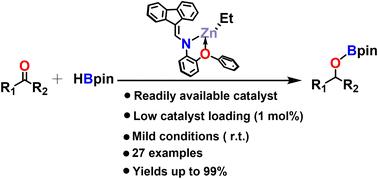
Five new alkyl zinc complexes supported by different formylfluorenimide ligands were prepared and characterized. Complex 1 was obtained by the reaction of 9-[N(CH3)2–Cy–NCH]Fl (Cy = 2-cyclohexyl) (Fl = fluorenyl) (L1) with diethylzinc (ZnEt2) in tetrahydrofuran. Reacting 9-[2-pyridyl–CH–NCH]Fl (L2) with ZnEt2 in tetrahydrofuran yielded complex 2. Under analogous conditions, complexes 3 and 4 were obtained through the reaction of 9-[2-pyridyl–CH(CH3)–NCH]Fl (L3) and 9-[8-quinoline–CH–NCH]Fl (L4) with ZnEt2 in tetrahydrofuran, respectively. The above ligands formed a tridentate four-coordinate structure with the introduction of a THF molecule along with the elimination of one ethyl group during its coordination with zinc. Notably, the formylfluorenimide ligand 9-[2-phenoxy–Ph–NCH]Fl (Ph = phenyl) (L5) bearing a phenoxy group exhibited unique reactivity compared to the other ligands and formed a bidentate three-coordinated structure when reacting with ZnEt2 in THF. All complexes were characterized via1H NMR, 13C NMR spectroscopy, and elemental analysis, with structural determination confirmed through single-crystal X-ray diffraction. Furthermore, the catalytic properties of these complexes were investigated. All these complexes exhibited excellent catalytic activities for the hydroboration of benzaldehyde, among which complex 5 demonstrated excellent catalytic performance (up to 99% yield) with a versatile substrate scope and high tolerance to functional groups (27 substrates) at a low catalyst loading (0.8 mol%) under mild reaction conditions.
期刊介绍:
Dalton Transactions is a journal for all areas of inorganic chemistry, which encompasses the organometallic, bioinorganic and materials chemistry of the elements, with applications including synthesis, catalysis, energy conversion/storage, electrical devices and medicine. Dalton Transactions welcomes high-quality, original submissions in all of these areas and more, where the advancement of knowledge in inorganic chemistry is significant.




 京公网安备 11010802042870号
京ICP备2023020795号-1
京公网安备 11010802042870号
京ICP备2023020795号-1

 分享
分享
 求助内容:
求助内容: 应助结果提醒方式:
 扫码关注我们
