Andrew T. Krasley, Sayantani Chakraborty, Lela Vuković, Abraham G. Beyene
{"title":"ssdna -碳纳米管生物传感器中光调制的分子决定因素","authors":"Andrew T. Krasley, Sayantani Chakraborty, Lela Vuković, Abraham G. Beyene","doi":"10.1021/acsnano.4c13814","DOIUrl":null,"url":null,"abstract":"Most traditional optical biosensors operate through molecular recognition, where ligand binding causes conformational changes that lead to optical perturbations in the emitting motif. Optical sensors developed from single-stranded DNA-functionalized single-walled carbon nanotubes (ssDNA–SWCNTs) have started to make useful contributions to biological research. However, the mechanisms underlying their function have remained poorly understood. In this study, we combine experimental and computational approaches to show that ligand binding alone is not sufficient for optical modulation in this class of synthetic biosensors. Instead, the optical response that occurs after ligand binding is highly dependent on the chemical properties of the ligands, resembling mechanisms seen in activity-based biosensors. Specifically, we show that in ssDNA–SWCNT catecholamine sensors, the optical response correlates positively with the electron density on the aryl motif, even among ligands with similar ligand binding affinities. Importantly, despite the strong correlations with electrochemical properties, we find that catechol oxidation itself is not necessary to drive the sensor optical response. We discuss how these findings could serve as a framework for tuning the performance of existing sensors and guiding the development of new biosensors of this class.","PeriodicalId":21,"journal":{"name":"ACS Nano","volume":"37 1","pages":""},"PeriodicalIF":17.3000,"publicationDate":"2025-01-16","publicationTypes":"Journal Article","fieldsOfStudy":null,"isOpenAccess":false,"openAccessPdf":"","citationCount":"0","resultStr":"{\"title\":\"Molecular Determinants of Optical Modulation in ssDNA–Carbon Nanotube Biosensors\",\"authors\":\"Andrew T. Krasley, Sayantani Chakraborty, Lela Vuković, Abraham G. Beyene\",\"doi\":\"10.1021/acsnano.4c13814\",\"DOIUrl\":null,\"url\":null,\"abstract\":\"Most traditional optical biosensors operate through molecular recognition, where ligand binding causes conformational changes that lead to optical perturbations in the emitting motif. Optical sensors developed from single-stranded DNA-functionalized single-walled carbon nanotubes (ssDNA–SWCNTs) have started to make useful contributions to biological research. However, the mechanisms underlying their function have remained poorly understood. In this study, we combine experimental and computational approaches to show that ligand binding alone is not sufficient for optical modulation in this class of synthetic biosensors. Instead, the optical response that occurs after ligand binding is highly dependent on the chemical properties of the ligands, resembling mechanisms seen in activity-based biosensors. Specifically, we show that in ssDNA–SWCNT catecholamine sensors, the optical response correlates positively with the electron density on the aryl motif, even among ligands with similar ligand binding affinities. Importantly, despite the strong correlations with electrochemical properties, we find that catechol oxidation itself is not necessary to drive the sensor optical response. We discuss how these findings could serve as a framework for tuning the performance of existing sensors and guiding the development of new biosensors of this class.\",\"PeriodicalId\":21,\"journal\":{\"name\":\"ACS Nano\",\"volume\":\"37 1\",\"pages\":\"\"},\"PeriodicalIF\":17.3000,\"publicationDate\":\"2025-01-16\",\"publicationTypes\":\"Journal Article\",\"fieldsOfStudy\":null,\"isOpenAccess\":false,\"openAccessPdf\":\"\",\"citationCount\":\"0\",\"resultStr\":null,\"platform\":\"Semanticscholar\",\"paperid\":null,\"PeriodicalName\":\"ACS Nano\",\"FirstCategoryId\":\"88\",\"ListUrlMain\":\"https://doi.org/10.1021/acsnano.4c13814\",\"RegionNum\":1,\"RegionCategory\":\"材料科学\",\"ArticlePicture\":[],\"TitleCN\":null,\"AbstractTextCN\":null,\"PMCID\":null,\"EPubDate\":\"\",\"PubModel\":\"\",\"JCR\":\"Q1\",\"JCRName\":\"CHEMISTRY, MULTIDISCIPLINARY\",\"Score\":null,\"Total\":0}","platform":"Semanticscholar","paperid":null,"PeriodicalName":"ACS Nano","FirstCategoryId":"88","ListUrlMain":"https://doi.org/10.1021/acsnano.4c13814","RegionNum":1,"RegionCategory":"材料科学","ArticlePicture":[],"TitleCN":null,"AbstractTextCN":null,"PMCID":null,"EPubDate":"","PubModel":"","JCR":"Q1","JCRName":"CHEMISTRY, MULTIDISCIPLINARY","Score":null,"Total":0}
Molecular Determinants of Optical Modulation in ssDNA–Carbon Nanotube Biosensors
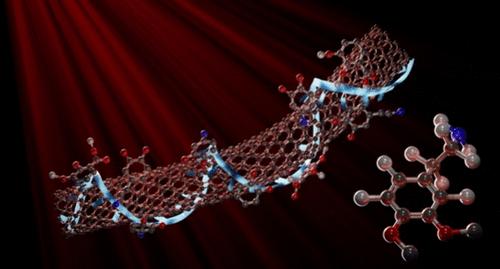
Most traditional optical biosensors operate through molecular recognition, where ligand binding causes conformational changes that lead to optical perturbations in the emitting motif. Optical sensors developed from single-stranded DNA-functionalized single-walled carbon nanotubes (ssDNA–SWCNTs) have started to make useful contributions to biological research. However, the mechanisms underlying their function have remained poorly understood. In this study, we combine experimental and computational approaches to show that ligand binding alone is not sufficient for optical modulation in this class of synthetic biosensors. Instead, the optical response that occurs after ligand binding is highly dependent on the chemical properties of the ligands, resembling mechanisms seen in activity-based biosensors. Specifically, we show that in ssDNA–SWCNT catecholamine sensors, the optical response correlates positively with the electron density on the aryl motif, even among ligands with similar ligand binding affinities. Importantly, despite the strong correlations with electrochemical properties, we find that catechol oxidation itself is not necessary to drive the sensor optical response. We discuss how these findings could serve as a framework for tuning the performance of existing sensors and guiding the development of new biosensors of this class.
期刊介绍:
ACS Nano, published monthly, serves as an international forum for comprehensive articles on nanoscience and nanotechnology research at the intersections of chemistry, biology, materials science, physics, and engineering. The journal fosters communication among scientists in these communities, facilitating collaboration, new research opportunities, and advancements through discoveries. ACS Nano covers synthesis, assembly, characterization, theory, and simulation of nanostructures, nanobiotechnology, nanofabrication, methods and tools for nanoscience and nanotechnology, and self- and directed-assembly. Alongside original research articles, it offers thorough reviews, perspectives on cutting-edge research, and discussions envisioning the future of nanoscience and nanotechnology.




 京公网安备 11010802042870号
京ICP备2023020795号-1
京公网安备 11010802042870号
京ICP备2023020795号-1

 分享
分享
 求助内容:
求助内容: 应助结果提醒方式:
 扫码关注我们
