Mohammad Awashra, Seyed Mehran Mirmohammadi, Lingju Meng, Sami Franssila, Ville Jokinen
{"title":"稳定的空气板延长浸没超疏水表面的生物驱避性","authors":"Mohammad Awashra, Seyed Mehran Mirmohammadi, Lingju Meng, Sami Franssila, Ville Jokinen","doi":"10.1021/acs.langmuir.4c04259","DOIUrl":null,"url":null,"abstract":"Superhydrophobic surfaces find applications in numerous biomedical scenarios, requiring the repellence of biofluids and biomolecules. Plastron, the trapped air between a superhydrophobic surface and a wetting liquid, plays a pivotal role in biofluid repellency. A key challenge, however, is the often short-lived plastron stability in biofluids and the lack of knowledge surrounding it. Plastron stability refers to the duration for which a surface remains in the Cassie state before transitioning to the fully wetting Wenzel state. Here, a submersion test with real-time optical monitoring is used to determine the plastron lifetime of different superhydrophobic surfaces upon immersion in various biofluids. We find that biofluids of all types exhibit shorter plastron lifetimes compared to pure water, which is attributed to their lower surface tension and biomolecular adsorption through hydrophobic–hydrophobic interactions. Proteins and glucose are identified as the major contributors to plastron dissipation in fetal bovine serum-based biofluids. Plastron minimizes the solid–liquid interface, reducing biomolecular adsorption, making its stability crucial for biofluid repellence. Thus, the effects of surface texture, feature size, Cassie solid fraction, Wenzel dimensionless roughness, and surface chemistry on plastron stability are investigated. Our key findings indicate that prolonged plastron stability and thus enhanced biofluid repellency are achieved through a combination of larger plastron volumes, increased Wenzel roughness degrees, greater Cassie solid fractions, and smaller feature sizes. We demonstrate that with optimized parameters, our surface design can maintain plastron stability and sustain a consistent solid–liquid area fraction for over 120 h in complex biofluids containing high levels of protein and glucose, underscoring a robust design for long-term use in biomedical and antifouling applications. This research is essential for advancing the design of superhydrophobic surfaces that effectively resist biofouling in diverse medical and engineering settings.","PeriodicalId":50,"journal":{"name":"Langmuir","volume":"54 1","pages":""},"PeriodicalIF":4.4000,"publicationDate":"2025-01-15","publicationTypes":"Journal Article","fieldsOfStudy":null,"isOpenAccess":false,"openAccessPdf":"","citationCount":"0","resultStr":"{\"title\":\"Stable Air Plastron Prolongs Biofluid Repellency of Submerged Superhydrophobic Surfaces\",\"authors\":\"Mohammad Awashra, Seyed Mehran Mirmohammadi, Lingju Meng, Sami Franssila, Ville Jokinen\",\"doi\":\"10.1021/acs.langmuir.4c04259\",\"DOIUrl\":null,\"url\":null,\"abstract\":\"Superhydrophobic surfaces find applications in numerous biomedical scenarios, requiring the repellence of biofluids and biomolecules. Plastron, the trapped air between a superhydrophobic surface and a wetting liquid, plays a pivotal role in biofluid repellency. A key challenge, however, is the often short-lived plastron stability in biofluids and the lack of knowledge surrounding it. Plastron stability refers to the duration for which a surface remains in the Cassie state before transitioning to the fully wetting Wenzel state. Here, a submersion test with real-time optical monitoring is used to determine the plastron lifetime of different superhydrophobic surfaces upon immersion in various biofluids. We find that biofluids of all types exhibit shorter plastron lifetimes compared to pure water, which is attributed to their lower surface tension and biomolecular adsorption through hydrophobic–hydrophobic interactions. Proteins and glucose are identified as the major contributors to plastron dissipation in fetal bovine serum-based biofluids. Plastron minimizes the solid–liquid interface, reducing biomolecular adsorption, making its stability crucial for biofluid repellence. Thus, the effects of surface texture, feature size, Cassie solid fraction, Wenzel dimensionless roughness, and surface chemistry on plastron stability are investigated. Our key findings indicate that prolonged plastron stability and thus enhanced biofluid repellency are achieved through a combination of larger plastron volumes, increased Wenzel roughness degrees, greater Cassie solid fractions, and smaller feature sizes. We demonstrate that with optimized parameters, our surface design can maintain plastron stability and sustain a consistent solid–liquid area fraction for over 120 h in complex biofluids containing high levels of protein and glucose, underscoring a robust design for long-term use in biomedical and antifouling applications. This research is essential for advancing the design of superhydrophobic surfaces that effectively resist biofouling in diverse medical and engineering settings.\",\"PeriodicalId\":50,\"journal\":{\"name\":\"Langmuir\",\"volume\":\"54 1\",\"pages\":\"\"},\"PeriodicalIF\":4.4000,\"publicationDate\":\"2025-01-15\",\"publicationTypes\":\"Journal Article\",\"fieldsOfStudy\":null,\"isOpenAccess\":false,\"openAccessPdf\":\"\",\"citationCount\":\"0\",\"resultStr\":null,\"platform\":\"Semanticscholar\",\"paperid\":null,\"PeriodicalName\":\"Langmuir\",\"FirstCategoryId\":\"92\",\"ListUrlMain\":\"https://doi.org/10.1021/acs.langmuir.4c04259\",\"RegionNum\":2,\"RegionCategory\":\"化学\",\"ArticlePicture\":[],\"TitleCN\":null,\"AbstractTextCN\":null,\"PMCID\":null,\"EPubDate\":\"\",\"PubModel\":\"\",\"JCR\":\"Q2\",\"JCRName\":\"CHEMISTRY, MULTIDISCIPLINARY\",\"Score\":null,\"Total\":0}","platform":"Semanticscholar","paperid":null,"PeriodicalName":"Langmuir","FirstCategoryId":"92","ListUrlMain":"https://doi.org/10.1021/acs.langmuir.4c04259","RegionNum":2,"RegionCategory":"化学","ArticlePicture":[],"TitleCN":null,"AbstractTextCN":null,"PMCID":null,"EPubDate":"","PubModel":"","JCR":"Q2","JCRName":"CHEMISTRY, MULTIDISCIPLINARY","Score":null,"Total":0}
Stable Air Plastron Prolongs Biofluid Repellency of Submerged Superhydrophobic Surfaces
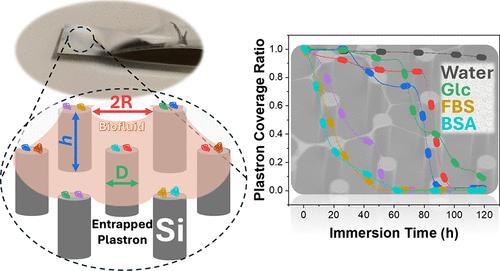
Superhydrophobic surfaces find applications in numerous biomedical scenarios, requiring the repellence of biofluids and biomolecules. Plastron, the trapped air between a superhydrophobic surface and a wetting liquid, plays a pivotal role in biofluid repellency. A key challenge, however, is the often short-lived plastron stability in biofluids and the lack of knowledge surrounding it. Plastron stability refers to the duration for which a surface remains in the Cassie state before transitioning to the fully wetting Wenzel state. Here, a submersion test with real-time optical monitoring is used to determine the plastron lifetime of different superhydrophobic surfaces upon immersion in various biofluids. We find that biofluids of all types exhibit shorter plastron lifetimes compared to pure water, which is attributed to their lower surface tension and biomolecular adsorption through hydrophobic–hydrophobic interactions. Proteins and glucose are identified as the major contributors to plastron dissipation in fetal bovine serum-based biofluids. Plastron minimizes the solid–liquid interface, reducing biomolecular adsorption, making its stability crucial for biofluid repellence. Thus, the effects of surface texture, feature size, Cassie solid fraction, Wenzel dimensionless roughness, and surface chemistry on plastron stability are investigated. Our key findings indicate that prolonged plastron stability and thus enhanced biofluid repellency are achieved through a combination of larger plastron volumes, increased Wenzel roughness degrees, greater Cassie solid fractions, and smaller feature sizes. We demonstrate that with optimized parameters, our surface design can maintain plastron stability and sustain a consistent solid–liquid area fraction for over 120 h in complex biofluids containing high levels of protein and glucose, underscoring a robust design for long-term use in biomedical and antifouling applications. This research is essential for advancing the design of superhydrophobic surfaces that effectively resist biofouling in diverse medical and engineering settings.
期刊介绍:
Langmuir is an interdisciplinary journal publishing articles in the following subject categories:
Colloids: surfactants and self-assembly, dispersions, emulsions, foams
Interfaces: adsorption, reactions, films, forces
Biological Interfaces: biocolloids, biomolecular and biomimetic materials
Materials: nano- and mesostructured materials, polymers, gels, liquid crystals
Electrochemistry: interfacial charge transfer, charge transport, electrocatalysis, electrokinetic phenomena, bioelectrochemistry
Devices and Applications: sensors, fluidics, patterning, catalysis, photonic crystals
However, when high-impact, original work is submitted that does not fit within the above categories, decisions to accept or decline such papers will be based on one criteria: What Would Irving Do?
Langmuir ranks #2 in citations out of 136 journals in the category of Physical Chemistry with 113,157 total citations. The journal received an Impact Factor of 4.384*.
This journal is also indexed in the categories of Materials Science (ranked #1) and Multidisciplinary Chemistry (ranked #5).




 京公网安备 11010802042870号
京ICP备2023020795号-1
京公网安备 11010802042870号
京ICP备2023020795号-1

 分享
分享
 求助内容:
求助内容: 应助结果提醒方式:
 扫码关注我们
