{"title":"砷胆碱型多阳离子电刷的合成及其水溶液水化结构","authors":"Takumi Komiya, Itsuki Watanabe, Raita Goseki, Motoyasu Kobayashi","doi":"10.1021/acs.langmuir.4c04541","DOIUrl":null,"url":null,"abstract":"Arsenocholine-containing methacrylate (MTAsB) inspired by marine organisms was synthesized by the reaction of 2-bromoethyl methacrylate and trimethylarsine to investigate its polymerization behavior and the fundamental properties of the resulting polymer. Controlled radical polymerization of MTAsB proceeded in the presence of a copper catalyst and imidazolium chloride at 60 °C for 8 h to give a water-soluble polycation with a 94% yield. The smaller amount of nonfreezing water and intermediate water of poly(MTAsB) was observed compared with that of the ammonium-containing polycations. A poly(MTAsB) brush was also prepared on a silicon substrate to investigate its swelling structure in aqueous salt solution by scanning probe microscopy and neutron reflectivity measurements. The brush chains adopted a relatively extended conformation in pure water because of the Coulombic repulsion among the arsenic cation groups of the polyelectrolyte, while the brush formed a collapsed structure in aqueous solutions of Hofmeister series anions as a result of the screening effect by salt ions. In particular, thiocyanate ions induced a significant reduction in the swollen thickness of the brush, probably caused by the attractive interaction between arsenic cations and chaotropic thiocyanate ions. The salt concentration dependency of the poly(MTAsB) brush was similar to that of the ammonium-cation-type polyelectrolyte brushes.","PeriodicalId":50,"journal":{"name":"Langmuir","volume":"13 1","pages":""},"PeriodicalIF":4.4000,"publicationDate":"2025-01-15","publicationTypes":"Journal Article","fieldsOfStudy":null,"isOpenAccess":false,"openAccessPdf":"","citationCount":"0","resultStr":"{\"title\":\"Synthesis of Arsenocholine-Type Polycation Brush and Its Hydration Structure in Aqueous Solution\",\"authors\":\"Takumi Komiya, Itsuki Watanabe, Raita Goseki, Motoyasu Kobayashi\",\"doi\":\"10.1021/acs.langmuir.4c04541\",\"DOIUrl\":null,\"url\":null,\"abstract\":\"Arsenocholine-containing methacrylate (MTAsB) inspired by marine organisms was synthesized by the reaction of 2-bromoethyl methacrylate and trimethylarsine to investigate its polymerization behavior and the fundamental properties of the resulting polymer. Controlled radical polymerization of MTAsB proceeded in the presence of a copper catalyst and imidazolium chloride at 60 °C for 8 h to give a water-soluble polycation with a 94% yield. The smaller amount of nonfreezing water and intermediate water of poly(MTAsB) was observed compared with that of the ammonium-containing polycations. A poly(MTAsB) brush was also prepared on a silicon substrate to investigate its swelling structure in aqueous salt solution by scanning probe microscopy and neutron reflectivity measurements. The brush chains adopted a relatively extended conformation in pure water because of the Coulombic repulsion among the arsenic cation groups of the polyelectrolyte, while the brush formed a collapsed structure in aqueous solutions of Hofmeister series anions as a result of the screening effect by salt ions. In particular, thiocyanate ions induced a significant reduction in the swollen thickness of the brush, probably caused by the attractive interaction between arsenic cations and chaotropic thiocyanate ions. The salt concentration dependency of the poly(MTAsB) brush was similar to that of the ammonium-cation-type polyelectrolyte brushes.\",\"PeriodicalId\":50,\"journal\":{\"name\":\"Langmuir\",\"volume\":\"13 1\",\"pages\":\"\"},\"PeriodicalIF\":4.4000,\"publicationDate\":\"2025-01-15\",\"publicationTypes\":\"Journal Article\",\"fieldsOfStudy\":null,\"isOpenAccess\":false,\"openAccessPdf\":\"\",\"citationCount\":\"0\",\"resultStr\":null,\"platform\":\"Semanticscholar\",\"paperid\":null,\"PeriodicalName\":\"Langmuir\",\"FirstCategoryId\":\"92\",\"ListUrlMain\":\"https://doi.org/10.1021/acs.langmuir.4c04541\",\"RegionNum\":2,\"RegionCategory\":\"化学\",\"ArticlePicture\":[],\"TitleCN\":null,\"AbstractTextCN\":null,\"PMCID\":null,\"EPubDate\":\"\",\"PubModel\":\"\",\"JCR\":\"Q2\",\"JCRName\":\"CHEMISTRY, MULTIDISCIPLINARY\",\"Score\":null,\"Total\":0}","platform":"Semanticscholar","paperid":null,"PeriodicalName":"Langmuir","FirstCategoryId":"92","ListUrlMain":"https://doi.org/10.1021/acs.langmuir.4c04541","RegionNum":2,"RegionCategory":"化学","ArticlePicture":[],"TitleCN":null,"AbstractTextCN":null,"PMCID":null,"EPubDate":"","PubModel":"","JCR":"Q2","JCRName":"CHEMISTRY, MULTIDISCIPLINARY","Score":null,"Total":0}
Synthesis of Arsenocholine-Type Polycation Brush and Its Hydration Structure in Aqueous Solution
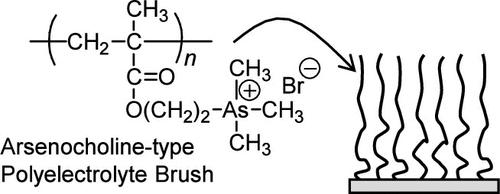
Arsenocholine-containing methacrylate (MTAsB) inspired by marine organisms was synthesized by the reaction of 2-bromoethyl methacrylate and trimethylarsine to investigate its polymerization behavior and the fundamental properties of the resulting polymer. Controlled radical polymerization of MTAsB proceeded in the presence of a copper catalyst and imidazolium chloride at 60 °C for 8 h to give a water-soluble polycation with a 94% yield. The smaller amount of nonfreezing water and intermediate water of poly(MTAsB) was observed compared with that of the ammonium-containing polycations. A poly(MTAsB) brush was also prepared on a silicon substrate to investigate its swelling structure in aqueous salt solution by scanning probe microscopy and neutron reflectivity measurements. The brush chains adopted a relatively extended conformation in pure water because of the Coulombic repulsion among the arsenic cation groups of the polyelectrolyte, while the brush formed a collapsed structure in aqueous solutions of Hofmeister series anions as a result of the screening effect by salt ions. In particular, thiocyanate ions induced a significant reduction in the swollen thickness of the brush, probably caused by the attractive interaction between arsenic cations and chaotropic thiocyanate ions. The salt concentration dependency of the poly(MTAsB) brush was similar to that of the ammonium-cation-type polyelectrolyte brushes.
期刊介绍:
Langmuir is an interdisciplinary journal publishing articles in the following subject categories:
Colloids: surfactants and self-assembly, dispersions, emulsions, foams
Interfaces: adsorption, reactions, films, forces
Biological Interfaces: biocolloids, biomolecular and biomimetic materials
Materials: nano- and mesostructured materials, polymers, gels, liquid crystals
Electrochemistry: interfacial charge transfer, charge transport, electrocatalysis, electrokinetic phenomena, bioelectrochemistry
Devices and Applications: sensors, fluidics, patterning, catalysis, photonic crystals
However, when high-impact, original work is submitted that does not fit within the above categories, decisions to accept or decline such papers will be based on one criteria: What Would Irving Do?
Langmuir ranks #2 in citations out of 136 journals in the category of Physical Chemistry with 113,157 total citations. The journal received an Impact Factor of 4.384*.
This journal is also indexed in the categories of Materials Science (ranked #1) and Multidisciplinary Chemistry (ranked #5).




 京公网安备 11010802042870号
京ICP备2023020795号-1
京公网安备 11010802042870号
京ICP备2023020795号-1

 分享
分享
 求助内容:
求助内容: 应助结果提醒方式:
 扫码关注我们
