Boyong Wu, Tong Yan, Sucheng Liu, Yufeng Su, Cong Xiang, Minjian Li, Zhiming Cui, Li Du, Zhenxing Liang, Huiyu Song
{"title":"用β-二酮添加剂重建高可逆锌阳极双电层","authors":"Boyong Wu, Tong Yan, Sucheng Liu, Yufeng Su, Cong Xiang, Minjian Li, Zhiming Cui, Li Du, Zhenxing Liang, Huiyu Song","doi":"10.1002/adfm.202421244","DOIUrl":null,"url":null,"abstract":"<p>Aqueous Zn ion batteries (AZIBs) have emerged as a promising option for energy storage on a large scale. However, the unsteady electric double layer (EDL) that causes the continuous H<sub>2</sub>O and SO<sub>4</sub><sup>2−</sup> induced side reactions and byproducts, results in unstable anode electrolyte interphase (AEI) and restricts the practical application of AZIBs. A novel EDL reconstruction strategy is proposed by a prior adsorption process of the organic molecules, achieving steady AEI and uniform Zn deposition. Experimental results and theoretical calculations illustrate that the zinc acetylacetonate (Zn(C<sub>5</sub>H<sub>7</sub>O<sub>2</sub>)<sub>2</sub>, Zn(acac)<sub>2</sub>) that conceives a pair of polar groups (─C═O) contributes to stability of AEI. As a result, the electrolyte with Zn(acac)<sub>2</sub> additive (ZnSO<sub>4</sub> + Zn(acac)<sub>2</sub>, ZAH) realizes Zn//Zn cells a highly invertible plating/stripping performance over 2400 h with an average Coulombic efficiency of 99.55%. Moreover, the Zn//NH<sub>4</sub>V<sub>4</sub>O<sub>10</sub> pouch cells with ZAH electrolyte maintain an impressive capacity retention of 55.81% during 3000 cycles. These results spotlight the enormous potential of Zn(acac)<sub>2</sub> additive, providing promising feasibility on highly reversible Zn anodes.</p>","PeriodicalId":112,"journal":{"name":"Advanced Functional Materials","volume":"35 22","pages":""},"PeriodicalIF":19.0000,"publicationDate":"2025-01-16","publicationTypes":"Journal Article","fieldsOfStudy":null,"isOpenAccess":false,"openAccessPdf":"","citationCount":"0","resultStr":"{\"title\":\"Reconstructing Electric Double Layer with β-diketone Additive for Highly Invertible Zn Anode\",\"authors\":\"Boyong Wu, Tong Yan, Sucheng Liu, Yufeng Su, Cong Xiang, Minjian Li, Zhiming Cui, Li Du, Zhenxing Liang, Huiyu Song\",\"doi\":\"10.1002/adfm.202421244\",\"DOIUrl\":null,\"url\":null,\"abstract\":\"<p>Aqueous Zn ion batteries (AZIBs) have emerged as a promising option for energy storage on a large scale. However, the unsteady electric double layer (EDL) that causes the continuous H<sub>2</sub>O and SO<sub>4</sub><sup>2−</sup> induced side reactions and byproducts, results in unstable anode electrolyte interphase (AEI) and restricts the practical application of AZIBs. A novel EDL reconstruction strategy is proposed by a prior adsorption process of the organic molecules, achieving steady AEI and uniform Zn deposition. Experimental results and theoretical calculations illustrate that the zinc acetylacetonate (Zn(C<sub>5</sub>H<sub>7</sub>O<sub>2</sub>)<sub>2</sub>, Zn(acac)<sub>2</sub>) that conceives a pair of polar groups (─C═O) contributes to stability of AEI. As a result, the electrolyte with Zn(acac)<sub>2</sub> additive (ZnSO<sub>4</sub> + Zn(acac)<sub>2</sub>, ZAH) realizes Zn//Zn cells a highly invertible plating/stripping performance over 2400 h with an average Coulombic efficiency of 99.55%. Moreover, the Zn//NH<sub>4</sub>V<sub>4</sub>O<sub>10</sub> pouch cells with ZAH electrolyte maintain an impressive capacity retention of 55.81% during 3000 cycles. These results spotlight the enormous potential of Zn(acac)<sub>2</sub> additive, providing promising feasibility on highly reversible Zn anodes.</p>\",\"PeriodicalId\":112,\"journal\":{\"name\":\"Advanced Functional Materials\",\"volume\":\"35 22\",\"pages\":\"\"},\"PeriodicalIF\":19.0000,\"publicationDate\":\"2025-01-16\",\"publicationTypes\":\"Journal Article\",\"fieldsOfStudy\":null,\"isOpenAccess\":false,\"openAccessPdf\":\"\",\"citationCount\":\"0\",\"resultStr\":null,\"platform\":\"Semanticscholar\",\"paperid\":null,\"PeriodicalName\":\"Advanced Functional Materials\",\"FirstCategoryId\":\"88\",\"ListUrlMain\":\"https://advanced.onlinelibrary.wiley.com/doi/10.1002/adfm.202421244\",\"RegionNum\":1,\"RegionCategory\":\"材料科学\",\"ArticlePicture\":[],\"TitleCN\":null,\"AbstractTextCN\":null,\"PMCID\":null,\"EPubDate\":\"\",\"PubModel\":\"\",\"JCR\":\"Q1\",\"JCRName\":\"CHEMISTRY, MULTIDISCIPLINARY\",\"Score\":null,\"Total\":0}","platform":"Semanticscholar","paperid":null,"PeriodicalName":"Advanced Functional Materials","FirstCategoryId":"88","ListUrlMain":"https://advanced.onlinelibrary.wiley.com/doi/10.1002/adfm.202421244","RegionNum":1,"RegionCategory":"材料科学","ArticlePicture":[],"TitleCN":null,"AbstractTextCN":null,"PMCID":null,"EPubDate":"","PubModel":"","JCR":"Q1","JCRName":"CHEMISTRY, MULTIDISCIPLINARY","Score":null,"Total":0}
Reconstructing Electric Double Layer with β-diketone Additive for Highly Invertible Zn Anode
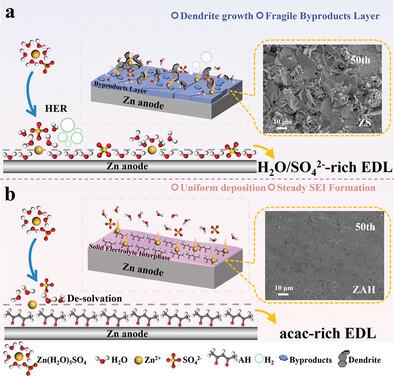
Aqueous Zn ion batteries (AZIBs) have emerged as a promising option for energy storage on a large scale. However, the unsteady electric double layer (EDL) that causes the continuous H2O and SO42− induced side reactions and byproducts, results in unstable anode electrolyte interphase (AEI) and restricts the practical application of AZIBs. A novel EDL reconstruction strategy is proposed by a prior adsorption process of the organic molecules, achieving steady AEI and uniform Zn deposition. Experimental results and theoretical calculations illustrate that the zinc acetylacetonate (Zn(C5H7O2)2, Zn(acac)2) that conceives a pair of polar groups (─C═O) contributes to stability of AEI. As a result, the electrolyte with Zn(acac)2 additive (ZnSO4 + Zn(acac)2, ZAH) realizes Zn//Zn cells a highly invertible plating/stripping performance over 2400 h with an average Coulombic efficiency of 99.55%. Moreover, the Zn//NH4V4O10 pouch cells with ZAH electrolyte maintain an impressive capacity retention of 55.81% during 3000 cycles. These results spotlight the enormous potential of Zn(acac)2 additive, providing promising feasibility on highly reversible Zn anodes.
期刊介绍:
Firmly established as a top-tier materials science journal, Advanced Functional Materials reports breakthrough research in all aspects of materials science, including nanotechnology, chemistry, physics, and biology every week.
Advanced Functional Materials is known for its rapid and fair peer review, quality content, and high impact, making it the first choice of the international materials science community.







 京公网安备 11010802042870号
京ICP备2023020795号-1
京公网安备 11010802042870号
京ICP备2023020795号-1

 分享
分享
 求助内容:
求助内容: 应助结果提醒方式:
 扫码关注我们
