Qingqing Huang, Zhanzhan Zhang, Yu Zhao, Xianghui Cao, Qiushi Li, Nana Feng, Xueyao Wu, Chun Wang, Jian Xiao, Linqi Shi, Yang Liu
{"title":"纳米免疫激活剂诱导内质网应激并减轻肿瘤免疫协同治疗的免疫抑制","authors":"Qingqing Huang, Zhanzhan Zhang, Yu Zhao, Xianghui Cao, Qiushi Li, Nana Feng, Xueyao Wu, Chun Wang, Jian Xiao, Linqi Shi, Yang Liu","doi":"10.1002/adfm.202420278","DOIUrl":null,"url":null,"abstract":"<p>Cancer immunotherapy has transformed the landscape of cancer treatment. However, the low immunogenicity and immunosuppressive tumor microenvironment (TME) often limit the efficacy of immunotherapy. Activating immune responses while alleviating negative feedback regulation offers a promising strategy to enhance the effectiveness of cancer immunotherapy. Herein, this work proposes a novel nanoparticle-based immune activator (nanoIA), which can induce immunogenic cell death (ICD) of tumor cells and deliver small-molecule immunomodulators to further enhance antitumor immune responses. NanoIA features a unique surface structure that enables it to induce ICD by targeting and retaining in the endoplasmic reticulum of tumor cells. Additionally, nanoIA can be loaded with various small-molecule drugs and released in response to stimuli from the TME. This distinct capability enables nanoIA to initiate and amplify antitumor immune responses. This study employs two small-molecule immunomodulators, JQ1 and NLG919, as examples for demonstration. NanoIA/JQ1 and nanoIA/NLG919 demonstrated significant efficacy in inhibiting tumor growth, prolonging survival in tumor-bearing mice, and preventing tumor recurrence and metastasis. These results confirm nanoIA's ability to activate antitumor immune responses and induce immune memory. This work provides new insights into the development of nanoparticles that actively participate in immune regulation.</p>","PeriodicalId":112,"journal":{"name":"Advanced Functional Materials","volume":"35 22","pages":""},"PeriodicalIF":19.0000,"publicationDate":"2025-01-16","publicationTypes":"Journal Article","fieldsOfStudy":null,"isOpenAccess":false,"openAccessPdf":"","citationCount":"0","resultStr":"{\"title\":\"A Nanoimmunoactivator Induces Endoplasmic Reticulum Stress and Alleviates the Immunosuppression for Synergistic Cancer Immunotherapy\",\"authors\":\"Qingqing Huang, Zhanzhan Zhang, Yu Zhao, Xianghui Cao, Qiushi Li, Nana Feng, Xueyao Wu, Chun Wang, Jian Xiao, Linqi Shi, Yang Liu\",\"doi\":\"10.1002/adfm.202420278\",\"DOIUrl\":null,\"url\":null,\"abstract\":\"<p>Cancer immunotherapy has transformed the landscape of cancer treatment. However, the low immunogenicity and immunosuppressive tumor microenvironment (TME) often limit the efficacy of immunotherapy. Activating immune responses while alleviating negative feedback regulation offers a promising strategy to enhance the effectiveness of cancer immunotherapy. Herein, this work proposes a novel nanoparticle-based immune activator (nanoIA), which can induce immunogenic cell death (ICD) of tumor cells and deliver small-molecule immunomodulators to further enhance antitumor immune responses. NanoIA features a unique surface structure that enables it to induce ICD by targeting and retaining in the endoplasmic reticulum of tumor cells. Additionally, nanoIA can be loaded with various small-molecule drugs and released in response to stimuli from the TME. This distinct capability enables nanoIA to initiate and amplify antitumor immune responses. This study employs two small-molecule immunomodulators, JQ1 and NLG919, as examples for demonstration. NanoIA/JQ1 and nanoIA/NLG919 demonstrated significant efficacy in inhibiting tumor growth, prolonging survival in tumor-bearing mice, and preventing tumor recurrence and metastasis. These results confirm nanoIA's ability to activate antitumor immune responses and induce immune memory. This work provides new insights into the development of nanoparticles that actively participate in immune regulation.</p>\",\"PeriodicalId\":112,\"journal\":{\"name\":\"Advanced Functional Materials\",\"volume\":\"35 22\",\"pages\":\"\"},\"PeriodicalIF\":19.0000,\"publicationDate\":\"2025-01-16\",\"publicationTypes\":\"Journal Article\",\"fieldsOfStudy\":null,\"isOpenAccess\":false,\"openAccessPdf\":\"\",\"citationCount\":\"0\",\"resultStr\":null,\"platform\":\"Semanticscholar\",\"paperid\":null,\"PeriodicalName\":\"Advanced Functional Materials\",\"FirstCategoryId\":\"88\",\"ListUrlMain\":\"https://advanced.onlinelibrary.wiley.com/doi/10.1002/adfm.202420278\",\"RegionNum\":1,\"RegionCategory\":\"材料科学\",\"ArticlePicture\":[],\"TitleCN\":null,\"AbstractTextCN\":null,\"PMCID\":null,\"EPubDate\":\"\",\"PubModel\":\"\",\"JCR\":\"Q1\",\"JCRName\":\"CHEMISTRY, MULTIDISCIPLINARY\",\"Score\":null,\"Total\":0}","platform":"Semanticscholar","paperid":null,"PeriodicalName":"Advanced Functional Materials","FirstCategoryId":"88","ListUrlMain":"https://advanced.onlinelibrary.wiley.com/doi/10.1002/adfm.202420278","RegionNum":1,"RegionCategory":"材料科学","ArticlePicture":[],"TitleCN":null,"AbstractTextCN":null,"PMCID":null,"EPubDate":"","PubModel":"","JCR":"Q1","JCRName":"CHEMISTRY, MULTIDISCIPLINARY","Score":null,"Total":0}
A Nanoimmunoactivator Induces Endoplasmic Reticulum Stress and Alleviates the Immunosuppression for Synergistic Cancer Immunotherapy
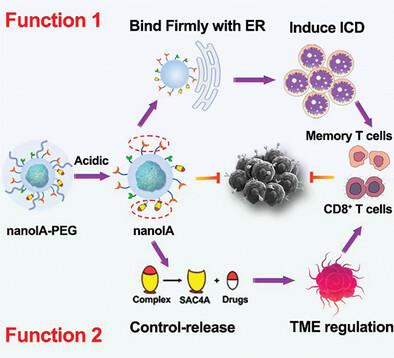
Cancer immunotherapy has transformed the landscape of cancer treatment. However, the low immunogenicity and immunosuppressive tumor microenvironment (TME) often limit the efficacy of immunotherapy. Activating immune responses while alleviating negative feedback regulation offers a promising strategy to enhance the effectiveness of cancer immunotherapy. Herein, this work proposes a novel nanoparticle-based immune activator (nanoIA), which can induce immunogenic cell death (ICD) of tumor cells and deliver small-molecule immunomodulators to further enhance antitumor immune responses. NanoIA features a unique surface structure that enables it to induce ICD by targeting and retaining in the endoplasmic reticulum of tumor cells. Additionally, nanoIA can be loaded with various small-molecule drugs and released in response to stimuli from the TME. This distinct capability enables nanoIA to initiate and amplify antitumor immune responses. This study employs two small-molecule immunomodulators, JQ1 and NLG919, as examples for demonstration. NanoIA/JQ1 and nanoIA/NLG919 demonstrated significant efficacy in inhibiting tumor growth, prolonging survival in tumor-bearing mice, and preventing tumor recurrence and metastasis. These results confirm nanoIA's ability to activate antitumor immune responses and induce immune memory. This work provides new insights into the development of nanoparticles that actively participate in immune regulation.
期刊介绍:
Firmly established as a top-tier materials science journal, Advanced Functional Materials reports breakthrough research in all aspects of materials science, including nanotechnology, chemistry, physics, and biology every week.
Advanced Functional Materials is known for its rapid and fair peer review, quality content, and high impact, making it the first choice of the international materials science community.







 京公网安备 11010802042870号
京ICP备2023020795号-1
京公网安备 11010802042870号
京ICP备2023020795号-1

 分享
分享
 求助内容:
求助内容: 应助结果提醒方式:
 扫码关注我们
