Yanping Zeng , Jian Xiao , Li Shi , Yangsha Li , Yuanxin Xu , Jiayun Zhou , Xiao Dong , Haiyang Hou , Chao Zhong , Gang Cheng , Yi Chen , Naixia Zhang , Yanfen Fang , Youhong Hu
{"title":"2,4-喹唑啉二酮衍生物在促进蛋白质复合物降解中作为LC3B招募者的发现","authors":"Yanping Zeng , Jian Xiao , Li Shi , Yangsha Li , Yuanxin Xu , Jiayun Zhou , Xiao Dong , Haiyang Hou , Chao Zhong , Gang Cheng , Yi Chen , Naixia Zhang , Yanfen Fang , Youhong Hu","doi":"10.1016/j.ejmech.2025.117293","DOIUrl":null,"url":null,"abstract":"<div><div>Targeted protein degradation through autophagosome-tethering compounds (ATTECs) that bypasses the ubiquitination process has garnered increasing attention. LC3B, a key protein in autophagosome formation, recruits substrates into the autophagy-lysosome system for degradation. In this study, we systematically optimized 2,4-quinazolinedione derivatives as LC3B-recruiting fragments, utilizing the CDK9 indicator. By attaching the designed LC3B-recruiting fragment to CDK9 inhibitor SNS-032 through a linker, the resulting bifunctional ATTEC molecule simultaneously degraded CDK9 and its associated Cyclin T1. Two-dimensional NMR experiments confirmed the direct interaction between the novel LC3B-recruiting fragments and LC3B. Mechanistic studies elucidated that degradation occurred <em>via</em> an LC3B-dependent autophagy-lysosomal pathway. Additionally, the general applicability of leveraging LC3B-recruiting fragments linked to inhibitors for the targeted degradation of protein complexes was validated with PRC2 and CDK2/4/6 along with their respective Cyclins. This work provides a series of novel LC3B-recruiting fragments that enrich the ATTEC toolbox and can be applied to the degradation of diverse intracellular disease-causing proteins.</div></div>","PeriodicalId":314,"journal":{"name":"European Journal of Medicinal Chemistry","volume":"287 ","pages":"Article 117293"},"PeriodicalIF":5.9000,"publicationDate":"2025-04-05","publicationTypes":"Journal Article","fieldsOfStudy":null,"isOpenAccess":false,"openAccessPdf":"","citationCount":"0","resultStr":"{\"title\":\"Discovery of 2,4-quinazolinedione derivatives as LC3B recruiters in the facilitation of protein complex degradations\",\"authors\":\"Yanping Zeng , Jian Xiao , Li Shi , Yangsha Li , Yuanxin Xu , Jiayun Zhou , Xiao Dong , Haiyang Hou , Chao Zhong , Gang Cheng , Yi Chen , Naixia Zhang , Yanfen Fang , Youhong Hu\",\"doi\":\"10.1016/j.ejmech.2025.117293\",\"DOIUrl\":null,\"url\":null,\"abstract\":\"<div><div>Targeted protein degradation through autophagosome-tethering compounds (ATTECs) that bypasses the ubiquitination process has garnered increasing attention. LC3B, a key protein in autophagosome formation, recruits substrates into the autophagy-lysosome system for degradation. In this study, we systematically optimized 2,4-quinazolinedione derivatives as LC3B-recruiting fragments, utilizing the CDK9 indicator. By attaching the designed LC3B-recruiting fragment to CDK9 inhibitor SNS-032 through a linker, the resulting bifunctional ATTEC molecule simultaneously degraded CDK9 and its associated Cyclin T1. Two-dimensional NMR experiments confirmed the direct interaction between the novel LC3B-recruiting fragments and LC3B. Mechanistic studies elucidated that degradation occurred <em>via</em> an LC3B-dependent autophagy-lysosomal pathway. Additionally, the general applicability of leveraging LC3B-recruiting fragments linked to inhibitors for the targeted degradation of protein complexes was validated with PRC2 and CDK2/4/6 along with their respective Cyclins. This work provides a series of novel LC3B-recruiting fragments that enrich the ATTEC toolbox and can be applied to the degradation of diverse intracellular disease-causing proteins.</div></div>\",\"PeriodicalId\":314,\"journal\":{\"name\":\"European Journal of Medicinal Chemistry\",\"volume\":\"287 \",\"pages\":\"Article 117293\"},\"PeriodicalIF\":5.9000,\"publicationDate\":\"2025-04-05\",\"publicationTypes\":\"Journal Article\",\"fieldsOfStudy\":null,\"isOpenAccess\":false,\"openAccessPdf\":\"\",\"citationCount\":\"0\",\"resultStr\":null,\"platform\":\"Semanticscholar\",\"paperid\":null,\"PeriodicalName\":\"European Journal of Medicinal Chemistry\",\"FirstCategoryId\":\"3\",\"ListUrlMain\":\"https://www.sciencedirect.com/science/article/pii/S0223523425000583\",\"RegionNum\":2,\"RegionCategory\":\"医学\",\"ArticlePicture\":[],\"TitleCN\":null,\"AbstractTextCN\":null,\"PMCID\":null,\"EPubDate\":\"2025/1/19 0:00:00\",\"PubModel\":\"Epub\",\"JCR\":\"Q1\",\"JCRName\":\"CHEMISTRY, MEDICINAL\",\"Score\":null,\"Total\":0}","platform":"Semanticscholar","paperid":null,"PeriodicalName":"European Journal of Medicinal Chemistry","FirstCategoryId":"3","ListUrlMain":"https://www.sciencedirect.com/science/article/pii/S0223523425000583","RegionNum":2,"RegionCategory":"医学","ArticlePicture":[],"TitleCN":null,"AbstractTextCN":null,"PMCID":null,"EPubDate":"2025/1/19 0:00:00","PubModel":"Epub","JCR":"Q1","JCRName":"CHEMISTRY, MEDICINAL","Score":null,"Total":0}
Discovery of 2,4-quinazolinedione derivatives as LC3B recruiters in the facilitation of protein complex degradations
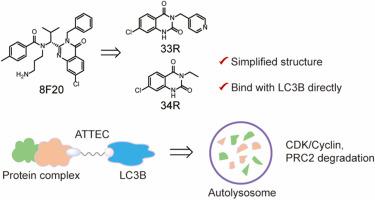
Targeted protein degradation through autophagosome-tethering compounds (ATTECs) that bypasses the ubiquitination process has garnered increasing attention. LC3B, a key protein in autophagosome formation, recruits substrates into the autophagy-lysosome system for degradation. In this study, we systematically optimized 2,4-quinazolinedione derivatives as LC3B-recruiting fragments, utilizing the CDK9 indicator. By attaching the designed LC3B-recruiting fragment to CDK9 inhibitor SNS-032 through a linker, the resulting bifunctional ATTEC molecule simultaneously degraded CDK9 and its associated Cyclin T1. Two-dimensional NMR experiments confirmed the direct interaction between the novel LC3B-recruiting fragments and LC3B. Mechanistic studies elucidated that degradation occurred via an LC3B-dependent autophagy-lysosomal pathway. Additionally, the general applicability of leveraging LC3B-recruiting fragments linked to inhibitors for the targeted degradation of protein complexes was validated with PRC2 and CDK2/4/6 along with their respective Cyclins. This work provides a series of novel LC3B-recruiting fragments that enrich the ATTEC toolbox and can be applied to the degradation of diverse intracellular disease-causing proteins.
期刊介绍:
The European Journal of Medicinal Chemistry is a global journal that publishes studies on all aspects of medicinal chemistry. It provides a medium for publication of original papers and also welcomes critical review papers.
A typical paper would report on the organic synthesis, characterization and pharmacological evaluation of compounds. Other topics of interest are drug design, QSAR, molecular modeling, drug-receptor interactions, molecular aspects of drug metabolism, prodrug synthesis and drug targeting. The journal expects manuscripts to present the rational for a study, provide insight into the design of compounds or understanding of mechanism, or clarify the targets.





 京公网安备 11010802042870号
京ICP备2023020795号-1
京公网安备 11010802042870号
京ICP备2023020795号-1

 分享
分享
 求助内容:
求助内容: 应助结果提醒方式:
 扫码关注我们
