Ignace L.J. De Lathauwer, Wessel W. Nieuwenhuys, Frederique Hafkamp, Marta Regis, Rutger W.M. Brouwers, Mathias Funk, Hareld M.C. Kemps
{"title":"心衰患者远程监测:降低住院和死亡率的有效方案组成部分的综合荟萃分析","authors":"Ignace L.J. De Lathauwer, Wessel W. Nieuwenhuys, Frederique Hafkamp, Marta Regis, Rutger W.M. Brouwers, Mathias Funk, Hareld M.C. Kemps","doi":"10.1002/ejhf.3568","DOIUrl":null,"url":null,"abstract":"<div>\n \n \n <section>\n \n <h3> Aims</h3>\n \n <p>Methods of non-invasive remote patient monitoring (RPM) for heart failure (HF) remain diverse. Understanding factors that influence the effectiveness of RPM on HF-related and all-cause hospitalizations, mortality, and emergency department visits is crucial for developing successful RPM interventions. This meta-analysis aims to synthesize and compare existing literature on RPM components that impact HF-related and all-cause hospitalizations, mortality and emergency department visits in HF patients.</p>\n </section>\n \n <section>\n \n <h3> Methods and results</h3>\n \n <p>A systematic search of electronic databases (PubMed, EMBASE, CENTRAL) identified randomized controlled trials from January 2012 to June 2023, comparing non-invasive RPM interventions for HF with usual care. A random-effects meta-analysis assessed outcomes, and additional analyses identified effective RPM components. A total of 41 studies with 16 312 patients (mean follow-up: 9.88 ± 6.37 months) were included. RPM was associated with lower mortality risk (pooled odds ratio [OR] 0.81 95% confidence interval [CI] 0.69–0.95; <i>I</i><sup>2</sup> = 0.39) and reduced first HF hospitalization risk (pooled OR 0.78, 95% CI: 0.70–0.87; <i>I</i><sup>2</sup> = 0.21) compared to usual care. RPM interventions with a self-management module (<i>p</i> < 0.001) and education module (<i>p</i> = 0.028) significantly lowered HF-related hospitalizations. Video calls during RPM interventions further reduced HF-related (<i>p</i> = 0.047) and all-cause hospitalizations (<i>p</i> < 0.001).</p>\n </section>\n \n <section>\n \n <h3> Conclusion</h3>\n \n <p>This meta-analysis confirms the efficacy of RPM in reducing HF-related hospitalizations and mortality. Effective components include self-management, education modules, and video communication. However, heterogeneity among interventions challenges the overall evaluation. Modernizing RPM with advanced technologies like non-invasive sensors, artificial intelligence, and cardiac telerehabilitation could enhance its potential.</p>\n </section>\n </div>","PeriodicalId":164,"journal":{"name":"European Journal of Heart Failure","volume":"27 9","pages":"1670-1685"},"PeriodicalIF":10.8000,"publicationDate":"2025-01-20","publicationTypes":"Journal Article","fieldsOfStudy":null,"isOpenAccess":false,"openAccessPdf":"https://onlinelibrary.wiley.com/doi/epdf/10.1002/ejhf.3568","citationCount":"0","resultStr":"{\"title\":\"Remote patient monitoring in heart failure: A comprehensive meta-analysis of effective programme components for hospitalization and mortality reduction\",\"authors\":\"Ignace L.J. De Lathauwer, Wessel W. Nieuwenhuys, Frederique Hafkamp, Marta Regis, Rutger W.M. Brouwers, Mathias Funk, Hareld M.C. Kemps\",\"doi\":\"10.1002/ejhf.3568\",\"DOIUrl\":null,\"url\":null,\"abstract\":\"<div>\\n \\n \\n <section>\\n \\n <h3> Aims</h3>\\n \\n <p>Methods of non-invasive remote patient monitoring (RPM) for heart failure (HF) remain diverse. Understanding factors that influence the effectiveness of RPM on HF-related and all-cause hospitalizations, mortality, and emergency department visits is crucial for developing successful RPM interventions. This meta-analysis aims to synthesize and compare existing literature on RPM components that impact HF-related and all-cause hospitalizations, mortality and emergency department visits in HF patients.</p>\\n </section>\\n \\n <section>\\n \\n <h3> Methods and results</h3>\\n \\n <p>A systematic search of electronic databases (PubMed, EMBASE, CENTRAL) identified randomized controlled trials from January 2012 to June 2023, comparing non-invasive RPM interventions for HF with usual care. A random-effects meta-analysis assessed outcomes, and additional analyses identified effective RPM components. A total of 41 studies with 16 312 patients (mean follow-up: 9.88 ± 6.37 months) were included. RPM was associated with lower mortality risk (pooled odds ratio [OR] 0.81 95% confidence interval [CI] 0.69–0.95; <i>I</i><sup>2</sup> = 0.39) and reduced first HF hospitalization risk (pooled OR 0.78, 95% CI: 0.70–0.87; <i>I</i><sup>2</sup> = 0.21) compared to usual care. RPM interventions with a self-management module (<i>p</i> < 0.001) and education module (<i>p</i> = 0.028) significantly lowered HF-related hospitalizations. Video calls during RPM interventions further reduced HF-related (<i>p</i> = 0.047) and all-cause hospitalizations (<i>p</i> < 0.001).</p>\\n </section>\\n \\n <section>\\n \\n <h3> Conclusion</h3>\\n \\n <p>This meta-analysis confirms the efficacy of RPM in reducing HF-related hospitalizations and mortality. Effective components include self-management, education modules, and video communication. However, heterogeneity among interventions challenges the overall evaluation. Modernizing RPM with advanced technologies like non-invasive sensors, artificial intelligence, and cardiac telerehabilitation could enhance its potential.</p>\\n </section>\\n </div>\",\"PeriodicalId\":164,\"journal\":{\"name\":\"European Journal of Heart Failure\",\"volume\":\"27 9\",\"pages\":\"1670-1685\"},\"PeriodicalIF\":10.8000,\"publicationDate\":\"2025-01-20\",\"publicationTypes\":\"Journal Article\",\"fieldsOfStudy\":null,\"isOpenAccess\":false,\"openAccessPdf\":\"https://onlinelibrary.wiley.com/doi/epdf/10.1002/ejhf.3568\",\"citationCount\":\"0\",\"resultStr\":null,\"platform\":\"Semanticscholar\",\"paperid\":null,\"PeriodicalName\":\"European Journal of Heart Failure\",\"FirstCategoryId\":\"3\",\"ListUrlMain\":\"https://onlinelibrary.wiley.com/doi/10.1002/ejhf.3568\",\"RegionNum\":1,\"RegionCategory\":\"医学\",\"ArticlePicture\":[],\"TitleCN\":null,\"AbstractTextCN\":null,\"PMCID\":null,\"EPubDate\":\"\",\"PubModel\":\"\",\"JCR\":\"Q1\",\"JCRName\":\"CARDIAC & CARDIOVASCULAR SYSTEMS\",\"Score\":null,\"Total\":0}","platform":"Semanticscholar","paperid":null,"PeriodicalName":"European Journal of Heart Failure","FirstCategoryId":"3","ListUrlMain":"https://onlinelibrary.wiley.com/doi/10.1002/ejhf.3568","RegionNum":1,"RegionCategory":"医学","ArticlePicture":[],"TitleCN":null,"AbstractTextCN":null,"PMCID":null,"EPubDate":"","PubModel":"","JCR":"Q1","JCRName":"CARDIAC & CARDIOVASCULAR SYSTEMS","Score":null,"Total":0}
Remote patient monitoring in heart failure: A comprehensive meta-analysis of effective programme components for hospitalization and mortality reduction
Aims
Methods of non-invasive remote patient monitoring (RPM) for heart failure (HF) remain diverse. Understanding factors that influence the effectiveness of RPM on HF-related and all-cause hospitalizations, mortality, and emergency department visits is crucial for developing successful RPM interventions. This meta-analysis aims to synthesize and compare existing literature on RPM components that impact HF-related and all-cause hospitalizations, mortality and emergency department visits in HF patients.
Methods and results
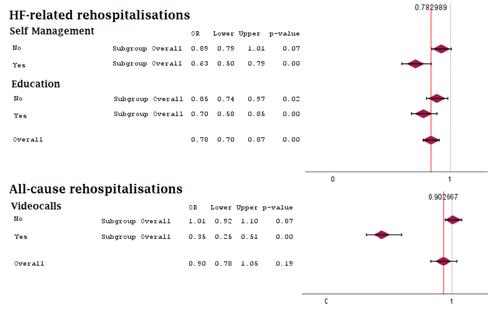
A systematic search of electronic databases (PubMed, EMBASE, CENTRAL) identified randomized controlled trials from January 2012 to June 2023, comparing non-invasive RPM interventions for HF with usual care. A random-effects meta-analysis assessed outcomes, and additional analyses identified effective RPM components. A total of 41 studies with 16 312 patients (mean follow-up: 9.88 ± 6.37 months) were included. RPM was associated with lower mortality risk (pooled odds ratio [OR] 0.81 95% confidence interval [CI] 0.69–0.95; I2 = 0.39) and reduced first HF hospitalization risk (pooled OR 0.78, 95% CI: 0.70–0.87; I2 = 0.21) compared to usual care. RPM interventions with a self-management module (p < 0.001) and education module (p = 0.028) significantly lowered HF-related hospitalizations. Video calls during RPM interventions further reduced HF-related (p = 0.047) and all-cause hospitalizations (p < 0.001).
Conclusion
This meta-analysis confirms the efficacy of RPM in reducing HF-related hospitalizations and mortality. Effective components include self-management, education modules, and video communication. However, heterogeneity among interventions challenges the overall evaluation. Modernizing RPM with advanced technologies like non-invasive sensors, artificial intelligence, and cardiac telerehabilitation could enhance its potential.
期刊介绍:
European Journal of Heart Failure is an international journal dedicated to advancing knowledge in the field of heart failure management. The journal publishes reviews and editorials aimed at improving understanding, prevention, investigation, and treatment of heart failure. It covers various disciplines such as molecular and cellular biology, pathology, physiology, electrophysiology, pharmacology, clinical sciences, social sciences, and population sciences. The journal welcomes submissions of manuscripts on basic, clinical, and population sciences, as well as original contributions on nursing, care of the elderly, primary care, health economics, and other related specialist fields. It is published monthly and has a readership that includes cardiologists, emergency room physicians, intensivists, internists, general physicians, cardiac nurses, diabetologists, epidemiologists, basic scientists focusing on cardiovascular research, and those working in rehabilitation. The journal is abstracted and indexed in various databases such as Academic Search, Embase, MEDLINE/PubMed, and Science Citation Index.





 京公网安备 11010802042870号
京ICP备2023020795号-1
京公网安备 11010802042870号
京ICP备2023020795号-1

 分享
分享
 求助内容:
求助内容: 应助结果提醒方式:
 扫码关注我们
