Hailun Qin, Bart J. van Essen, Jozine M. ter Maaten, Adriaan A. Voors
{"title":"饮酒与男性和女性心力衰竭的关系","authors":"Hailun Qin, Bart J. van Essen, Jozine M. ter Maaten, Adriaan A. Voors","doi":"10.1002/ejhf.3587","DOIUrl":null,"url":null,"abstract":"<div>\n \n \n <section>\n \n <h3> Aims</h3>\n \n <p>Regular heavy alcohol consumption may lead to the development of alcohol-related cardiomyopathy and symptomatic heart failure (HF) later in life. However, the dose–response relationship between alcohol consumption and risk for incident HF, and whether these associations vary by sex and type of alcoholic beverage remains unclear.</p>\n </section>\n \n <section>\n \n <h3> Methods and results</h3>\n \n <p>A total of 407 014 participants (52% women, age 56 years) from the UK Biobank who completed alcohol-related questionnaires and without a history of HF at baseline were included in the study. Competing-risk model and cubic spline regression analyses were used to calculate hazard ratios of the association between alcohol consumption and incident HF in men and women. The associations were adjusted for an extensive set of potential confounders. During a median follow-up of 12 years, 11 735 (34% women) cases of incident HF were identified. Total alcohol consumption was higher in men than in women (median consumption: 16 vs. 8 drinks/week, <i>p</i> < 0.001). A J-shaped association was observed between total alcohol consumption and incident HF in both men and women. Drinking alcohol <28 units/week was associated with a lower risk for developing HF, with a ~20% maximum risk reduction at 14 units/week in men and 7 units/week in women, independent of common confounders. Similar trends were observed in wine consumption. However, the risk of incident HF increases with beer consumption, particularly in women (<i>p</i> for sex interaction = 0.002). Consuming 7–14 units/week of beer was associated with a 29% increased risk of incident HF in women.</p>\n </section>\n \n <section>\n \n <h3> Conclusion</h3>\n \n <p>Alcohol consumption was higher among men compared with women. Although low to moderate total alcohol consumption appears to be associated with a reduced risk of developed HF, beer drinkers, particularly women, were at higher risk of developed HF.</p>\n </section>\n </div>","PeriodicalId":164,"journal":{"name":"European Journal of Heart Failure","volume":"27 10","pages":"1881-1890"},"PeriodicalIF":10.8000,"publicationDate":"2025-01-20","publicationTypes":"Journal Article","fieldsOfStudy":null,"isOpenAccess":false,"openAccessPdf":"https://onlinelibrary.wiley.com/doi/epdf/10.1002/ejhf.3587","citationCount":"0","resultStr":"{\"title\":\"Alcohol consumption and incident heart failure in men and women\",\"authors\":\"Hailun Qin, Bart J. van Essen, Jozine M. ter Maaten, Adriaan A. Voors\",\"doi\":\"10.1002/ejhf.3587\",\"DOIUrl\":null,\"url\":null,\"abstract\":\"<div>\\n \\n \\n <section>\\n \\n <h3> Aims</h3>\\n \\n <p>Regular heavy alcohol consumption may lead to the development of alcohol-related cardiomyopathy and symptomatic heart failure (HF) later in life. However, the dose–response relationship between alcohol consumption and risk for incident HF, and whether these associations vary by sex and type of alcoholic beverage remains unclear.</p>\\n </section>\\n \\n <section>\\n \\n <h3> Methods and results</h3>\\n \\n <p>A total of 407 014 participants (52% women, age 56 years) from the UK Biobank who completed alcohol-related questionnaires and without a history of HF at baseline were included in the study. Competing-risk model and cubic spline regression analyses were used to calculate hazard ratios of the association between alcohol consumption and incident HF in men and women. The associations were adjusted for an extensive set of potential confounders. During a median follow-up of 12 years, 11 735 (34% women) cases of incident HF were identified. Total alcohol consumption was higher in men than in women (median consumption: 16 vs. 8 drinks/week, <i>p</i> < 0.001). A J-shaped association was observed between total alcohol consumption and incident HF in both men and women. Drinking alcohol <28 units/week was associated with a lower risk for developing HF, with a ~20% maximum risk reduction at 14 units/week in men and 7 units/week in women, independent of common confounders. Similar trends were observed in wine consumption. However, the risk of incident HF increases with beer consumption, particularly in women (<i>p</i> for sex interaction = 0.002). Consuming 7–14 units/week of beer was associated with a 29% increased risk of incident HF in women.</p>\\n </section>\\n \\n <section>\\n \\n <h3> Conclusion</h3>\\n \\n <p>Alcohol consumption was higher among men compared with women. Although low to moderate total alcohol consumption appears to be associated with a reduced risk of developed HF, beer drinkers, particularly women, were at higher risk of developed HF.</p>\\n </section>\\n </div>\",\"PeriodicalId\":164,\"journal\":{\"name\":\"European Journal of Heart Failure\",\"volume\":\"27 10\",\"pages\":\"1881-1890\"},\"PeriodicalIF\":10.8000,\"publicationDate\":\"2025-01-20\",\"publicationTypes\":\"Journal Article\",\"fieldsOfStudy\":null,\"isOpenAccess\":false,\"openAccessPdf\":\"https://onlinelibrary.wiley.com/doi/epdf/10.1002/ejhf.3587\",\"citationCount\":\"0\",\"resultStr\":null,\"platform\":\"Semanticscholar\",\"paperid\":null,\"PeriodicalName\":\"European Journal of Heart Failure\",\"FirstCategoryId\":\"3\",\"ListUrlMain\":\"https://onlinelibrary.wiley.com/doi/10.1002/ejhf.3587\",\"RegionNum\":1,\"RegionCategory\":\"医学\",\"ArticlePicture\":[],\"TitleCN\":null,\"AbstractTextCN\":null,\"PMCID\":null,\"EPubDate\":\"\",\"PubModel\":\"\",\"JCR\":\"Q1\",\"JCRName\":\"CARDIAC & CARDIOVASCULAR SYSTEMS\",\"Score\":null,\"Total\":0}","platform":"Semanticscholar","paperid":null,"PeriodicalName":"European Journal of Heart Failure","FirstCategoryId":"3","ListUrlMain":"https://onlinelibrary.wiley.com/doi/10.1002/ejhf.3587","RegionNum":1,"RegionCategory":"医学","ArticlePicture":[],"TitleCN":null,"AbstractTextCN":null,"PMCID":null,"EPubDate":"","PubModel":"","JCR":"Q1","JCRName":"CARDIAC & CARDIOVASCULAR SYSTEMS","Score":null,"Total":0}
Alcohol consumption and incident heart failure in men and women
Aims
Regular heavy alcohol consumption may lead to the development of alcohol-related cardiomyopathy and symptomatic heart failure (HF) later in life. However, the dose–response relationship between alcohol consumption and risk for incident HF, and whether these associations vary by sex and type of alcoholic beverage remains unclear.
Methods and results
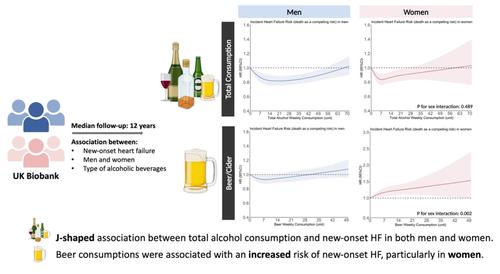
A total of 407 014 participants (52% women, age 56 years) from the UK Biobank who completed alcohol-related questionnaires and without a history of HF at baseline were included in the study. Competing-risk model and cubic spline regression analyses were used to calculate hazard ratios of the association between alcohol consumption and incident HF in men and women. The associations were adjusted for an extensive set of potential confounders. During a median follow-up of 12 years, 11 735 (34% women) cases of incident HF were identified. Total alcohol consumption was higher in men than in women (median consumption: 16 vs. 8 drinks/week, p < 0.001). A J-shaped association was observed between total alcohol consumption and incident HF in both men and women. Drinking alcohol <28 units/week was associated with a lower risk for developing HF, with a ~20% maximum risk reduction at 14 units/week in men and 7 units/week in women, independent of common confounders. Similar trends were observed in wine consumption. However, the risk of incident HF increases with beer consumption, particularly in women (p for sex interaction = 0.002). Consuming 7–14 units/week of beer was associated with a 29% increased risk of incident HF in women.
Conclusion
Alcohol consumption was higher among men compared with women. Although low to moderate total alcohol consumption appears to be associated with a reduced risk of developed HF, beer drinkers, particularly women, were at higher risk of developed HF.
期刊介绍:
European Journal of Heart Failure is an international journal dedicated to advancing knowledge in the field of heart failure management. The journal publishes reviews and editorials aimed at improving understanding, prevention, investigation, and treatment of heart failure. It covers various disciplines such as molecular and cellular biology, pathology, physiology, electrophysiology, pharmacology, clinical sciences, social sciences, and population sciences. The journal welcomes submissions of manuscripts on basic, clinical, and population sciences, as well as original contributions on nursing, care of the elderly, primary care, health economics, and other related specialist fields. It is published monthly and has a readership that includes cardiologists, emergency room physicians, intensivists, internists, general physicians, cardiac nurses, diabetologists, epidemiologists, basic scientists focusing on cardiovascular research, and those working in rehabilitation. The journal is abstracted and indexed in various databases such as Academic Search, Embase, MEDLINE/PubMed, and Science Citation Index.





 京公网安备 11010802042870号
京ICP备2023020795号-1
京公网安备 11010802042870号
京ICP备2023020795号-1

 分享
分享
 求助内容:
求助内容: 应助结果提醒方式:
 扫码关注我们
