{"title":"铒:在2:17型永磁体中同时实现卓越的温度稳定性和高磁性能的关键。","authors":"Zan Long, Chaoyue Zhang, Yuqing Li, Baoguo Zhang, Mengying Bian, Chong Ling, Youning Kang, Hongguo Zhang, Qiong Wu and Ming Yue","doi":"10.1039/D4MH01765J","DOIUrl":null,"url":null,"abstract":"<p >To address the demands of rapidly advancing precision instruments requiring higher efficiency and miniaturization, permanent magnets must exhibit exceptional energy density, temperature stability, high magnetic energy product [(<em>BH</em>)<small><sub>max</sub></small>], and adequate coercivity (<em>H</em><small><sub>cj</sub></small>). Herein, we design rare earth Er-based magnets (2 : 17-type Er-magnets) with a composition of (Er, Sm)(Co, Fe, Cu, Zr)<small><sub>7.6</sub></small>. Erbium-based compounds (Er<small><sub>2</sub></small>Co<small><sub>17</sub></small>) offer a unique combination of temperature compensation and high saturation magnetization compared to other heavy rare earth elements, resulting in 2 : 17-type Er-magnets with superior temperature stability in <em>B</em><small><sub>r</sub></small> and (<em>BH</em>)<small><sub>max</sub></small>. Partially substituting Sm reduces the energy barrier for the 2 : 17H-to-2 : 17R phase transition, promoting the development of a complete cellular structure and achieving enhanced coercivity. Notably, the optimal performance is obtained with Er constituting 60% of the total rare earth content, delivering a near-zero temperature-coefficient for <em>B</em><small><sub>r</sub></small> and (<em>BH</em>)<small><sub>max</sub></small> within 20–150 °C while maintaining <em>B</em><small><sub>r</sub></small> at 8.92 kG, <em>H</em><small><sub>cj</sub></small> at 29.83 kOe, and (<em>BH</em>)<small><sub>max</sub></small> at 18.5 MGOe. These 2 : 17-type Er-magnets provide valuable insights for developing permanent magnets with exceptional comprehensive properties.</p>","PeriodicalId":87,"journal":{"name":"Materials Horizons","volume":" 9","pages":" 2999-3010"},"PeriodicalIF":11.4000,"publicationDate":"2025-01-18","publicationTypes":"Journal Article","fieldsOfStudy":null,"isOpenAccess":false,"openAccessPdf":"","citationCount":"0","resultStr":"{\"title\":\"Erbium: key to simultaneously achieving superior temperature-stability and high magnetic properties in 2 : 17-type permanent magnets†\",\"authors\":\"Zan Long, Chaoyue Zhang, Yuqing Li, Baoguo Zhang, Mengying Bian, Chong Ling, Youning Kang, Hongguo Zhang, Qiong Wu and Ming Yue\",\"doi\":\"10.1039/D4MH01765J\",\"DOIUrl\":null,\"url\":null,\"abstract\":\"<p >To address the demands of rapidly advancing precision instruments requiring higher efficiency and miniaturization, permanent magnets must exhibit exceptional energy density, temperature stability, high magnetic energy product [(<em>BH</em>)<small><sub>max</sub></small>], and adequate coercivity (<em>H</em><small><sub>cj</sub></small>). Herein, we design rare earth Er-based magnets (2 : 17-type Er-magnets) with a composition of (Er, Sm)(Co, Fe, Cu, Zr)<small><sub>7.6</sub></small>. Erbium-based compounds (Er<small><sub>2</sub></small>Co<small><sub>17</sub></small>) offer a unique combination of temperature compensation and high saturation magnetization compared to other heavy rare earth elements, resulting in 2 : 17-type Er-magnets with superior temperature stability in <em>B</em><small><sub>r</sub></small> and (<em>BH</em>)<small><sub>max</sub></small>. Partially substituting Sm reduces the energy barrier for the 2 : 17H-to-2 : 17R phase transition, promoting the development of a complete cellular structure and achieving enhanced coercivity. Notably, the optimal performance is obtained with Er constituting 60% of the total rare earth content, delivering a near-zero temperature-coefficient for <em>B</em><small><sub>r</sub></small> and (<em>BH</em>)<small><sub>max</sub></small> within 20–150 °C while maintaining <em>B</em><small><sub>r</sub></small> at 8.92 kG, <em>H</em><small><sub>cj</sub></small> at 29.83 kOe, and (<em>BH</em>)<small><sub>max</sub></small> at 18.5 MGOe. These 2 : 17-type Er-magnets provide valuable insights for developing permanent magnets with exceptional comprehensive properties.</p>\",\"PeriodicalId\":87,\"journal\":{\"name\":\"Materials Horizons\",\"volume\":\" 9\",\"pages\":\" 2999-3010\"},\"PeriodicalIF\":11.4000,\"publicationDate\":\"2025-01-18\",\"publicationTypes\":\"Journal Article\",\"fieldsOfStudy\":null,\"isOpenAccess\":false,\"openAccessPdf\":\"\",\"citationCount\":\"0\",\"resultStr\":null,\"platform\":\"Semanticscholar\",\"paperid\":null,\"PeriodicalName\":\"Materials Horizons\",\"FirstCategoryId\":\"88\",\"ListUrlMain\":\"https://pubs.rsc.org/en/content/articlelanding/2025/mh/d4mh01765j\",\"RegionNum\":2,\"RegionCategory\":\"材料科学\",\"ArticlePicture\":[],\"TitleCN\":null,\"AbstractTextCN\":null,\"PMCID\":null,\"EPubDate\":\"\",\"PubModel\":\"\",\"JCR\":\"Q1\",\"JCRName\":\"CHEMISTRY, MULTIDISCIPLINARY\",\"Score\":null,\"Total\":0}","platform":"Semanticscholar","paperid":null,"PeriodicalName":"Materials Horizons","FirstCategoryId":"88","ListUrlMain":"https://pubs.rsc.org/en/content/articlelanding/2025/mh/d4mh01765j","RegionNum":2,"RegionCategory":"材料科学","ArticlePicture":[],"TitleCN":null,"AbstractTextCN":null,"PMCID":null,"EPubDate":"","PubModel":"","JCR":"Q1","JCRName":"CHEMISTRY, MULTIDISCIPLINARY","Score":null,"Total":0}
Erbium: key to simultaneously achieving superior temperature-stability and high magnetic properties in 2 : 17-type permanent magnets†
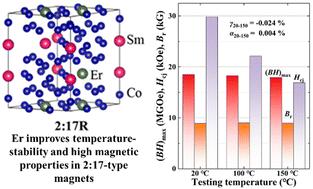
To address the demands of rapidly advancing precision instruments requiring higher efficiency and miniaturization, permanent magnets must exhibit exceptional energy density, temperature stability, high magnetic energy product [(BH)max], and adequate coercivity (Hcj). Herein, we design rare earth Er-based magnets (2 : 17-type Er-magnets) with a composition of (Er, Sm)(Co, Fe, Cu, Zr)7.6. Erbium-based compounds (Er2Co17) offer a unique combination of temperature compensation and high saturation magnetization compared to other heavy rare earth elements, resulting in 2 : 17-type Er-magnets with superior temperature stability in Br and (BH)max. Partially substituting Sm reduces the energy barrier for the 2 : 17H-to-2 : 17R phase transition, promoting the development of a complete cellular structure and achieving enhanced coercivity. Notably, the optimal performance is obtained with Er constituting 60% of the total rare earth content, delivering a near-zero temperature-coefficient for Br and (BH)max within 20–150 °C while maintaining Br at 8.92 kG, Hcj at 29.83 kOe, and (BH)max at 18.5 MGOe. These 2 : 17-type Er-magnets provide valuable insights for developing permanent magnets with exceptional comprehensive properties.




 京公网安备 11010802042870号
京ICP备2023020795号-1
京公网安备 11010802042870号
京ICP备2023020795号-1

 分享
分享
 求助内容:
求助内容: 应助结果提醒方式:
 扫码关注我们
