Jiaojiao Mou , Jie Yang , Yanying Sun , Jing Liu , Yuxin Zhao , Hong Lin , Jianjun Yang
{"title":"枸杞阿拉伯半乳聚糖通过抑制黏膜损伤和调节肠道菌群紊乱来减轻DSS引起的肠道损伤。","authors":"Jiaojiao Mou , Jie Yang , Yanying Sun , Jing Liu , Yuxin Zhao , Hong Lin , Jianjun Yang","doi":"10.1016/j.carbpol.2024.123155","DOIUrl":null,"url":null,"abstract":"<div><div>Intestinal injury and microbiota disorder take part in the development of UC. In this research, we obtained an arabinogalactan (LBP-m) from <em>Lycium barbarum</em> and firstly characterized its physicochemical properties. LBP-m was a homogeneous polysaccharide (172 kDa) consisted of Ara, Gal, Glc, GalA, and GlcA with a mole ratio of 1.00: 0.73: 0.18: 0.20: 0.07, and constructed a →6)-<em>β</em>-Gal<em>p</em>(1→ backbone with different Ara<em>f</em> branches at O-3 position, which exerted as random coil in PBS with single helical structure. Furthermore, oral administration of LBP-m ameliorated the DSS induced UC from different aspects, including regulating barrier dysfunction by promoting the expression of TJs, elevating the anti-oxidative stress capacity through activating the Nrf2/HO-1 pathway, relieving the mucosal inflammation via inhibiting NF-κB pathway. In addition, LBP-m regulated the gut microbiota disorder by reshaping the microbial composition and enhancing the generation of SCFAs. Our research revealed the physicochemical properties of LBP-m and systematically indicated its mitigative effect against DSS induced UC, which could benefit its application in food and pharmacy fields.</div></div>","PeriodicalId":261,"journal":{"name":"Carbohydrate Polymers","volume":"352 ","pages":"Article 123155"},"PeriodicalIF":13.2000,"publicationDate":"2025-03-15","publicationTypes":"Journal Article","fieldsOfStudy":null,"isOpenAccess":false,"openAccessPdf":"","citationCount":"0","resultStr":"{\"title\":\"An arabinogalactan from Lycium barbarum mitigated DSS caused intestinal injury via inhibiting mucosal damage and regulating the gut microbiota disorder\",\"authors\":\"Jiaojiao Mou , Jie Yang , Yanying Sun , Jing Liu , Yuxin Zhao , Hong Lin , Jianjun Yang\",\"doi\":\"10.1016/j.carbpol.2024.123155\",\"DOIUrl\":null,\"url\":null,\"abstract\":\"<div><div>Intestinal injury and microbiota disorder take part in the development of UC. In this research, we obtained an arabinogalactan (LBP-m) from <em>Lycium barbarum</em> and firstly characterized its physicochemical properties. LBP-m was a homogeneous polysaccharide (172 kDa) consisted of Ara, Gal, Glc, GalA, and GlcA with a mole ratio of 1.00: 0.73: 0.18: 0.20: 0.07, and constructed a →6)-<em>β</em>-Gal<em>p</em>(1→ backbone with different Ara<em>f</em> branches at O-3 position, which exerted as random coil in PBS with single helical structure. Furthermore, oral administration of LBP-m ameliorated the DSS induced UC from different aspects, including regulating barrier dysfunction by promoting the expression of TJs, elevating the anti-oxidative stress capacity through activating the Nrf2/HO-1 pathway, relieving the mucosal inflammation via inhibiting NF-κB pathway. In addition, LBP-m regulated the gut microbiota disorder by reshaping the microbial composition and enhancing the generation of SCFAs. Our research revealed the physicochemical properties of LBP-m and systematically indicated its mitigative effect against DSS induced UC, which could benefit its application in food and pharmacy fields.</div></div>\",\"PeriodicalId\":261,\"journal\":{\"name\":\"Carbohydrate Polymers\",\"volume\":\"352 \",\"pages\":\"Article 123155\"},\"PeriodicalIF\":13.2000,\"publicationDate\":\"2025-03-15\",\"publicationTypes\":\"Journal Article\",\"fieldsOfStudy\":null,\"isOpenAccess\":false,\"openAccessPdf\":\"\",\"citationCount\":\"0\",\"resultStr\":null,\"platform\":\"Semanticscholar\",\"paperid\":null,\"PeriodicalName\":\"Carbohydrate Polymers\",\"FirstCategoryId\":\"92\",\"ListUrlMain\":\"https://www.sciencedirect.com/science/article/pii/S014486172401381X\",\"RegionNum\":1,\"RegionCategory\":\"化学\",\"ArticlePicture\":[],\"TitleCN\":null,\"AbstractTextCN\":null,\"PMCID\":null,\"EPubDate\":\"2024/12/15 0:00:00\",\"PubModel\":\"Epub\",\"JCR\":\"Q1\",\"JCRName\":\"CHEMISTRY, APPLIED\",\"Score\":null,\"Total\":0}","platform":"Semanticscholar","paperid":null,"PeriodicalName":"Carbohydrate Polymers","FirstCategoryId":"92","ListUrlMain":"https://www.sciencedirect.com/science/article/pii/S014486172401381X","RegionNum":1,"RegionCategory":"化学","ArticlePicture":[],"TitleCN":null,"AbstractTextCN":null,"PMCID":null,"EPubDate":"2024/12/15 0:00:00","PubModel":"Epub","JCR":"Q1","JCRName":"CHEMISTRY, APPLIED","Score":null,"Total":0}
An arabinogalactan from Lycium barbarum mitigated DSS caused intestinal injury via inhibiting mucosal damage and regulating the gut microbiota disorder
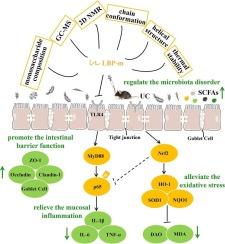
Intestinal injury and microbiota disorder take part in the development of UC. In this research, we obtained an arabinogalactan (LBP-m) from Lycium barbarum and firstly characterized its physicochemical properties. LBP-m was a homogeneous polysaccharide (172 kDa) consisted of Ara, Gal, Glc, GalA, and GlcA with a mole ratio of 1.00: 0.73: 0.18: 0.20: 0.07, and constructed a →6)-β-Galp(1→ backbone with different Araf branches at O-3 position, which exerted as random coil in PBS with single helical structure. Furthermore, oral administration of LBP-m ameliorated the DSS induced UC from different aspects, including regulating barrier dysfunction by promoting the expression of TJs, elevating the anti-oxidative stress capacity through activating the Nrf2/HO-1 pathway, relieving the mucosal inflammation via inhibiting NF-κB pathway. In addition, LBP-m regulated the gut microbiota disorder by reshaping the microbial composition and enhancing the generation of SCFAs. Our research revealed the physicochemical properties of LBP-m and systematically indicated its mitigative effect against DSS induced UC, which could benefit its application in food and pharmacy fields.
期刊介绍:
Carbohydrate Polymers stands as a prominent journal in the glycoscience field, dedicated to exploring and harnessing the potential of polysaccharides with applications spanning bioenergy, bioplastics, biomaterials, biorefining, chemistry, drug delivery, food, health, nanotechnology, packaging, paper, pharmaceuticals, medicine, oil recovery, textiles, tissue engineering, wood, and various aspects of glycoscience.
The journal emphasizes the central role of well-characterized carbohydrate polymers, highlighting their significance as the primary focus rather than a peripheral topic. Each paper must prominently feature at least one named carbohydrate polymer, evident in both citation and title, with a commitment to innovative research that advances scientific knowledge.




 京公网安备 11010802042870号
京ICP备2023020795号-1
京公网安备 11010802042870号
京ICP备2023020795号-1

 分享
分享
 求助内容:
求助内容: 应助结果提醒方式:
 扫码关注我们
