Alfonso Miranda-Molina , Sol Castrejón-Carrillo , Guadalupe Trinidad Zavala-Padilla , Mayra Antúnez-Mojica , Laura Alvarez , María Elena Rodríguez-Alegría , Agustín López Munguía
{"title":"levan的分支和分子量:结构变异性和酶水解敏感性的详细分析。","authors":"Alfonso Miranda-Molina , Sol Castrejón-Carrillo , Guadalupe Trinidad Zavala-Padilla , Mayra Antúnez-Mojica , Laura Alvarez , María Elena Rodríguez-Alegría , Agustín López Munguía","doi":"10.1016/j.carbpol.2025.123236","DOIUrl":null,"url":null,"abstract":"<div><div>Levan, a β(2 → 6) linked D-fructofuranosyl polymer, is gaining significant attention in basic and applied research. It has been demonstrated that most properties are related to levan molecular weight but also its β(2 → 1) branching degree. In this paper the relationship between levan branching degree, particle size, and molecular weight is reviewed, exploring also how these structural parameters influence levan susceptibility to exo- and endolevanase hydrolysis for levans produced by three recombinants bacterial levansucrases. We found almost no association between molecular weight and neither particle size nor branching degree in levans described in the literature including those evaluated in this work. We also found that all evaluated levans form spherical nanoparticles. Interestingly, in enzyme assays with the synthesized levans, increasing branching and decreasing particle size are inversely associated with lower exolevanase (<em>Bs-</em>SacB) and endolevanase (<em>Bl</em>-LevB) hydrolysis rates. After a limited but exclusive β(2 → 6) exolevanase hydrolysis a <em>limit-levan</em> structure may be obtained. In the case of endolevanase hydrolysis, branching not only decreases endolevanase activity but also affects the type of oligosaccharides obtained, probably due to limited access to the enzyme to linear regions of the polymer.</div></div>","PeriodicalId":261,"journal":{"name":"Carbohydrate Polymers","volume":"352 ","pages":"Article 123236"},"PeriodicalIF":13.2000,"publicationDate":"2025-03-15","publicationTypes":"Journal Article","fieldsOfStudy":null,"isOpenAccess":false,"openAccessPdf":"","citationCount":"0","resultStr":"{\"title\":\"Branching and molecular weight in levan: A detailed analysis of structural variability and enzymatic hydrolysis susceptibility\",\"authors\":\"Alfonso Miranda-Molina , Sol Castrejón-Carrillo , Guadalupe Trinidad Zavala-Padilla , Mayra Antúnez-Mojica , Laura Alvarez , María Elena Rodríguez-Alegría , Agustín López Munguía\",\"doi\":\"10.1016/j.carbpol.2025.123236\",\"DOIUrl\":null,\"url\":null,\"abstract\":\"<div><div>Levan, a β(2 → 6) linked D-fructofuranosyl polymer, is gaining significant attention in basic and applied research. It has been demonstrated that most properties are related to levan molecular weight but also its β(2 → 1) branching degree. In this paper the relationship between levan branching degree, particle size, and molecular weight is reviewed, exploring also how these structural parameters influence levan susceptibility to exo- and endolevanase hydrolysis for levans produced by three recombinants bacterial levansucrases. We found almost no association between molecular weight and neither particle size nor branching degree in levans described in the literature including those evaluated in this work. We also found that all evaluated levans form spherical nanoparticles. Interestingly, in enzyme assays with the synthesized levans, increasing branching and decreasing particle size are inversely associated with lower exolevanase (<em>Bs-</em>SacB) and endolevanase (<em>Bl</em>-LevB) hydrolysis rates. After a limited but exclusive β(2 → 6) exolevanase hydrolysis a <em>limit-levan</em> structure may be obtained. In the case of endolevanase hydrolysis, branching not only decreases endolevanase activity but also affects the type of oligosaccharides obtained, probably due to limited access to the enzyme to linear regions of the polymer.</div></div>\",\"PeriodicalId\":261,\"journal\":{\"name\":\"Carbohydrate Polymers\",\"volume\":\"352 \",\"pages\":\"Article 123236\"},\"PeriodicalIF\":13.2000,\"publicationDate\":\"2025-03-15\",\"publicationTypes\":\"Journal Article\",\"fieldsOfStudy\":null,\"isOpenAccess\":false,\"openAccessPdf\":\"\",\"citationCount\":\"0\",\"resultStr\":null,\"platform\":\"Semanticscholar\",\"paperid\":null,\"PeriodicalName\":\"Carbohydrate Polymers\",\"FirstCategoryId\":\"92\",\"ListUrlMain\":\"https://www.sciencedirect.com/science/article/pii/S0144861725000177\",\"RegionNum\":1,\"RegionCategory\":\"化学\",\"ArticlePicture\":[],\"TitleCN\":null,\"AbstractTextCN\":null,\"PMCID\":null,\"EPubDate\":\"2025/1/5 0:00:00\",\"PubModel\":\"Epub\",\"JCR\":\"Q1\",\"JCRName\":\"CHEMISTRY, APPLIED\",\"Score\":null,\"Total\":0}","platform":"Semanticscholar","paperid":null,"PeriodicalName":"Carbohydrate Polymers","FirstCategoryId":"92","ListUrlMain":"https://www.sciencedirect.com/science/article/pii/S0144861725000177","RegionNum":1,"RegionCategory":"化学","ArticlePicture":[],"TitleCN":null,"AbstractTextCN":null,"PMCID":null,"EPubDate":"2025/1/5 0:00:00","PubModel":"Epub","JCR":"Q1","JCRName":"CHEMISTRY, APPLIED","Score":null,"Total":0}
Branching and molecular weight in levan: A detailed analysis of structural variability and enzymatic hydrolysis susceptibility
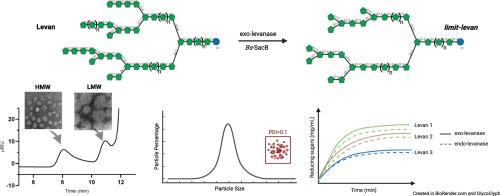
Levan, a β(2 → 6) linked D-fructofuranosyl polymer, is gaining significant attention in basic and applied research. It has been demonstrated that most properties are related to levan molecular weight but also its β(2 → 1) branching degree. In this paper the relationship between levan branching degree, particle size, and molecular weight is reviewed, exploring also how these structural parameters influence levan susceptibility to exo- and endolevanase hydrolysis for levans produced by three recombinants bacterial levansucrases. We found almost no association between molecular weight and neither particle size nor branching degree in levans described in the literature including those evaluated in this work. We also found that all evaluated levans form spherical nanoparticles. Interestingly, in enzyme assays with the synthesized levans, increasing branching and decreasing particle size are inversely associated with lower exolevanase (Bs-SacB) and endolevanase (Bl-LevB) hydrolysis rates. After a limited but exclusive β(2 → 6) exolevanase hydrolysis a limit-levan structure may be obtained. In the case of endolevanase hydrolysis, branching not only decreases endolevanase activity but also affects the type of oligosaccharides obtained, probably due to limited access to the enzyme to linear regions of the polymer.
期刊介绍:
Carbohydrate Polymers stands as a prominent journal in the glycoscience field, dedicated to exploring and harnessing the potential of polysaccharides with applications spanning bioenergy, bioplastics, biomaterials, biorefining, chemistry, drug delivery, food, health, nanotechnology, packaging, paper, pharmaceuticals, medicine, oil recovery, textiles, tissue engineering, wood, and various aspects of glycoscience.
The journal emphasizes the central role of well-characterized carbohydrate polymers, highlighting their significance as the primary focus rather than a peripheral topic. Each paper must prominently feature at least one named carbohydrate polymer, evident in both citation and title, with a commitment to innovative research that advances scientific knowledge.




 京公网安备 11010802042870号
京ICP备2023020795号-1
京公网安备 11010802042870号
京ICP备2023020795号-1

 分享
分享
 求助内容:
求助内容: 应助结果提醒方式:
 扫码关注我们
