Solin Lee , Donguk Kim , Alem Araya Meresa, Suk Tai Chang, Felix Sunjoo Kim
{"title":"纤维素- pedot:PSS复合材料与阴离子在固态有机电化学晶体管中的相容性。","authors":"Solin Lee , Donguk Kim , Alem Araya Meresa, Suk Tai Chang, Felix Sunjoo Kim","doi":"10.1016/j.carbpol.2024.123146","DOIUrl":null,"url":null,"abstract":"<div><div>We investigate the effects of water-processable celluloses on the charge-transport properties in the conducting polymer composites and their solid-state organic electrochemical transistors (OECTs). Water-soluble methyl cellulose (MC) and water-dispersible cellulose nanofiber (CNF) are blended with poly(3,4-ethylenedioxythiophene):poly(styrene sulfonate) (PEDOT:PSS) in solution and used as a conductive channel. Both cellulose–PEDOT:PSS composites show fibrillar structures in thin films with respective dimensions of cellulose. The electrical conductivity was increased with 5–10 wt% of cellulose in the composite. The solid-state OECTs show better performance when the ionogel contains 1-ethyl-3-methylimidazolium triflate (EMIM:OTf) compared to the system with the commonly used EMIM bis(trifluoromethyl sulfonyl)imide (EMIM:TFSI). The MC–PEDOT:PSS composite paired with an EMIM:OTf-based ionogel exhibits a high figure-of-merit (μC<sup>⁎</sup>) of OECTs of >50 F cm<sup>−1</sup> V<sup>−1</sup> s<sup>−1</sup> and an on-to-off current ratio of >10<sup>3</sup>. Our results show that cellulose and EMIM:OTf are compatible with PEDOT:PSS and that appropriate materials pairing can improve the properties of PEDOT:PSS-based composites and the performance of their electrochemical devices.</div></div>","PeriodicalId":261,"journal":{"name":"Carbohydrate Polymers","volume":"352 ","pages":"Article 123146"},"PeriodicalIF":12.5000,"publicationDate":"2025-03-15","publicationTypes":"Journal Article","fieldsOfStudy":null,"isOpenAccess":false,"openAccessPdf":"","citationCount":"0","resultStr":"{\"title\":\"Compatibility of cellulose–PEDOT:PSS composites and anions in solid-state organic electrochemical transistors\",\"authors\":\"Solin Lee , Donguk Kim , Alem Araya Meresa, Suk Tai Chang, Felix Sunjoo Kim\",\"doi\":\"10.1016/j.carbpol.2024.123146\",\"DOIUrl\":null,\"url\":null,\"abstract\":\"<div><div>We investigate the effects of water-processable celluloses on the charge-transport properties in the conducting polymer composites and their solid-state organic electrochemical transistors (OECTs). Water-soluble methyl cellulose (MC) and water-dispersible cellulose nanofiber (CNF) are blended with poly(3,4-ethylenedioxythiophene):poly(styrene sulfonate) (PEDOT:PSS) in solution and used as a conductive channel. Both cellulose–PEDOT:PSS composites show fibrillar structures in thin films with respective dimensions of cellulose. The electrical conductivity was increased with 5–10 wt% of cellulose in the composite. The solid-state OECTs show better performance when the ionogel contains 1-ethyl-3-methylimidazolium triflate (EMIM:OTf) compared to the system with the commonly used EMIM bis(trifluoromethyl sulfonyl)imide (EMIM:TFSI). The MC–PEDOT:PSS composite paired with an EMIM:OTf-based ionogel exhibits a high figure-of-merit (μC<sup>⁎</sup>) of OECTs of >50 F cm<sup>−1</sup> V<sup>−1</sup> s<sup>−1</sup> and an on-to-off current ratio of >10<sup>3</sup>. Our results show that cellulose and EMIM:OTf are compatible with PEDOT:PSS and that appropriate materials pairing can improve the properties of PEDOT:PSS-based composites and the performance of their electrochemical devices.</div></div>\",\"PeriodicalId\":261,\"journal\":{\"name\":\"Carbohydrate Polymers\",\"volume\":\"352 \",\"pages\":\"Article 123146\"},\"PeriodicalIF\":12.5000,\"publicationDate\":\"2025-03-15\",\"publicationTypes\":\"Journal Article\",\"fieldsOfStudy\":null,\"isOpenAccess\":false,\"openAccessPdf\":\"\",\"citationCount\":\"0\",\"resultStr\":null,\"platform\":\"Semanticscholar\",\"paperid\":null,\"PeriodicalName\":\"Carbohydrate Polymers\",\"FirstCategoryId\":\"92\",\"ListUrlMain\":\"https://www.sciencedirect.com/science/article/pii/S0144861724013729\",\"RegionNum\":1,\"RegionCategory\":\"化学\",\"ArticlePicture\":[],\"TitleCN\":null,\"AbstractTextCN\":null,\"PMCID\":null,\"EPubDate\":\"2024/12/13 0:00:00\",\"PubModel\":\"Epub\",\"JCR\":\"Q1\",\"JCRName\":\"CHEMISTRY, APPLIED\",\"Score\":null,\"Total\":0}","platform":"Semanticscholar","paperid":null,"PeriodicalName":"Carbohydrate Polymers","FirstCategoryId":"92","ListUrlMain":"https://www.sciencedirect.com/science/article/pii/S0144861724013729","RegionNum":1,"RegionCategory":"化学","ArticlePicture":[],"TitleCN":null,"AbstractTextCN":null,"PMCID":null,"EPubDate":"2024/12/13 0:00:00","PubModel":"Epub","JCR":"Q1","JCRName":"CHEMISTRY, APPLIED","Score":null,"Total":0}
引用次数: 0
摘要
研究了可水处理纤维素对导电聚合物复合材料及其固态有机电化学晶体管(OECTs)中电荷输运特性的影响。将水溶性甲基纤维素(MC)和水分散纤维素纳米纤维(CNF)与聚(3,4-乙烯二氧噻吩):聚(苯乙烯磺酸盐)(PEDOT:PSS)溶液共混,作为导电通道。两种纤维素- pedot:PSS复合材料均表现出纤维状结构,其薄膜具有纤维素的相应尺寸。在复合材料中加入5-10 wt%的纤维素可提高导电率。当离子凝胶中含有1-乙基-3-甲基咪唑三氟酸酯(EMIM:OTf)时,固态oect的性能优于含有常用的EMIM双(三氟甲基磺酰)亚胺(EMIM:TFSI)的体系。MC-PEDOT:PSS复合材料与基于EMIM: otf的离子凝胶配对,其OECTs的高品质系数(μC β)为bbb50 F cm-1 V-1 s-1,通断电流比为>103。研究结果表明,纤维素和EMIM:OTf与PEDOT:PSS具有良好的相容性,适当的材料搭配可以提高PEDOT:PSS复合材料的性能和电化学器件的性能。
Compatibility of cellulose–PEDOT:PSS composites and anions in solid-state organic electrochemical transistors
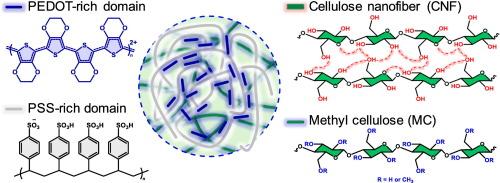
We investigate the effects of water-processable celluloses on the charge-transport properties in the conducting polymer composites and their solid-state organic electrochemical transistors (OECTs). Water-soluble methyl cellulose (MC) and water-dispersible cellulose nanofiber (CNF) are blended with poly(3,4-ethylenedioxythiophene):poly(styrene sulfonate) (PEDOT:PSS) in solution and used as a conductive channel. Both cellulose–PEDOT:PSS composites show fibrillar structures in thin films with respective dimensions of cellulose. The electrical conductivity was increased with 5–10 wt% of cellulose in the composite. The solid-state OECTs show better performance when the ionogel contains 1-ethyl-3-methylimidazolium triflate (EMIM:OTf) compared to the system with the commonly used EMIM bis(trifluoromethyl sulfonyl)imide (EMIM:TFSI). The MC–PEDOT:PSS composite paired with an EMIM:OTf-based ionogel exhibits a high figure-of-merit (μC⁎) of OECTs of >50 F cm−1 V−1 s−1 and an on-to-off current ratio of >103. Our results show that cellulose and EMIM:OTf are compatible with PEDOT:PSS and that appropriate materials pairing can improve the properties of PEDOT:PSS-based composites and the performance of their electrochemical devices.
期刊介绍:
Carbohydrate Polymers stands as a prominent journal in the glycoscience field, dedicated to exploring and harnessing the potential of polysaccharides with applications spanning bioenergy, bioplastics, biomaterials, biorefining, chemistry, drug delivery, food, health, nanotechnology, packaging, paper, pharmaceuticals, medicine, oil recovery, textiles, tissue engineering, wood, and various aspects of glycoscience.
The journal emphasizes the central role of well-characterized carbohydrate polymers, highlighting their significance as the primary focus rather than a peripheral topic. Each paper must prominently feature at least one named carbohydrate polymer, evident in both citation and title, with a commitment to innovative research that advances scientific knowledge.




 京公网安备 11010802042870号
京ICP备2023020795号-1
京公网安备 11010802042870号
京ICP备2023020795号-1

 分享
分享
 求助内容:
求助内容: 应助结果提醒方式:
 扫码关注我们
