Arman Jafari , Khushbu Bhatt , Seyyed Vahid Niknezhad , Abdellah Ajji , May Griffith , Gregor Andelfinger , Sidi A. Bencherif , Houman Savoji
{"title":"用于软组织工程的光交联木瓜籽水凝胶的合成与表征。","authors":"Arman Jafari , Khushbu Bhatt , Seyyed Vahid Niknezhad , Abdellah Ajji , May Griffith , Gregor Andelfinger , Sidi A. Bencherif , Houman Savoji","doi":"10.1016/j.carbpol.2024.123140","DOIUrl":null,"url":null,"abstract":"<div><div>The convenience, versatility, and biocompatibility of photocrosslinkable hydrogel precursors make them promising candidates for developing tissue engineering scaffolds. However, the current library of photosensitive materials is limited. This study reports, for the first time, the modification of quince seed mucilage (QS) with glycidyl methacrylate (GM), resulting in the synthesis of methacrylated QS (QSGM). The chemical composition and structure of QS were analyzed. The effects of reaction time, temperature, QS concentration, and GM/QS ratio on the degree of methacrylation, as well as the physicochemical, rheological, mechanical, and biological properties of the synthesized materials were explored. Chemical characterization using <sup>1</sup>H NMR and FTIR confirmed the successful methacrylation of QS. Hydrogels fabricated from QSGMs at a 0.5 wt% concentration exhibited high swelling ratios of 320 to 580 g/g, and compressive strengths between 0.6 ± 0.1 and 1.2 ± 0.3 kPa. No significant changes in the rheological properties of hydrogel precursors were observed. Moreover, QSGM-based hydrogels supported cell encapsulation for 14 days with minimal cytotoxicity and immune cell activation. Finally, as a proof of concept, the potential use of QSGM for 3D printing was demonstrated. Overall, the results highlight the significant potential of QSGMs as a biomaterial of choice for soft tissue engineering applications.</div></div>","PeriodicalId":261,"journal":{"name":"Carbohydrate Polymers","volume":"352 ","pages":"Article 123140"},"PeriodicalIF":12.5000,"publicationDate":"2025-03-15","publicationTypes":"Journal Article","fieldsOfStudy":null,"isOpenAccess":false,"openAccessPdf":"","citationCount":"0","resultStr":"{\"title\":\"Synthesis and characterization of photo-cross-linkable quince seed-based hydrogels for soft tissue engineering applications\",\"authors\":\"Arman Jafari , Khushbu Bhatt , Seyyed Vahid Niknezhad , Abdellah Ajji , May Griffith , Gregor Andelfinger , Sidi A. Bencherif , Houman Savoji\",\"doi\":\"10.1016/j.carbpol.2024.123140\",\"DOIUrl\":null,\"url\":null,\"abstract\":\"<div><div>The convenience, versatility, and biocompatibility of photocrosslinkable hydrogel precursors make them promising candidates for developing tissue engineering scaffolds. However, the current library of photosensitive materials is limited. This study reports, for the first time, the modification of quince seed mucilage (QS) with glycidyl methacrylate (GM), resulting in the synthesis of methacrylated QS (QSGM). The chemical composition and structure of QS were analyzed. The effects of reaction time, temperature, QS concentration, and GM/QS ratio on the degree of methacrylation, as well as the physicochemical, rheological, mechanical, and biological properties of the synthesized materials were explored. Chemical characterization using <sup>1</sup>H NMR and FTIR confirmed the successful methacrylation of QS. Hydrogels fabricated from QSGMs at a 0.5 wt% concentration exhibited high swelling ratios of 320 to 580 g/g, and compressive strengths between 0.6 ± 0.1 and 1.2 ± 0.3 kPa. No significant changes in the rheological properties of hydrogel precursors were observed. Moreover, QSGM-based hydrogels supported cell encapsulation for 14 days with minimal cytotoxicity and immune cell activation. Finally, as a proof of concept, the potential use of QSGM for 3D printing was demonstrated. Overall, the results highlight the significant potential of QSGMs as a biomaterial of choice for soft tissue engineering applications.</div></div>\",\"PeriodicalId\":261,\"journal\":{\"name\":\"Carbohydrate Polymers\",\"volume\":\"352 \",\"pages\":\"Article 123140\"},\"PeriodicalIF\":12.5000,\"publicationDate\":\"2025-03-15\",\"publicationTypes\":\"Journal Article\",\"fieldsOfStudy\":null,\"isOpenAccess\":false,\"openAccessPdf\":\"\",\"citationCount\":\"0\",\"resultStr\":null,\"platform\":\"Semanticscholar\",\"paperid\":null,\"PeriodicalName\":\"Carbohydrate Polymers\",\"FirstCategoryId\":\"92\",\"ListUrlMain\":\"https://www.sciencedirect.com/science/article/pii/S0144861724013663\",\"RegionNum\":1,\"RegionCategory\":\"化学\",\"ArticlePicture\":[],\"TitleCN\":null,\"AbstractTextCN\":null,\"PMCID\":null,\"EPubDate\":\"2024/12/12 0:00:00\",\"PubModel\":\"Epub\",\"JCR\":\"Q1\",\"JCRName\":\"CHEMISTRY, APPLIED\",\"Score\":null,\"Total\":0}","platform":"Semanticscholar","paperid":null,"PeriodicalName":"Carbohydrate Polymers","FirstCategoryId":"92","ListUrlMain":"https://www.sciencedirect.com/science/article/pii/S0144861724013663","RegionNum":1,"RegionCategory":"化学","ArticlePicture":[],"TitleCN":null,"AbstractTextCN":null,"PMCID":null,"EPubDate":"2024/12/12 0:00:00","PubModel":"Epub","JCR":"Q1","JCRName":"CHEMISTRY, APPLIED","Score":null,"Total":0}
Synthesis and characterization of photo-cross-linkable quince seed-based hydrogels for soft tissue engineering applications
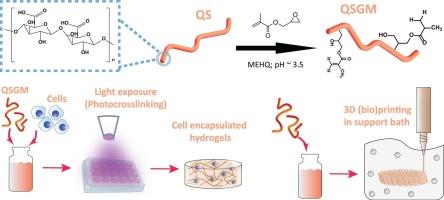
The convenience, versatility, and biocompatibility of photocrosslinkable hydrogel precursors make them promising candidates for developing tissue engineering scaffolds. However, the current library of photosensitive materials is limited. This study reports, for the first time, the modification of quince seed mucilage (QS) with glycidyl methacrylate (GM), resulting in the synthesis of methacrylated QS (QSGM). The chemical composition and structure of QS were analyzed. The effects of reaction time, temperature, QS concentration, and GM/QS ratio on the degree of methacrylation, as well as the physicochemical, rheological, mechanical, and biological properties of the synthesized materials were explored. Chemical characterization using 1H NMR and FTIR confirmed the successful methacrylation of QS. Hydrogels fabricated from QSGMs at a 0.5 wt% concentration exhibited high swelling ratios of 320 to 580 g/g, and compressive strengths between 0.6 ± 0.1 and 1.2 ± 0.3 kPa. No significant changes in the rheological properties of hydrogel precursors were observed. Moreover, QSGM-based hydrogels supported cell encapsulation for 14 days with minimal cytotoxicity and immune cell activation. Finally, as a proof of concept, the potential use of QSGM for 3D printing was demonstrated. Overall, the results highlight the significant potential of QSGMs as a biomaterial of choice for soft tissue engineering applications.
期刊介绍:
Carbohydrate Polymers stands as a prominent journal in the glycoscience field, dedicated to exploring and harnessing the potential of polysaccharides with applications spanning bioenergy, bioplastics, biomaterials, biorefining, chemistry, drug delivery, food, health, nanotechnology, packaging, paper, pharmaceuticals, medicine, oil recovery, textiles, tissue engineering, wood, and various aspects of glycoscience.
The journal emphasizes the central role of well-characterized carbohydrate polymers, highlighting their significance as the primary focus rather than a peripheral topic. Each paper must prominently feature at least one named carbohydrate polymer, evident in both citation and title, with a commitment to innovative research that advances scientific knowledge.




 京公网安备 11010802042870号
京ICP备2023020795号-1
京公网安备 11010802042870号
京ICP备2023020795号-1

 分享
分享
 求助内容:
求助内容: 应助结果提醒方式:
 扫码关注我们
