Meijuan Liu, Bingyan Cao, Qipeng Luo, Yanning Song, Kai Liu, Di Wu
{"title":"中国肥胖儿童血清尿酸与高密度脂蛋白胆固醇比值与代谢功能障碍相关脂肪变性肝病的关系","authors":"Meijuan Liu, Bingyan Cao, Qipeng Luo, Yanning Song, Kai Liu, Di Wu","doi":"10.3389/fendo.2024.1474384","DOIUrl":null,"url":null,"abstract":"<p><strong>Background: </strong>Metabolic dysfunction-associated steatotic liver disease (MASLD) has become one of the most prevalent chronic liver diseases worldwide. The serum uric acid-to-high-density lipoprotein cholesterol ratio (UHR) has been recognized as a novel marker for metabolic diseases, including MASLD. However, all previous studies were performed in adults.</p><p><strong>Objectives: </strong>To explore the relationship between the UHR and MASLD in Chinese children with obesity.</p><p><strong>Methods: </strong>A retrospective study was conducted including 1284 obese children hospitalized at Beijing Children's Hospital between January 2016 and December 2022. Logistic regression analysis and restricted cubic splines were performed to assess the association between the UHR and the odds of MASLD. The receiver operator characteristic (ROC) curve analysis was used to estimate the diagnostic value of UHR for MASLD in children with obesity.</p><p><strong>Results: </strong>The prevalence of MASLD was high, which reached 61.76% in children with obesity. UHR levels were higher in obese children with MASLD than those with non-MASLD for both genders. After dividing all individuals into three groups according to the tertiles of UHR, the prevalence rate of MASLD increased progressively from the tertile 1 to tertile 3 of UHR (34.11% <i>vs</i>. 70.56% <i>vs</i>. 80.61%). Logistic regression analysis showed that obese children with higher UHR levels were significantly associated with MASLD risk, independent of confounding factors such as age, gender, body mass index (BMI), fasting blood glucose (FBG), alanine aminotransferase (ALT), aspartate aminotransferase (AST), gamma-glutamyl transferase (GGT), low-density lipoprotein cholesterol (LDL-C), triglycerides (TG), and creatinine (Cr). The non-linear relationship analysis demonstrated that a UHR between approximately 300 and 900 suggested a saturation effect of MASLD risk. ROC analysis indicated that UHR might serve as a predictive marker for diagnosing MASLD in obese children.</p><p><strong>Conclusions: </strong>In children with obesity, UHR is significantly associated with MASLD and might serve as a novel and useful predictor for MASLD onset.</p>","PeriodicalId":12447,"journal":{"name":"Frontiers in Endocrinology","volume":"15 ","pages":"1474384"},"PeriodicalIF":5.7000,"publicationDate":"2025-01-08","publicationTypes":"Journal Article","fieldsOfStudy":null,"isOpenAccess":false,"openAccessPdf":"https://www.ncbi.nlm.nih.gov/pmc/articles/PMC11750666/pdf/","citationCount":"0","resultStr":"{\"title\":\"Association between serum uric acid-to-high-density lipoprotein cholesterol ratio and metabolic dysfunction-associated steatotic liver disease among Chinese children with obesity.\",\"authors\":\"Meijuan Liu, Bingyan Cao, Qipeng Luo, Yanning Song, Kai Liu, Di Wu\",\"doi\":\"10.3389/fendo.2024.1474384\",\"DOIUrl\":null,\"url\":null,\"abstract\":\"<p><strong>Background: </strong>Metabolic dysfunction-associated steatotic liver disease (MASLD) has become one of the most prevalent chronic liver diseases worldwide. The serum uric acid-to-high-density lipoprotein cholesterol ratio (UHR) has been recognized as a novel marker for metabolic diseases, including MASLD. However, all previous studies were performed in adults.</p><p><strong>Objectives: </strong>To explore the relationship between the UHR and MASLD in Chinese children with obesity.</p><p><strong>Methods: </strong>A retrospective study was conducted including 1284 obese children hospitalized at Beijing Children's Hospital between January 2016 and December 2022. Logistic regression analysis and restricted cubic splines were performed to assess the association between the UHR and the odds of MASLD. The receiver operator characteristic (ROC) curve analysis was used to estimate the diagnostic value of UHR for MASLD in children with obesity.</p><p><strong>Results: </strong>The prevalence of MASLD was high, which reached 61.76% in children with obesity. UHR levels were higher in obese children with MASLD than those with non-MASLD for both genders. After dividing all individuals into three groups according to the tertiles of UHR, the prevalence rate of MASLD increased progressively from the tertile 1 to tertile 3 of UHR (34.11% <i>vs</i>. 70.56% <i>vs</i>. 80.61%). Logistic regression analysis showed that obese children with higher UHR levels were significantly associated with MASLD risk, independent of confounding factors such as age, gender, body mass index (BMI), fasting blood glucose (FBG), alanine aminotransferase (ALT), aspartate aminotransferase (AST), gamma-glutamyl transferase (GGT), low-density lipoprotein cholesterol (LDL-C), triglycerides (TG), and creatinine (Cr). The non-linear relationship analysis demonstrated that a UHR between approximately 300 and 900 suggested a saturation effect of MASLD risk. ROC analysis indicated that UHR might serve as a predictive marker for diagnosing MASLD in obese children.</p><p><strong>Conclusions: </strong>In children with obesity, UHR is significantly associated with MASLD and might serve as a novel and useful predictor for MASLD onset.</p>\",\"PeriodicalId\":12447,\"journal\":{\"name\":\"Frontiers in Endocrinology\",\"volume\":\"15 \",\"pages\":\"1474384\"},\"PeriodicalIF\":5.7000,\"publicationDate\":\"2025-01-08\",\"publicationTypes\":\"Journal Article\",\"fieldsOfStudy\":null,\"isOpenAccess\":false,\"openAccessPdf\":\"https://www.ncbi.nlm.nih.gov/pmc/articles/PMC11750666/pdf/\",\"citationCount\":\"0\",\"resultStr\":null,\"platform\":\"Semanticscholar\",\"paperid\":null,\"PeriodicalName\":\"Frontiers in Endocrinology\",\"FirstCategoryId\":\"3\",\"ListUrlMain\":\"https://doi.org/10.3389/fendo.2024.1474384\",\"RegionNum\":2,\"RegionCategory\":\"医学\",\"ArticlePicture\":[],\"TitleCN\":null,\"AbstractTextCN\":null,\"PMCID\":null,\"EPubDate\":\"2024/1/1 0:00:00\",\"PubModel\":\"eCollection\",\"JCR\":\"Q2\",\"JCRName\":\"ENDOCRINOLOGY & METABOLISM\",\"Score\":null,\"Total\":0}","platform":"Semanticscholar","paperid":null,"PeriodicalName":"Frontiers in Endocrinology","FirstCategoryId":"3","ListUrlMain":"https://doi.org/10.3389/fendo.2024.1474384","RegionNum":2,"RegionCategory":"医学","ArticlePicture":[],"TitleCN":null,"AbstractTextCN":null,"PMCID":null,"EPubDate":"2024/1/1 0:00:00","PubModel":"eCollection","JCR":"Q2","JCRName":"ENDOCRINOLOGY & METABOLISM","Score":null,"Total":0}
引用次数: 0
摘要
背景:代谢功能障碍相关脂肪变性肝病(MASLD)已成为世界范围内最常见的慢性肝病之一。血清尿酸与高密度脂蛋白胆固醇比值(UHR)已被认为是代谢性疾病的新标志物,包括MASLD。然而,之前所有的研究都是在成年人中进行的。目的:探讨中国肥胖儿童UHR与MASLD的关系。方法:对2016年1月至2022年12月在北京儿童医院住院的1284例肥胖儿童进行回顾性研究。采用Logistic回归分析和限制性三次样条来评估UHR与MASLD几率之间的关系。采用receiver operator characteristic (ROC)曲线分析估计UHR对肥胖儿童MASLD的诊断价值。结果:肥胖儿童MASLD患病率较高,达61.76%。无论男女,肥胖儿童MASLD的UHR水平均高于非MASLD。根据UHR分位数将所有个体分为3组,从UHR分位数1分位数到3分位数MASLD患病率依次上升(34.11% vs. 70.56% vs. 80.61%)。Logistic回归分析显示,年龄、性别、体重指数(BMI)、空腹血糖(FBG)、丙氨酸转氨酶(ALT)、天冬氨酸转氨酶(AST)、γ -谷氨酰转移酶(GGT)、低密度脂蛋白胆固醇(LDL-C)、甘油三酯(TG)、肌酐(Cr)等混杂因素与UHR水平较高的肥胖儿童MASLD风险显著相关。非线性关系分析表明,UHR在300 ~ 900之间表明存在饱和效应。ROC分析显示UHR可作为诊断肥胖儿童MASLD的预测指标。结论:在肥胖儿童中,UHR与MASLD显著相关,可能是一种新的、有用的MASLD发病预测指标。
Association between serum uric acid-to-high-density lipoprotein cholesterol ratio and metabolic dysfunction-associated steatotic liver disease among Chinese children with obesity.
Background: Metabolic dysfunction-associated steatotic liver disease (MASLD) has become one of the most prevalent chronic liver diseases worldwide. The serum uric acid-to-high-density lipoprotein cholesterol ratio (UHR) has been recognized as a novel marker for metabolic diseases, including MASLD. However, all previous studies were performed in adults.
Objectives: To explore the relationship between the UHR and MASLD in Chinese children with obesity.
Methods: A retrospective study was conducted including 1284 obese children hospitalized at Beijing Children's Hospital between January 2016 and December 2022. Logistic regression analysis and restricted cubic splines were performed to assess the association between the UHR and the odds of MASLD. The receiver operator characteristic (ROC) curve analysis was used to estimate the diagnostic value of UHR for MASLD in children with obesity.
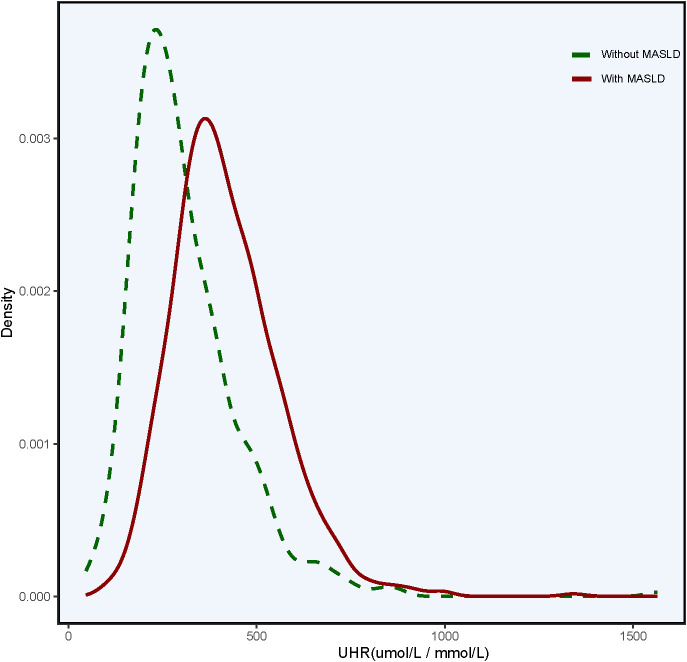
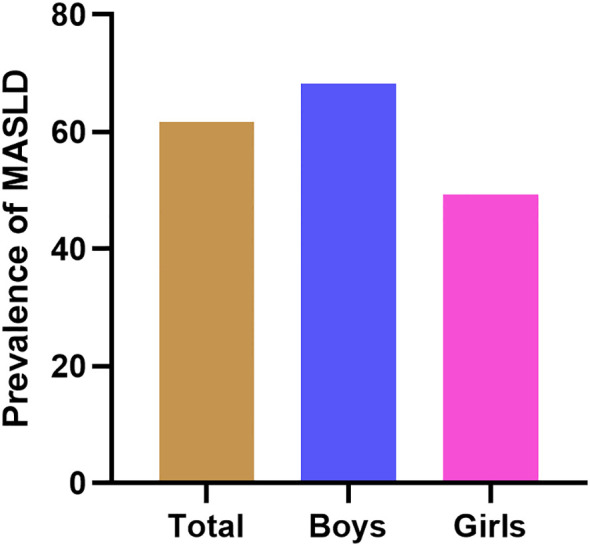
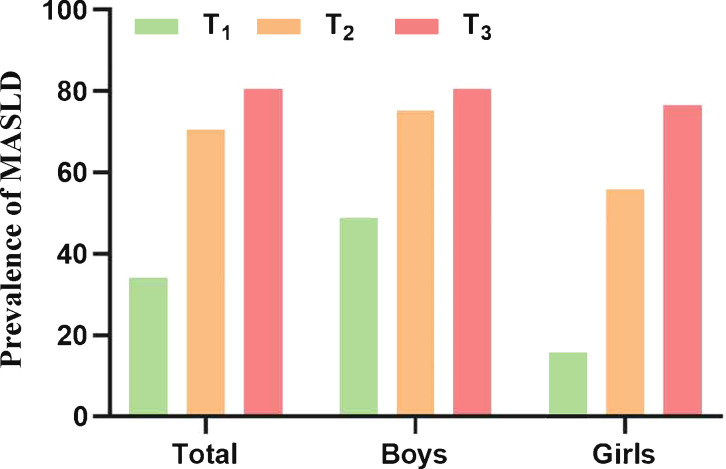
Results: The prevalence of MASLD was high, which reached 61.76% in children with obesity. UHR levels were higher in obese children with MASLD than those with non-MASLD for both genders. After dividing all individuals into three groups according to the tertiles of UHR, the prevalence rate of MASLD increased progressively from the tertile 1 to tertile 3 of UHR (34.11% vs. 70.56% vs. 80.61%). Logistic regression analysis showed that obese children with higher UHR levels were significantly associated with MASLD risk, independent of confounding factors such as age, gender, body mass index (BMI), fasting blood glucose (FBG), alanine aminotransferase (ALT), aspartate aminotransferase (AST), gamma-glutamyl transferase (GGT), low-density lipoprotein cholesterol (LDL-C), triglycerides (TG), and creatinine (Cr). The non-linear relationship analysis demonstrated that a UHR between approximately 300 and 900 suggested a saturation effect of MASLD risk. ROC analysis indicated that UHR might serve as a predictive marker for diagnosing MASLD in obese children.
Conclusions: In children with obesity, UHR is significantly associated with MASLD and might serve as a novel and useful predictor for MASLD onset.
期刊介绍:
Frontiers in Endocrinology is a field journal of the "Frontiers in" journal series.
In today’s world, endocrinology is becoming increasingly important as it underlies many of the challenges societies face - from obesity and diabetes to reproduction, population control and aging. Endocrinology covers a broad field from basic molecular and cellular communication through to clinical care and some of the most crucial public health issues. The journal, thus, welcomes outstanding contributions in any domain of endocrinology.
Frontiers in Endocrinology publishes articles on the most outstanding discoveries across a wide research spectrum of Endocrinology. The mission of Frontiers in Endocrinology is to bring all relevant Endocrinology areas together on a single platform.




 京公网安备 11010802042870号
京ICP备2023020795号-1
京公网安备 11010802042870号
京ICP备2023020795号-1

 分享
分享
 求助内容:
求助内容: 应助结果提醒方式:
 扫码关注我们
