Malin Mickelsson, Kim Ekblom, Kristina Stefansson, Per Liv, Anders Själander, Ulf Näslund, Johan Hultdin
{"title":"ABO和RhD血型是血脂异常的贡献者-一项横断面研究。","authors":"Malin Mickelsson, Kim Ekblom, Kristina Stefansson, Per Liv, Anders Själander, Ulf Näslund, Johan Hultdin","doi":"10.1186/s12944-025-02444-6","DOIUrl":null,"url":null,"abstract":"<p><strong>Background: </strong>The ABO blood group system has shown an association with cardiovascular disease. The susceptibility to CVD is proposed to be partly mediated by dyslipidaemia in non-O individuals. Previous studies are scarce for the RhD blood group, but we recently showed that RhD - young individuals are associated with subclinical atherosclerosis. Hence, we sought to examine whether the ABO blood groups and RhD factor are associated with dyslipidaemia.</p><p><strong>Methods: </strong>All participants were part of the VIPVIZA study, including 3532 individuals with available plasma lipid levels. Lipids were assessed as total, LDL, HDL, remnant, non-HDL cholesterol and triglycerides. Information about ABO and RhD was retrieved by linking VIPVIZA with the SCANDAT-3 database, where 85% of VIPVIZA participants were registered.</p><p><strong>Results: </strong>For the ABO blood groups, no significant differences in lipid levels between non-O and O individuals were seen. In 40-year-old males, RhD - individuals compared to RhD + had higher levels of non-HDL cholesterol, LDL cholesterol, and remnant cholesterol, with ratios of geometric means of 1.21 (CI95% 1.03; 1.43), 1.20 (1.02; 1.41) and 1.38 (1.00; 1.92), respectively. No differences in lipid levels depending on the RhD blood group were seen in women or the older age groups.</p><p><strong>Conclusion: </strong>Our study indicates that younger RhD - men have increased non-HDL, LDL, and remnant cholesterol levels. Thus, the RhD blood group, but not ABO, seems to be associated with dyslipidaemia and may act as a future possible risk marker of cardiovascular disease.</p>","PeriodicalId":18073,"journal":{"name":"Lipids in Health and Disease","volume":"24 1","pages":"18"},"PeriodicalIF":3.9000,"publicationDate":"2025-01-22","publicationTypes":"Journal Article","fieldsOfStudy":null,"isOpenAccess":false,"openAccessPdf":"https://www.ncbi.nlm.nih.gov/pmc/articles/PMC11753059/pdf/","citationCount":"0","resultStr":"{\"title\":\"ABO and RhD blood groups as contributors to dyslipidaemia - a cross-sectional study.\",\"authors\":\"Malin Mickelsson, Kim Ekblom, Kristina Stefansson, Per Liv, Anders Själander, Ulf Näslund, Johan Hultdin\",\"doi\":\"10.1186/s12944-025-02444-6\",\"DOIUrl\":null,\"url\":null,\"abstract\":\"<p><strong>Background: </strong>The ABO blood group system has shown an association with cardiovascular disease. The susceptibility to CVD is proposed to be partly mediated by dyslipidaemia in non-O individuals. Previous studies are scarce for the RhD blood group, but we recently showed that RhD - young individuals are associated with subclinical atherosclerosis. Hence, we sought to examine whether the ABO blood groups and RhD factor are associated with dyslipidaemia.</p><p><strong>Methods: </strong>All participants were part of the VIPVIZA study, including 3532 individuals with available plasma lipid levels. Lipids were assessed as total, LDL, HDL, remnant, non-HDL cholesterol and triglycerides. Information about ABO and RhD was retrieved by linking VIPVIZA with the SCANDAT-3 database, where 85% of VIPVIZA participants were registered.</p><p><strong>Results: </strong>For the ABO blood groups, no significant differences in lipid levels between non-O and O individuals were seen. In 40-year-old males, RhD - individuals compared to RhD + had higher levels of non-HDL cholesterol, LDL cholesterol, and remnant cholesterol, with ratios of geometric means of 1.21 (CI95% 1.03; 1.43), 1.20 (1.02; 1.41) and 1.38 (1.00; 1.92), respectively. No differences in lipid levels depending on the RhD blood group were seen in women or the older age groups.</p><p><strong>Conclusion: </strong>Our study indicates that younger RhD - men have increased non-HDL, LDL, and remnant cholesterol levels. Thus, the RhD blood group, but not ABO, seems to be associated with dyslipidaemia and may act as a future possible risk marker of cardiovascular disease.</p>\",\"PeriodicalId\":18073,\"journal\":{\"name\":\"Lipids in Health and Disease\",\"volume\":\"24 1\",\"pages\":\"18\"},\"PeriodicalIF\":3.9000,\"publicationDate\":\"2025-01-22\",\"publicationTypes\":\"Journal Article\",\"fieldsOfStudy\":null,\"isOpenAccess\":false,\"openAccessPdf\":\"https://www.ncbi.nlm.nih.gov/pmc/articles/PMC11753059/pdf/\",\"citationCount\":\"0\",\"resultStr\":null,\"platform\":\"Semanticscholar\",\"paperid\":null,\"PeriodicalName\":\"Lipids in Health and Disease\",\"FirstCategoryId\":\"3\",\"ListUrlMain\":\"https://doi.org/10.1186/s12944-025-02444-6\",\"RegionNum\":2,\"RegionCategory\":\"医学\",\"ArticlePicture\":[],\"TitleCN\":null,\"AbstractTextCN\":null,\"PMCID\":null,\"EPubDate\":\"\",\"PubModel\":\"\",\"JCR\":\"Q2\",\"JCRName\":\"BIOCHEMISTRY & MOLECULAR BIOLOGY\",\"Score\":null,\"Total\":0}","platform":"Semanticscholar","paperid":null,"PeriodicalName":"Lipids in Health and Disease","FirstCategoryId":"3","ListUrlMain":"https://doi.org/10.1186/s12944-025-02444-6","RegionNum":2,"RegionCategory":"医学","ArticlePicture":[],"TitleCN":null,"AbstractTextCN":null,"PMCID":null,"EPubDate":"","PubModel":"","JCR":"Q2","JCRName":"BIOCHEMISTRY & MOLECULAR BIOLOGY","Score":null,"Total":0}
ABO and RhD blood groups as contributors to dyslipidaemia - a cross-sectional study.
Background: The ABO blood group system has shown an association with cardiovascular disease. The susceptibility to CVD is proposed to be partly mediated by dyslipidaemia in non-O individuals. Previous studies are scarce for the RhD blood group, but we recently showed that RhD - young individuals are associated with subclinical atherosclerosis. Hence, we sought to examine whether the ABO blood groups and RhD factor are associated with dyslipidaemia.
Methods: All participants were part of the VIPVIZA study, including 3532 individuals with available plasma lipid levels. Lipids were assessed as total, LDL, HDL, remnant, non-HDL cholesterol and triglycerides. Information about ABO and RhD was retrieved by linking VIPVIZA with the SCANDAT-3 database, where 85% of VIPVIZA participants were registered.
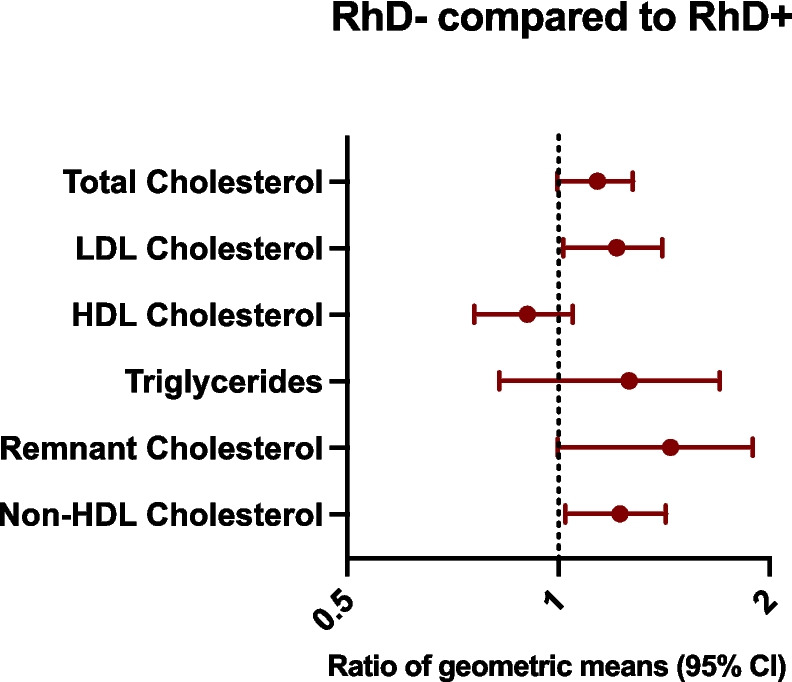
Results: For the ABO blood groups, no significant differences in lipid levels between non-O and O individuals were seen. In 40-year-old males, RhD - individuals compared to RhD + had higher levels of non-HDL cholesterol, LDL cholesterol, and remnant cholesterol, with ratios of geometric means of 1.21 (CI95% 1.03; 1.43), 1.20 (1.02; 1.41) and 1.38 (1.00; 1.92), respectively. No differences in lipid levels depending on the RhD blood group were seen in women or the older age groups.
Conclusion: Our study indicates that younger RhD - men have increased non-HDL, LDL, and remnant cholesterol levels. Thus, the RhD blood group, but not ABO, seems to be associated with dyslipidaemia and may act as a future possible risk marker of cardiovascular disease.
期刊介绍:
Lipids in Health and Disease is an open access, peer-reviewed, journal that publishes articles on all aspects of lipids: their biochemistry, pharmacology, toxicology, role in health and disease, and the synthesis of new lipid compounds.
Lipids in Health and Disease is aimed at all scientists, health professionals and physicians interested in the area of lipids. Lipids are defined here in their broadest sense, to include: cholesterol, essential fatty acids, saturated fatty acids, phospholipids, inositol lipids, second messenger lipids, enzymes and synthetic machinery that is involved in the metabolism of various lipids in the cells and tissues, and also various aspects of lipid transport, etc. In addition, the journal also publishes research that investigates and defines the role of lipids in various physiological processes, pathology and disease. In particular, the journal aims to bridge the gap between the bench and the clinic by publishing articles that are particularly relevant to human diseases and the role of lipids in the management of various diseases.






 京公网安备 11010802042870号
京ICP备2023020795号-1
京公网安备 11010802042870号
京ICP备2023020795号-1

 分享
分享
 求助内容:
求助内容: 应助结果提醒方式:
 扫码关注我们
