{"title":"致病生物的发育同步性和异常增殖率。","authors":"Megan A Greischar, Lauren M Childs","doi":"10.1098/rstb.2023.0337","DOIUrl":null,"url":null,"abstract":"<p><p>The multiplication rates of pathogenic organisms influence disease progression, efficacy of immunity and therapeutics, and potential for within-host evolution. Thus, accurate estimates of multiplication rates are essential for biological understanding. We recently showed that common methods for inferring multiplication rates from malaria infection data substantially overestimate true values (i.e. under simulated scenarios), providing context for extraordinarily large estimates in human malaria parasites. A key unknown is whether this bias arises specifically from malaria parasite biology or represents a broader concern. Here, we identify the potential for biased multiplication rate estimates across pathogenic organisms with different developmental biology by generalizing a within-host malaria model. We find that diverse patterns of developmental sampling bias-the change in detectability over developmental age-reliably generate overestimates of the fold change in abundance, obscuring not just true growth rates but potentially even whether populations are expanding or declining. This pattern emerges whenever synchrony-the degree to which development is synchronized across the population of pathogenic organisms comprising an infection-decays with time. Only with simulated increases in synchrony do we find noticeable underestimates of multiplication rates. Obtaining robust estimates of multiplication rates may require accounting for diverse patterns of synchrony in pathogenic organisms.This article is part of the Theo Murphy meeting issue 'Circadian rhythms in infection and immunity'.</p>","PeriodicalId":19872,"journal":{"name":"Philosophical Transactions of the Royal Society B: Biological Sciences","volume":"380 1918","pages":"20230337"},"PeriodicalIF":5.3000,"publicationDate":"2025-01-23","publicationTypes":"Journal Article","fieldsOfStudy":null,"isOpenAccess":false,"openAccessPdf":"https://www.ncbi.nlm.nih.gov/pmc/articles/PMC11753877/pdf/","citationCount":"0","resultStr":"{\"title\":\"Developmental synchrony and extraordinary multiplication rates in pathogenic organisms.\",\"authors\":\"Megan A Greischar, Lauren M Childs\",\"doi\":\"10.1098/rstb.2023.0337\",\"DOIUrl\":null,\"url\":null,\"abstract\":\"<p><p>The multiplication rates of pathogenic organisms influence disease progression, efficacy of immunity and therapeutics, and potential for within-host evolution. Thus, accurate estimates of multiplication rates are essential for biological understanding. We recently showed that common methods for inferring multiplication rates from malaria infection data substantially overestimate true values (i.e. under simulated scenarios), providing context for extraordinarily large estimates in human malaria parasites. A key unknown is whether this bias arises specifically from malaria parasite biology or represents a broader concern. Here, we identify the potential for biased multiplication rate estimates across pathogenic organisms with different developmental biology by generalizing a within-host malaria model. We find that diverse patterns of developmental sampling bias-the change in detectability over developmental age-reliably generate overestimates of the fold change in abundance, obscuring not just true growth rates but potentially even whether populations are expanding or declining. This pattern emerges whenever synchrony-the degree to which development is synchronized across the population of pathogenic organisms comprising an infection-decays with time. Only with simulated increases in synchrony do we find noticeable underestimates of multiplication rates. Obtaining robust estimates of multiplication rates may require accounting for diverse patterns of synchrony in pathogenic organisms.This article is part of the Theo Murphy meeting issue 'Circadian rhythms in infection and immunity'.</p>\",\"PeriodicalId\":19872,\"journal\":{\"name\":\"Philosophical Transactions of the Royal Society B: Biological Sciences\",\"volume\":\"380 1918\",\"pages\":\"20230337\"},\"PeriodicalIF\":5.3000,\"publicationDate\":\"2025-01-23\",\"publicationTypes\":\"Journal Article\",\"fieldsOfStudy\":null,\"isOpenAccess\":false,\"openAccessPdf\":\"https://www.ncbi.nlm.nih.gov/pmc/articles/PMC11753877/pdf/\",\"citationCount\":\"0\",\"resultStr\":null,\"platform\":\"Semanticscholar\",\"paperid\":null,\"PeriodicalName\":\"Philosophical Transactions of the Royal Society B: Biological Sciences\",\"FirstCategoryId\":\"99\",\"ListUrlMain\":\"https://doi.org/10.1098/rstb.2023.0337\",\"RegionNum\":2,\"RegionCategory\":\"生物学\",\"ArticlePicture\":[],\"TitleCN\":null,\"AbstractTextCN\":null,\"PMCID\":null,\"EPubDate\":\"\",\"PubModel\":\"\",\"JCR\":\"Q1\",\"JCRName\":\"BIOLOGY\",\"Score\":null,\"Total\":0}","platform":"Semanticscholar","paperid":null,"PeriodicalName":"Philosophical Transactions of the Royal Society B: Biological Sciences","FirstCategoryId":"99","ListUrlMain":"https://doi.org/10.1098/rstb.2023.0337","RegionNum":2,"RegionCategory":"生物学","ArticlePicture":[],"TitleCN":null,"AbstractTextCN":null,"PMCID":null,"EPubDate":"","PubModel":"","JCR":"Q1","JCRName":"BIOLOGY","Score":null,"Total":0}
Developmental synchrony and extraordinary multiplication rates in pathogenic organisms.
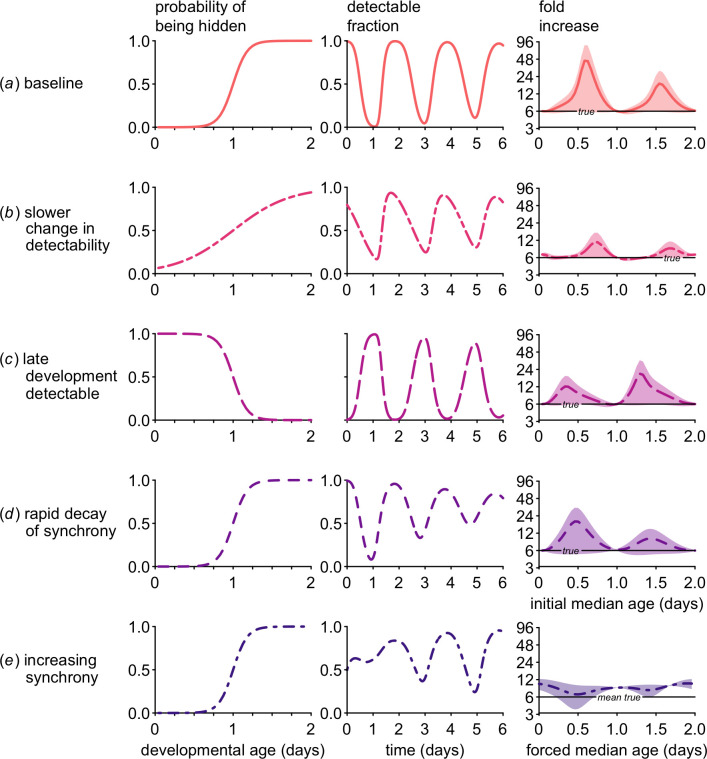
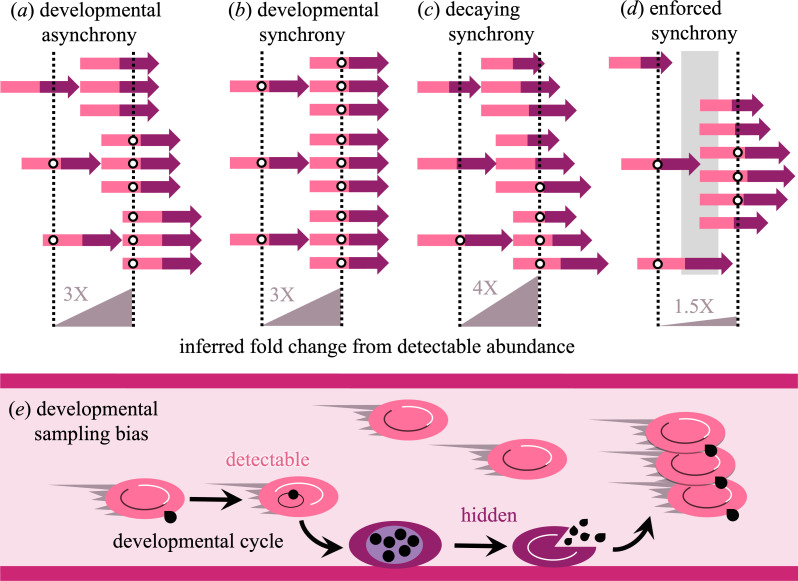
The multiplication rates of pathogenic organisms influence disease progression, efficacy of immunity and therapeutics, and potential for within-host evolution. Thus, accurate estimates of multiplication rates are essential for biological understanding. We recently showed that common methods for inferring multiplication rates from malaria infection data substantially overestimate true values (i.e. under simulated scenarios), providing context for extraordinarily large estimates in human malaria parasites. A key unknown is whether this bias arises specifically from malaria parasite biology or represents a broader concern. Here, we identify the potential for biased multiplication rate estimates across pathogenic organisms with different developmental biology by generalizing a within-host malaria model. We find that diverse patterns of developmental sampling bias-the change in detectability over developmental age-reliably generate overestimates of the fold change in abundance, obscuring not just true growth rates but potentially even whether populations are expanding or declining. This pattern emerges whenever synchrony-the degree to which development is synchronized across the population of pathogenic organisms comprising an infection-decays with time. Only with simulated increases in synchrony do we find noticeable underestimates of multiplication rates. Obtaining robust estimates of multiplication rates may require accounting for diverse patterns of synchrony in pathogenic organisms.This article is part of the Theo Murphy meeting issue 'Circadian rhythms in infection and immunity'.
期刊介绍:
The journal publishes topics across the life sciences. As long as the core subject lies within the biological sciences, some issues may also include content crossing into other areas such as the physical sciences, social sciences, biophysics, policy, economics etc. Issues generally sit within four broad areas (although many issues sit across these areas):
Organismal, environmental and evolutionary biology
Neuroscience and cognition
Cellular, molecular and developmental biology
Health and disease.





 京公网安备 11010802042870号
京ICP备2023020795号-1
京公网安备 11010802042870号
京ICP备2023020795号-1

 分享
分享
 求助内容:
求助内容: 应助结果提醒方式:
 扫码关注我们
