Rachel S Edgar, Aidan J O'Donnell, Alan Xiaodong Zhuang, Sarah E Reece
{"title":"是时候开始认真对待时间了:如何在传染病研究中调查意想不到的生物节律。","authors":"Rachel S Edgar, Aidan J O'Donnell, Alan Xiaodong Zhuang, Sarah E Reece","doi":"10.1098/rstb.2023.0336","DOIUrl":null,"url":null,"abstract":"<p><p>The discovery of rhythmicity in host and pathogen activities dates back to the Hippocratic era, but the causes and consequences of these biological rhythms have remained poorly understood. Rhythms in infection phenotypes or traits are observed across taxonomically diverse hosts and pathogens, suggesting general evolutionary principles. Understanding these principles may enable rhythms to be leveraged in manners that improve drug and vaccine efficacy or disrupt pathogen timekeeping to reduce virulence and transmission. Explaining and exploiting rhythms in infections require an integrative and multidisciplinary approach, which is a hallmark of research within chronobiology. Many researchers are welcomed into chronobiology from other fields after observing an unexpected rhythm or time-of-day effect in their data. Such findings can launch a rich new research topic, but engaging with the concepts, approaches and dogma in a new discipline can be daunting. Fortunately, chronobiology has well-developed frameworks for interrogating rhythms that can be readily applied in novel contexts. Here, we provide a 'how to' guide for exploring unexpected daily rhythms in infectious disease research. We outline how to establish: whether the rhythm is circadian, to what extent the host and pathogen are responsible, the relevance for host-pathogen interactions, and how to explore therapeutic potential.This article is part of the Theo Murphy meeting issue 'Circadian rhythms in infection and immunity'.</p>","PeriodicalId":19872,"journal":{"name":"Philosophical Transactions of the Royal Society B: Biological Sciences","volume":"380 1918","pages":"20230336"},"PeriodicalIF":5.3000,"publicationDate":"2025-01-23","publicationTypes":"Journal Article","fieldsOfStudy":null,"isOpenAccess":false,"openAccessPdf":"https://www.ncbi.nlm.nih.gov/pmc/articles/PMC11753885/pdf/","citationCount":"0","resultStr":"{\"title\":\"Time to start taking time seriously: how to investigate unexpected biological rhythms within infectious disease research.\",\"authors\":\"Rachel S Edgar, Aidan J O'Donnell, Alan Xiaodong Zhuang, Sarah E Reece\",\"doi\":\"10.1098/rstb.2023.0336\",\"DOIUrl\":null,\"url\":null,\"abstract\":\"<p><p>The discovery of rhythmicity in host and pathogen activities dates back to the Hippocratic era, but the causes and consequences of these biological rhythms have remained poorly understood. Rhythms in infection phenotypes or traits are observed across taxonomically diverse hosts and pathogens, suggesting general evolutionary principles. Understanding these principles may enable rhythms to be leveraged in manners that improve drug and vaccine efficacy or disrupt pathogen timekeeping to reduce virulence and transmission. Explaining and exploiting rhythms in infections require an integrative and multidisciplinary approach, which is a hallmark of research within chronobiology. Many researchers are welcomed into chronobiology from other fields after observing an unexpected rhythm or time-of-day effect in their data. Such findings can launch a rich new research topic, but engaging with the concepts, approaches and dogma in a new discipline can be daunting. Fortunately, chronobiology has well-developed frameworks for interrogating rhythms that can be readily applied in novel contexts. Here, we provide a 'how to' guide for exploring unexpected daily rhythms in infectious disease research. We outline how to establish: whether the rhythm is circadian, to what extent the host and pathogen are responsible, the relevance for host-pathogen interactions, and how to explore therapeutic potential.This article is part of the Theo Murphy meeting issue 'Circadian rhythms in infection and immunity'.</p>\",\"PeriodicalId\":19872,\"journal\":{\"name\":\"Philosophical Transactions of the Royal Society B: Biological Sciences\",\"volume\":\"380 1918\",\"pages\":\"20230336\"},\"PeriodicalIF\":5.3000,\"publicationDate\":\"2025-01-23\",\"publicationTypes\":\"Journal Article\",\"fieldsOfStudy\":null,\"isOpenAccess\":false,\"openAccessPdf\":\"https://www.ncbi.nlm.nih.gov/pmc/articles/PMC11753885/pdf/\",\"citationCount\":\"0\",\"resultStr\":null,\"platform\":\"Semanticscholar\",\"paperid\":null,\"PeriodicalName\":\"Philosophical Transactions of the Royal Society B: Biological Sciences\",\"FirstCategoryId\":\"99\",\"ListUrlMain\":\"https://doi.org/10.1098/rstb.2023.0336\",\"RegionNum\":2,\"RegionCategory\":\"生物学\",\"ArticlePicture\":[],\"TitleCN\":null,\"AbstractTextCN\":null,\"PMCID\":null,\"EPubDate\":\"\",\"PubModel\":\"\",\"JCR\":\"Q1\",\"JCRName\":\"BIOLOGY\",\"Score\":null,\"Total\":0}","platform":"Semanticscholar","paperid":null,"PeriodicalName":"Philosophical Transactions of the Royal Society B: Biological Sciences","FirstCategoryId":"99","ListUrlMain":"https://doi.org/10.1098/rstb.2023.0336","RegionNum":2,"RegionCategory":"生物学","ArticlePicture":[],"TitleCN":null,"AbstractTextCN":null,"PMCID":null,"EPubDate":"","PubModel":"","JCR":"Q1","JCRName":"BIOLOGY","Score":null,"Total":0}
Time to start taking time seriously: how to investigate unexpected biological rhythms within infectious disease research.
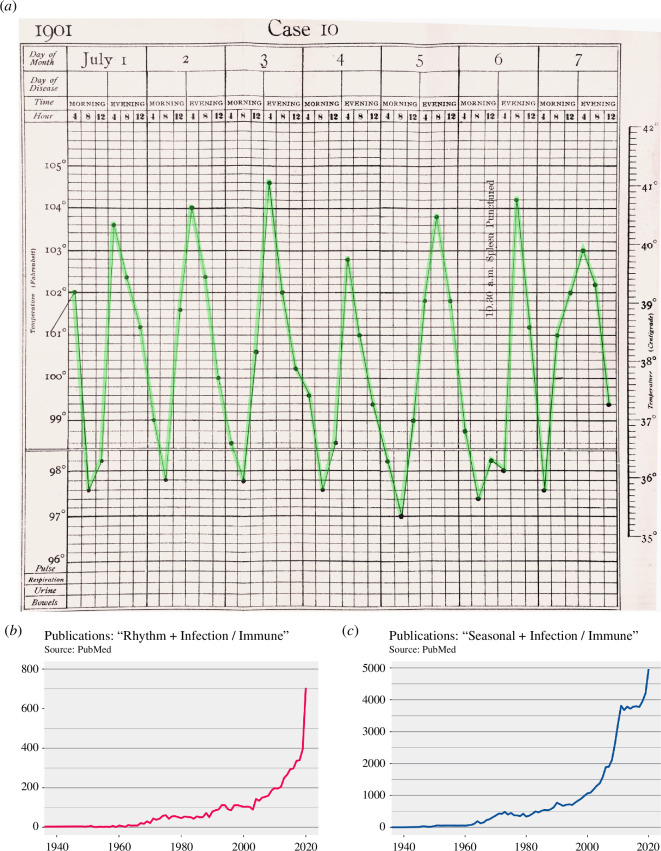
The discovery of rhythmicity in host and pathogen activities dates back to the Hippocratic era, but the causes and consequences of these biological rhythms have remained poorly understood. Rhythms in infection phenotypes or traits are observed across taxonomically diverse hosts and pathogens, suggesting general evolutionary principles. Understanding these principles may enable rhythms to be leveraged in manners that improve drug and vaccine efficacy or disrupt pathogen timekeeping to reduce virulence and transmission. Explaining and exploiting rhythms in infections require an integrative and multidisciplinary approach, which is a hallmark of research within chronobiology. Many researchers are welcomed into chronobiology from other fields after observing an unexpected rhythm or time-of-day effect in their data. Such findings can launch a rich new research topic, but engaging with the concepts, approaches and dogma in a new discipline can be daunting. Fortunately, chronobiology has well-developed frameworks for interrogating rhythms that can be readily applied in novel contexts. Here, we provide a 'how to' guide for exploring unexpected daily rhythms in infectious disease research. We outline how to establish: whether the rhythm is circadian, to what extent the host and pathogen are responsible, the relevance for host-pathogen interactions, and how to explore therapeutic potential.This article is part of the Theo Murphy meeting issue 'Circadian rhythms in infection and immunity'.
期刊介绍:
The journal publishes topics across the life sciences. As long as the core subject lies within the biological sciences, some issues may also include content crossing into other areas such as the physical sciences, social sciences, biophysics, policy, economics etc. Issues generally sit within four broad areas (although many issues sit across these areas):
Organismal, environmental and evolutionary biology
Neuroscience and cognition
Cellular, molecular and developmental biology
Health and disease.






 京公网安备 11010802042870号
京ICP备2023020795号-1
京公网安备 11010802042870号
京ICP备2023020795号-1

 分享
分享
 求助内容:
求助内容: 应助结果提醒方式:
 扫码关注我们
