A Alipouriani, F Almadi, D R Rosen, D Liska, A E Kanters, K Ban, E Gorgun, S R Steele
{"title":"切缘问题:分析环切缘受累对直肠癌不完全全肠系膜切除术后生存和复发的影响。","authors":"A Alipouriani, F Almadi, D R Rosen, D Liska, A E Kanters, K Ban, E Gorgun, S R Steele","doi":"10.1007/s10151-024-03098-9","DOIUrl":null,"url":null,"abstract":"<p><strong>Background: </strong>Incomplete mesorectal excision during rectal cancer surgery often leads to positive circumferential margins, with uncertain prognostic impacts. This study examines whether negative margins can mitigate the poorer prognosis typically associated with incomplete total mesorectal excision (TME) in rectal cancer surgery, thus potentially challenging the prevailing emphasis on complete mesorectal excision.</p><p><strong>Patients and methods: </strong>A retrospective analysis was conducted on patients who underwent proctectomy for rectal adenocarcinoma with incomplete TME at a single center from 2010 to 2022. Patients were stratified by margin status as determined by pathologic analysis into three groups: involved, not involved with closest margin distance ≤ 2 mm, and not involved with closest margin distance > 2 mm. Outcomes included recurrence and survival. Effects of neoadjuvant therapy protocols on margin status were also assessed.</p><p><strong>Results: </strong>From 2010 to 2022, 7941 patients underwent proctectomy for rectal cancer, with 236 (3%) having incomplete TME. The median age of these patients was 64 years, and 63% were male. Overall, margin involvement was observed in 54 (23%) patients. The median tumor size was 3.05 cm (interquartile range (IQR): 2-6) for the whole group. Involved margins (23.2%) had reduced overall survival (60.5 months versus 87.3 months, p < 0.001), increased local recurrence (20.4% versus 9.4%, p = 0.024), and lower disease-free survival (45.2 versus 58.9 months, p = 0.006) versus uninvolved margins. Margin involvement was prognostic for decreased survival even after adjusting for confounders (p < 0.05). Among uninvolved margins, distance (> 2 mm versus ≤ 2 mm) did not affect outcomes. Total neoadjuvant therapy (versus standard chemoradiation) was associated with lower involved margins (p = 0.007).</p><p><strong>Conclusions: </strong>Positive margins retain negative prognostic impact with incomplete TME. Optimization of surgical resection remains vital. Total neoadjuvant therapy was associated with a lower rate of margin involvement.</p>","PeriodicalId":51192,"journal":{"name":"Techniques in Coloproctology","volume":"29 1","pages":"50"},"PeriodicalIF":2.9000,"publicationDate":"2025-01-23","publicationTypes":"Journal Article","fieldsOfStudy":null,"isOpenAccess":false,"openAccessPdf":"https://www.ncbi.nlm.nih.gov/pmc/articles/PMC11757853/pdf/","citationCount":"0","resultStr":"{\"title\":\"Margin matters: analyzing the impact of circumferential margin involvement on survival and recurrence after incomplete total mesorectal excision for rectal cancer.\",\"authors\":\"A Alipouriani, F Almadi, D R Rosen, D Liska, A E Kanters, K Ban, E Gorgun, S R Steele\",\"doi\":\"10.1007/s10151-024-03098-9\",\"DOIUrl\":null,\"url\":null,\"abstract\":\"<p><strong>Background: </strong>Incomplete mesorectal excision during rectal cancer surgery often leads to positive circumferential margins, with uncertain prognostic impacts. This study examines whether negative margins can mitigate the poorer prognosis typically associated with incomplete total mesorectal excision (TME) in rectal cancer surgery, thus potentially challenging the prevailing emphasis on complete mesorectal excision.</p><p><strong>Patients and methods: </strong>A retrospective analysis was conducted on patients who underwent proctectomy for rectal adenocarcinoma with incomplete TME at a single center from 2010 to 2022. Patients were stratified by margin status as determined by pathologic analysis into three groups: involved, not involved with closest margin distance ≤ 2 mm, and not involved with closest margin distance > 2 mm. Outcomes included recurrence and survival. Effects of neoadjuvant therapy protocols on margin status were also assessed.</p><p><strong>Results: </strong>From 2010 to 2022, 7941 patients underwent proctectomy for rectal cancer, with 236 (3%) having incomplete TME. The median age of these patients was 64 years, and 63% were male. Overall, margin involvement was observed in 54 (23%) patients. The median tumor size was 3.05 cm (interquartile range (IQR): 2-6) for the whole group. Involved margins (23.2%) had reduced overall survival (60.5 months versus 87.3 months, p < 0.001), increased local recurrence (20.4% versus 9.4%, p = 0.024), and lower disease-free survival (45.2 versus 58.9 months, p = 0.006) versus uninvolved margins. Margin involvement was prognostic for decreased survival even after adjusting for confounders (p < 0.05). Among uninvolved margins, distance (> 2 mm versus ≤ 2 mm) did not affect outcomes. Total neoadjuvant therapy (versus standard chemoradiation) was associated with lower involved margins (p = 0.007).</p><p><strong>Conclusions: </strong>Positive margins retain negative prognostic impact with incomplete TME. Optimization of surgical resection remains vital. Total neoadjuvant therapy was associated with a lower rate of margin involvement.</p>\",\"PeriodicalId\":51192,\"journal\":{\"name\":\"Techniques in Coloproctology\",\"volume\":\"29 1\",\"pages\":\"50\"},\"PeriodicalIF\":2.9000,\"publicationDate\":\"2025-01-23\",\"publicationTypes\":\"Journal Article\",\"fieldsOfStudy\":null,\"isOpenAccess\":false,\"openAccessPdf\":\"https://www.ncbi.nlm.nih.gov/pmc/articles/PMC11757853/pdf/\",\"citationCount\":\"0\",\"resultStr\":null,\"platform\":\"Semanticscholar\",\"paperid\":null,\"PeriodicalName\":\"Techniques in Coloproctology\",\"FirstCategoryId\":\"3\",\"ListUrlMain\":\"https://doi.org/10.1007/s10151-024-03098-9\",\"RegionNum\":3,\"RegionCategory\":\"医学\",\"ArticlePicture\":[],\"TitleCN\":null,\"AbstractTextCN\":null,\"PMCID\":null,\"EPubDate\":\"\",\"PubModel\":\"\",\"JCR\":\"Q2\",\"JCRName\":\"GASTROENTEROLOGY & HEPATOLOGY\",\"Score\":null,\"Total\":0}","platform":"Semanticscholar","paperid":null,"PeriodicalName":"Techniques in Coloproctology","FirstCategoryId":"3","ListUrlMain":"https://doi.org/10.1007/s10151-024-03098-9","RegionNum":3,"RegionCategory":"医学","ArticlePicture":[],"TitleCN":null,"AbstractTextCN":null,"PMCID":null,"EPubDate":"","PubModel":"","JCR":"Q2","JCRName":"GASTROENTEROLOGY & HEPATOLOGY","Score":null,"Total":0}
Margin matters: analyzing the impact of circumferential margin involvement on survival and recurrence after incomplete total mesorectal excision for rectal cancer.
Background: Incomplete mesorectal excision during rectal cancer surgery often leads to positive circumferential margins, with uncertain prognostic impacts. This study examines whether negative margins can mitigate the poorer prognosis typically associated with incomplete total mesorectal excision (TME) in rectal cancer surgery, thus potentially challenging the prevailing emphasis on complete mesorectal excision.
Patients and methods: A retrospective analysis was conducted on patients who underwent proctectomy for rectal adenocarcinoma with incomplete TME at a single center from 2010 to 2022. Patients were stratified by margin status as determined by pathologic analysis into three groups: involved, not involved with closest margin distance ≤ 2 mm, and not involved with closest margin distance > 2 mm. Outcomes included recurrence and survival. Effects of neoadjuvant therapy protocols on margin status were also assessed.
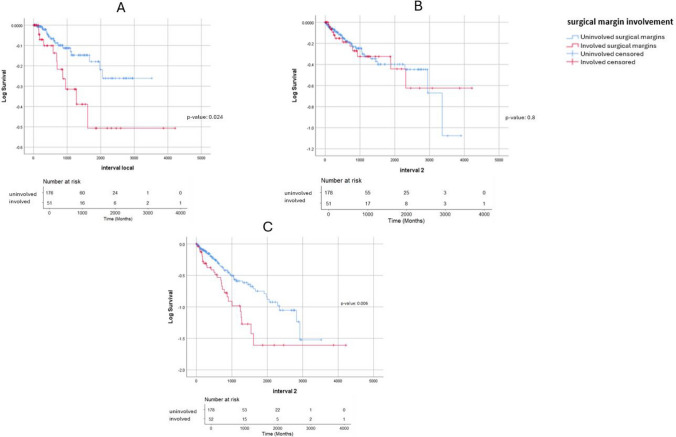
Results: From 2010 to 2022, 7941 patients underwent proctectomy for rectal cancer, with 236 (3%) having incomplete TME. The median age of these patients was 64 years, and 63% were male. Overall, margin involvement was observed in 54 (23%) patients. The median tumor size was 3.05 cm (interquartile range (IQR): 2-6) for the whole group. Involved margins (23.2%) had reduced overall survival (60.5 months versus 87.3 months, p < 0.001), increased local recurrence (20.4% versus 9.4%, p = 0.024), and lower disease-free survival (45.2 versus 58.9 months, p = 0.006) versus uninvolved margins. Margin involvement was prognostic for decreased survival even after adjusting for confounders (p < 0.05). Among uninvolved margins, distance (> 2 mm versus ≤ 2 mm) did not affect outcomes. Total neoadjuvant therapy (versus standard chemoradiation) was associated with lower involved margins (p = 0.007).
Conclusions: Positive margins retain negative prognostic impact with incomplete TME. Optimization of surgical resection remains vital. Total neoadjuvant therapy was associated with a lower rate of margin involvement.
期刊介绍:
Techniques in Coloproctology is an international journal fully devoted to diagnostic and operative procedures carried out in the management of colorectal diseases. Imaging, clinical physiology, laparoscopy, open abdominal surgery and proctoperineology are the main topics covered by the journal. Reviews, original articles, technical notes and short communications with many detailed illustrations render this publication indispensable for coloproctologists and related specialists. Both surgeons and gastroenterologists are represented on the distinguished Editorial Board, together with pathologists, radiologists and basic scientists from all over the world. The journal is strongly recommended to those who wish to be updated on recent developments in the field, and improve the standards of their work.
Manuscripts submitted for publication must contain a statement to the effect that all human studies have been reviewed by the appropriate ethics committee and have therefore been performed in accordance with the ethical standards laid down in an appropriate version of the 1965 Declaration of Helsinki. It should also be stated clearly in the text that all persons gave their informed consent prior to their inclusion in the study. Details that might disclose the identity of the subjects under study should be omitted. Reports of animal experiments must state that the Principles of Laboratory Animal Care (NIH publication no. 86-23 revised 1985) were followed as were applicable national laws (e.g. the current version of the German Law on the Protection of Animals). The Editor-in-Chief reserves the right to reject manuscripts that do not comply with the above-mentioned requirements. Authors will be held responsible for false statements or for failure to fulfill such requirements.






 京公网安备 11010802042870号
京ICP备2023020795号-1
京公网安备 11010802042870号
京ICP备2023020795号-1

 分享
分享
 求助内容:
求助内容: 应助结果提醒方式:
 扫码关注我们
