Catherine Fahey, Dennis Choi, Jianmin Wang, Grant M. Domke, Joseph D. Edwards, Songlin Fei, Stephanie N. Kivlin, Elizabeth A. LaRue, Melissa K. McCormick, William J. McShea, Richard P. Phillips, Jamie Pullen, John D. Parker
{"title":"在两个树木多样性试验中,冠层复杂性驱动树木多样性对生产力的正向影响。","authors":"Catherine Fahey, Dennis Choi, Jianmin Wang, Grant M. Domke, Joseph D. Edwards, Songlin Fei, Stephanie N. Kivlin, Elizabeth A. LaRue, Melissa K. McCormick, William J. McShea, Richard P. Phillips, Jamie Pullen, John D. Parker","doi":"10.1002/ecy.4500","DOIUrl":null,"url":null,"abstract":"<p>Forest canopy complexity (i.e., the three-dimensional structure of the canopy) is often associated with increased species diversity as well as high primary productivity across natural forests. However, canopy complexity, tree diversity, and productivity are often confounded in natural forests, and the mechanisms of these relationships remain unclear. Here, we used two large tree diversity experiments in North America to assess three hypotheses: (1) increasing tree diversity leads to increased canopy complexity, (2) canopy complexity is positively related to tree productivity, and (3) the relationship between tree diversity and tree productivity is indirect and driven by the positive effects of canopy complexity. We found that increasing tree diversity from monocultures to mixtures of 12 species increases canopy complexity and productivity by up to 71% and 73%, respectively. Moreover, structural equation modeling indicates that the effects of tree diversity on productivity are indirect and mediated primarily by changes in internal canopy complexity. Ultimately, we suggest that increasing canopy complexity can be a major mechanism by which tree diversity enhances productivity in young forests.</p>","PeriodicalId":11484,"journal":{"name":"Ecology","volume":"106 1","pages":""},"PeriodicalIF":4.1000,"publicationDate":"2025-01-22","publicationTypes":"Journal Article","fieldsOfStudy":null,"isOpenAccess":false,"openAccessPdf":"https://onlinelibrary.wiley.com/doi/epdf/10.1002/ecy.4500","citationCount":"0","resultStr":"{\"title\":\"Canopy complexity drives positive effects of tree diversity on productivity in two tree diversity experiments\",\"authors\":\"Catherine Fahey, Dennis Choi, Jianmin Wang, Grant M. Domke, Joseph D. Edwards, Songlin Fei, Stephanie N. Kivlin, Elizabeth A. LaRue, Melissa K. McCormick, William J. McShea, Richard P. Phillips, Jamie Pullen, John D. Parker\",\"doi\":\"10.1002/ecy.4500\",\"DOIUrl\":null,\"url\":null,\"abstract\":\"<p>Forest canopy complexity (i.e., the three-dimensional structure of the canopy) is often associated with increased species diversity as well as high primary productivity across natural forests. However, canopy complexity, tree diversity, and productivity are often confounded in natural forests, and the mechanisms of these relationships remain unclear. Here, we used two large tree diversity experiments in North America to assess three hypotheses: (1) increasing tree diversity leads to increased canopy complexity, (2) canopy complexity is positively related to tree productivity, and (3) the relationship between tree diversity and tree productivity is indirect and driven by the positive effects of canopy complexity. We found that increasing tree diversity from monocultures to mixtures of 12 species increases canopy complexity and productivity by up to 71% and 73%, respectively. Moreover, structural equation modeling indicates that the effects of tree diversity on productivity are indirect and mediated primarily by changes in internal canopy complexity. Ultimately, we suggest that increasing canopy complexity can be a major mechanism by which tree diversity enhances productivity in young forests.</p>\",\"PeriodicalId\":11484,\"journal\":{\"name\":\"Ecology\",\"volume\":\"106 1\",\"pages\":\"\"},\"PeriodicalIF\":4.1000,\"publicationDate\":\"2025-01-22\",\"publicationTypes\":\"Journal Article\",\"fieldsOfStudy\":null,\"isOpenAccess\":false,\"openAccessPdf\":\"https://onlinelibrary.wiley.com/doi/epdf/10.1002/ecy.4500\",\"citationCount\":\"0\",\"resultStr\":null,\"platform\":\"Semanticscholar\",\"paperid\":null,\"PeriodicalName\":\"Ecology\",\"FirstCategoryId\":\"93\",\"ListUrlMain\":\"https://esajournals.onlinelibrary.wiley.com/doi/10.1002/ecy.4500\",\"RegionNum\":2,\"RegionCategory\":\"环境科学与生态学\",\"ArticlePicture\":[],\"TitleCN\":null,\"AbstractTextCN\":null,\"PMCID\":null,\"EPubDate\":\"\",\"PubModel\":\"\",\"JCR\":\"Q1\",\"JCRName\":\"ECOLOGY\",\"Score\":null,\"Total\":0}","platform":"Semanticscholar","paperid":null,"PeriodicalName":"Ecology","FirstCategoryId":"93","ListUrlMain":"https://esajournals.onlinelibrary.wiley.com/doi/10.1002/ecy.4500","RegionNum":2,"RegionCategory":"环境科学与生态学","ArticlePicture":[],"TitleCN":null,"AbstractTextCN":null,"PMCID":null,"EPubDate":"","PubModel":"","JCR":"Q1","JCRName":"ECOLOGY","Score":null,"Total":0}
Canopy complexity drives positive effects of tree diversity on productivity in two tree diversity experiments
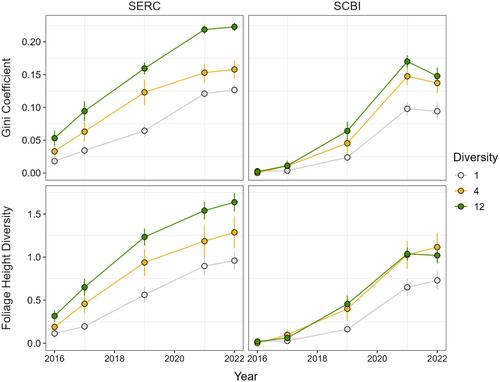
Forest canopy complexity (i.e., the three-dimensional structure of the canopy) is often associated with increased species diversity as well as high primary productivity across natural forests. However, canopy complexity, tree diversity, and productivity are often confounded in natural forests, and the mechanisms of these relationships remain unclear. Here, we used two large tree diversity experiments in North America to assess three hypotheses: (1) increasing tree diversity leads to increased canopy complexity, (2) canopy complexity is positively related to tree productivity, and (3) the relationship between tree diversity and tree productivity is indirect and driven by the positive effects of canopy complexity. We found that increasing tree diversity from monocultures to mixtures of 12 species increases canopy complexity and productivity by up to 71% and 73%, respectively. Moreover, structural equation modeling indicates that the effects of tree diversity on productivity are indirect and mediated primarily by changes in internal canopy complexity. Ultimately, we suggest that increasing canopy complexity can be a major mechanism by which tree diversity enhances productivity in young forests.
期刊介绍:
Ecology publishes articles that report on the basic elements of ecological research. Emphasis is placed on concise, clear articles documenting important ecological phenomena. The journal publishes a broad array of research that includes a rapidly expanding envelope of subject matter, techniques, approaches, and concepts: paleoecology through present-day phenomena; evolutionary, population, physiological, community, and ecosystem ecology, as well as biogeochemistry; inclusive of descriptive, comparative, experimental, mathematical, statistical, and interdisciplinary approaches.






 京公网安备 11010802042870号
京ICP备2023020795号-1
京公网安备 11010802042870号
京ICP备2023020795号-1

 分享
分享
 求助内容:
求助内容: 应助结果提醒方式:
 扫码关注我们
