Beibei Gao, Yi Zhou, Yuan Fang, Richeng Jin, Yuchi Fan, Lianjun Wang, Wan Jiang, Pengpeng Qiu, Wei Luo
{"title":"将CuNi合金纳米颗粒限制在介孔碳化硅纳米纤维中以增强串联催化功能","authors":"Beibei Gao, Yi Zhou, Yuan Fang, Richeng Jin, Yuchi Fan, Lianjun Wang, Wan Jiang, Pengpeng Qiu, Wei Luo","doi":"10.1016/j.jmst.2024.11.076","DOIUrl":null,"url":null,"abstract":"Mesoporous framework supported metal nanoparticle catalyst represents a promising material platform for creating multiple active sites that drive tandem reactions. In this study, we demonstrate a novel catalyst design that involves the encapsulation of CuNi alloy nanoparticles within mesoporous silicon carbide nanofibers (mSiC<sub>f</sub>) to achieve efficient tandem conversion of furfural (FFA) into 2-(isopropoxymethyl)furan (IPF). The unique one-dimensional (1D) mesoporous structure of mSiC<sub>f</sub>, coupled with abundant oxygen-containing groups, offers a favorable surface microenvironment for the stabilization of bimetallic CuNi active sites. Through carefully optimizing metal to acid sites, we have developed a catalyst containing a total mass ratio of 20% Cu and Ni, which exhibits a remarkable performance with complete FFA conversion and 92% IPF selectivity in 4 h. In-depth mechanistic investigations have revealed that the superior activity of this catalyst is attributed to a tandem reaction mechanism. Initially, FFA is hydrogenated at the dual metal active sites to produce furfuryl alcohol (FOL) as an intermediate, which is subsequently etherified at the acid sites with suitable species and strengths on the mSiC<sub>f</sub> supports. Additionally, the robust 1D mSiC<sub>f</sub> framework effectively protects the metal sites from agglomeration, resulting in excellent reusability of the catalyst. This study underscores the potential of mesoporous silicon carbide-supported bimetallic active sites for achieving enhanced tandem catalytic functionality.","PeriodicalId":16154,"journal":{"name":"Journal of Materials Science & Technology","volume":"17 1","pages":""},"PeriodicalIF":16.8000,"publicationDate":"2025-01-24","publicationTypes":"Journal Article","fieldsOfStudy":null,"isOpenAccess":false,"openAccessPdf":"","citationCount":"0","resultStr":"{\"title\":\"Confining CuNi alloy nanoparticles into mesoporous silicon carbide nanofibers for enhanced tandem catalytic functionality\",\"authors\":\"Beibei Gao, Yi Zhou, Yuan Fang, Richeng Jin, Yuchi Fan, Lianjun Wang, Wan Jiang, Pengpeng Qiu, Wei Luo\",\"doi\":\"10.1016/j.jmst.2024.11.076\",\"DOIUrl\":null,\"url\":null,\"abstract\":\"Mesoporous framework supported metal nanoparticle catalyst represents a promising material platform for creating multiple active sites that drive tandem reactions. In this study, we demonstrate a novel catalyst design that involves the encapsulation of CuNi alloy nanoparticles within mesoporous silicon carbide nanofibers (mSiC<sub>f</sub>) to achieve efficient tandem conversion of furfural (FFA) into 2-(isopropoxymethyl)furan (IPF). The unique one-dimensional (1D) mesoporous structure of mSiC<sub>f</sub>, coupled with abundant oxygen-containing groups, offers a favorable surface microenvironment for the stabilization of bimetallic CuNi active sites. Through carefully optimizing metal to acid sites, we have developed a catalyst containing a total mass ratio of 20% Cu and Ni, which exhibits a remarkable performance with complete FFA conversion and 92% IPF selectivity in 4 h. In-depth mechanistic investigations have revealed that the superior activity of this catalyst is attributed to a tandem reaction mechanism. Initially, FFA is hydrogenated at the dual metal active sites to produce furfuryl alcohol (FOL) as an intermediate, which is subsequently etherified at the acid sites with suitable species and strengths on the mSiC<sub>f</sub> supports. Additionally, the robust 1D mSiC<sub>f</sub> framework effectively protects the metal sites from agglomeration, resulting in excellent reusability of the catalyst. This study underscores the potential of mesoporous silicon carbide-supported bimetallic active sites for achieving enhanced tandem catalytic functionality.\",\"PeriodicalId\":16154,\"journal\":{\"name\":\"Journal of Materials Science & Technology\",\"volume\":\"17 1\",\"pages\":\"\"},\"PeriodicalIF\":16.8000,\"publicationDate\":\"2025-01-24\",\"publicationTypes\":\"Journal Article\",\"fieldsOfStudy\":null,\"isOpenAccess\":false,\"openAccessPdf\":\"\",\"citationCount\":\"0\",\"resultStr\":null,\"platform\":\"Semanticscholar\",\"paperid\":null,\"PeriodicalName\":\"Journal of Materials Science & Technology\",\"FirstCategoryId\":\"88\",\"ListUrlMain\":\"https://doi.org/10.1016/j.jmst.2024.11.076\",\"RegionNum\":1,\"RegionCategory\":\"材料科学\",\"ArticlePicture\":[],\"TitleCN\":null,\"AbstractTextCN\":null,\"PMCID\":null,\"EPubDate\":\"\",\"PubModel\":\"\",\"JCR\":\"Q1\",\"JCRName\":\"MATERIALS SCIENCE, MULTIDISCIPLINARY\",\"Score\":null,\"Total\":0}","platform":"Semanticscholar","paperid":null,"PeriodicalName":"Journal of Materials Science & Technology","FirstCategoryId":"88","ListUrlMain":"https://doi.org/10.1016/j.jmst.2024.11.076","RegionNum":1,"RegionCategory":"材料科学","ArticlePicture":[],"TitleCN":null,"AbstractTextCN":null,"PMCID":null,"EPubDate":"","PubModel":"","JCR":"Q1","JCRName":"MATERIALS SCIENCE, MULTIDISCIPLINARY","Score":null,"Total":0}
Confining CuNi alloy nanoparticles into mesoporous silicon carbide nanofibers for enhanced tandem catalytic functionality
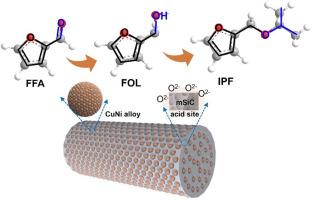
Mesoporous framework supported metal nanoparticle catalyst represents a promising material platform for creating multiple active sites that drive tandem reactions. In this study, we demonstrate a novel catalyst design that involves the encapsulation of CuNi alloy nanoparticles within mesoporous silicon carbide nanofibers (mSiCf) to achieve efficient tandem conversion of furfural (FFA) into 2-(isopropoxymethyl)furan (IPF). The unique one-dimensional (1D) mesoporous structure of mSiCf, coupled with abundant oxygen-containing groups, offers a favorable surface microenvironment for the stabilization of bimetallic CuNi active sites. Through carefully optimizing metal to acid sites, we have developed a catalyst containing a total mass ratio of 20% Cu and Ni, which exhibits a remarkable performance with complete FFA conversion and 92% IPF selectivity in 4 h. In-depth mechanistic investigations have revealed that the superior activity of this catalyst is attributed to a tandem reaction mechanism. Initially, FFA is hydrogenated at the dual metal active sites to produce furfuryl alcohol (FOL) as an intermediate, which is subsequently etherified at the acid sites with suitable species and strengths on the mSiCf supports. Additionally, the robust 1D mSiCf framework effectively protects the metal sites from agglomeration, resulting in excellent reusability of the catalyst. This study underscores the potential of mesoporous silicon carbide-supported bimetallic active sites for achieving enhanced tandem catalytic functionality.
期刊介绍:
Journal of Materials Science & Technology strives to promote global collaboration in the field of materials science and technology. It primarily publishes original research papers, invited review articles, letters, research notes, and summaries of scientific achievements. The journal covers a wide range of materials science and technology topics, including metallic materials, inorganic nonmetallic materials, and composite materials.




 京公网安备 11010802042870号
京ICP备2023020795号-1
京公网安备 11010802042870号
京ICP备2023020795号-1

 分享
分享
 求助内容:
求助内容: 应助结果提醒方式:
 扫码关注我们
