Martin Hayhurst Appel, Alexander Ghorbal, Noah Shofer, Leon Zaporski, Santanu Manna, Saimon Filipe Covre da Silva, Urs Haeusler, Claire Le Gall, Armando Rastelli, Dorian A. Gangloff, Mete Atatüre
{"title":"自旋量子位的多体量子寄存器","authors":"Martin Hayhurst Appel, Alexander Ghorbal, Noah Shofer, Leon Zaporski, Santanu Manna, Saimon Filipe Covre da Silva, Urs Haeusler, Claire Le Gall, Armando Rastelli, Dorian A. Gangloff, Mete Atatüre","doi":"10.1038/s41567-024-02746-z","DOIUrl":null,"url":null,"abstract":"Quantum networks require quantum nodes with coherent optical interfaces and several stationary qubits. In terms of optical properties, semiconductor quantum dots are highly compelling, but their adoption as quantum nodes has been impaired by the lack of auxiliary qubits. Here we demonstrate that the dense, always-present, nuclear spin ensemble surrounding a gallium arsenide quantum dot can be used as a functional quantum register. We prepared 13,000 host nuclear spins in a single many-body dark state that acts as a logical state of the register. A second logical state is defined as a single nuclear-magnon excitation, enabling controlled quantum-state transfer between an electron spin qubit in the quantum dot and the nuclear magnonic register. Using SWAP gates, we implemented a full write–store–retrieve-read-out protocol with 68.6(4)% raw overall fidelity and a storage time of 130(16) μs, which could be extended to 20 ms or beyond using dynamical decoupling techniques. Our work establishes how many-body physics can add functionality to quantum devices, in this case transforming quantum dots into multi-qubit quantum nodes with deterministic registers. The thousands of nuclear spins surrounding gallium arsenide quantum dots can interface with electron spin qubits and photons. With quantum engineering, this nuclear spin ensemble becomes a robust register for quantum information storage.","PeriodicalId":19100,"journal":{"name":"Nature Physics","volume":"21 3","pages":"368-373"},"PeriodicalIF":18.4000,"publicationDate":"2025-01-24","publicationTypes":"Journal Article","fieldsOfStudy":null,"isOpenAccess":false,"openAccessPdf":"https://www.nature.com/articles/s41567-024-02746-z.pdf","citationCount":"0","resultStr":"{\"title\":\"A many-body quantum register for a spin qubit\",\"authors\":\"Martin Hayhurst Appel, Alexander Ghorbal, Noah Shofer, Leon Zaporski, Santanu Manna, Saimon Filipe Covre da Silva, Urs Haeusler, Claire Le Gall, Armando Rastelli, Dorian A. Gangloff, Mete Atatüre\",\"doi\":\"10.1038/s41567-024-02746-z\",\"DOIUrl\":null,\"url\":null,\"abstract\":\"Quantum networks require quantum nodes with coherent optical interfaces and several stationary qubits. In terms of optical properties, semiconductor quantum dots are highly compelling, but their adoption as quantum nodes has been impaired by the lack of auxiliary qubits. Here we demonstrate that the dense, always-present, nuclear spin ensemble surrounding a gallium arsenide quantum dot can be used as a functional quantum register. We prepared 13,000 host nuclear spins in a single many-body dark state that acts as a logical state of the register. A second logical state is defined as a single nuclear-magnon excitation, enabling controlled quantum-state transfer between an electron spin qubit in the quantum dot and the nuclear magnonic register. Using SWAP gates, we implemented a full write–store–retrieve-read-out protocol with 68.6(4)% raw overall fidelity and a storage time of 130(16) μs, which could be extended to 20 ms or beyond using dynamical decoupling techniques. Our work establishes how many-body physics can add functionality to quantum devices, in this case transforming quantum dots into multi-qubit quantum nodes with deterministic registers. The thousands of nuclear spins surrounding gallium arsenide quantum dots can interface with electron spin qubits and photons. With quantum engineering, this nuclear spin ensemble becomes a robust register for quantum information storage.\",\"PeriodicalId\":19100,\"journal\":{\"name\":\"Nature Physics\",\"volume\":\"21 3\",\"pages\":\"368-373\"},\"PeriodicalIF\":18.4000,\"publicationDate\":\"2025-01-24\",\"publicationTypes\":\"Journal Article\",\"fieldsOfStudy\":null,\"isOpenAccess\":false,\"openAccessPdf\":\"https://www.nature.com/articles/s41567-024-02746-z.pdf\",\"citationCount\":\"0\",\"resultStr\":null,\"platform\":\"Semanticscholar\",\"paperid\":null,\"PeriodicalName\":\"Nature Physics\",\"FirstCategoryId\":\"101\",\"ListUrlMain\":\"https://www.nature.com/articles/s41567-024-02746-z\",\"RegionNum\":1,\"RegionCategory\":\"物理与天体物理\",\"ArticlePicture\":[],\"TitleCN\":null,\"AbstractTextCN\":null,\"PMCID\":null,\"EPubDate\":\"\",\"PubModel\":\"\",\"JCR\":\"Q1\",\"JCRName\":\"PHYSICS, MULTIDISCIPLINARY\",\"Score\":null,\"Total\":0}","platform":"Semanticscholar","paperid":null,"PeriodicalName":"Nature Physics","FirstCategoryId":"101","ListUrlMain":"https://www.nature.com/articles/s41567-024-02746-z","RegionNum":1,"RegionCategory":"物理与天体物理","ArticlePicture":[],"TitleCN":null,"AbstractTextCN":null,"PMCID":null,"EPubDate":"","PubModel":"","JCR":"Q1","JCRName":"PHYSICS, MULTIDISCIPLINARY","Score":null,"Total":0}
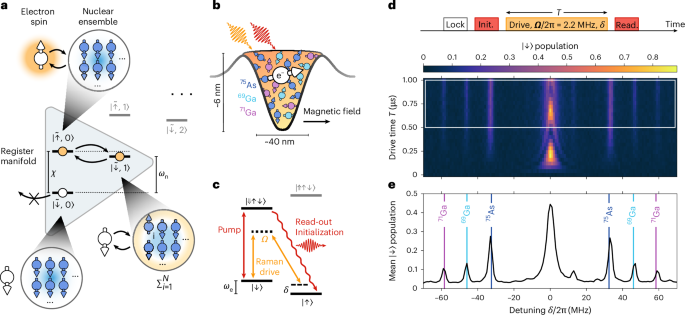
Quantum networks require quantum nodes with coherent optical interfaces and several stationary qubits. In terms of optical properties, semiconductor quantum dots are highly compelling, but their adoption as quantum nodes has been impaired by the lack of auxiliary qubits. Here we demonstrate that the dense, always-present, nuclear spin ensemble surrounding a gallium arsenide quantum dot can be used as a functional quantum register. We prepared 13,000 host nuclear spins in a single many-body dark state that acts as a logical state of the register. A second logical state is defined as a single nuclear-magnon excitation, enabling controlled quantum-state transfer between an electron spin qubit in the quantum dot and the nuclear magnonic register. Using SWAP gates, we implemented a full write–store–retrieve-read-out protocol with 68.6(4)% raw overall fidelity and a storage time of 130(16) μs, which could be extended to 20 ms or beyond using dynamical decoupling techniques. Our work establishes how many-body physics can add functionality to quantum devices, in this case transforming quantum dots into multi-qubit quantum nodes with deterministic registers. The thousands of nuclear spins surrounding gallium arsenide quantum dots can interface with electron spin qubits and photons. With quantum engineering, this nuclear spin ensemble becomes a robust register for quantum information storage.
期刊介绍:
Nature Physics is dedicated to publishing top-tier original research in physics with a fair and rigorous review process. It provides high visibility and access to a broad readership, maintaining high standards in copy editing and production, ensuring rapid publication, and maintaining independence from academic societies and other vested interests.
The journal presents two main research paper formats: Letters and Articles. Alongside primary research, Nature Physics serves as a central source for valuable information within the physics community through Review Articles, News & Views, Research Highlights covering crucial developments across the physics literature, Commentaries, Book Reviews, and Correspondence.





 京公网安备 11010802042870号
京ICP备2023020795号-1
京公网安备 11010802042870号
京ICP备2023020795号-1

 分享
分享
 求助内容:
求助内容: 应助结果提醒方式:
 扫码关注我们
