Xueying Liu , Wei Yang , Ali Zaoui , Chenghui Guo , Renpeng Chen
{"title":"使用改性膨润土-砂衬垫增强从污染地下水中去除铬:实验和模拟见解","authors":"Xueying Liu , Wei Yang , Ali Zaoui , Chenghui Guo , Renpeng Chen","doi":"10.1016/j.seppur.2025.131689","DOIUrl":null,"url":null,"abstract":"<div><div>Chromium and its compounds, as industrial solid wastes featuring high storage capacity but low utilization rate and high environmental risk. Therefore, a liner composed of cetyltrimethylammonium bromide modified bentonite (CMB), polymer modified bentonite (PMB), and sand was developed to remove chromium pollution in groundwater of chromium slag landfills. Microscopic characterizations and molecular dynamic simulations were employed to elucidate the modification and adsorption/impermeability mechanisms of CMB and PMB. The cetyltrimethylammonium (CTMA<sup>+</sup>) chains were intercalated into the interlayer space of NaB, with the adsorption mechanism attributed to electrostatic interactions between the head groups of CTMA<sup>+</sup> and CrO<sub>4</sub><sup>2-</sup>. SEM-EDS revealed that PMB exhibited an enhanced three-dimensional network structure woven by entangled polymer chains and the orthogonally aligned stacks of bentonite plates prevented NaB from undergoing cation exchange, a key mechanism for impermeability enhancement. Five long-term column tests were conducted to determine the transport parameters of chromium in the modified liner. The hydraulic conductivity of the single-liner CPBS and double-liner D-PC was 2.18 × 10<sup>-10</sup> m/s and 2.50 × 10<sup>-12</sup> m/s, respectively, meeting the typical requirement of hydraulic barriers for contaminant containment. Analytic calculations were employed to evaluate the service life of CPBS and D-PC liners under varying hydraulic gradients in chromium-contaminated groundwater. Notably, the D-PC exhibits minimal sensitivity to changes in hydraulic gradient, with a required thickness of approximately 0.09 m for a 50-year service life, indicating broad prospects in control of environmental risks associated with groundwater contamination at polluted sites.</div></div>","PeriodicalId":427,"journal":{"name":"Separation and Purification Technology","volume":"363 ","pages":"Article 131689"},"PeriodicalIF":9.0000,"publicationDate":"2025-08-14","publicationTypes":"Journal Article","fieldsOfStudy":null,"isOpenAccess":false,"openAccessPdf":"","citationCount":"0","resultStr":"{\"title\":\"Enhanced chromium removal from contaminated groundwater using modified bentonite-sand liners: Experimental and simulation insights\",\"authors\":\"Xueying Liu , Wei Yang , Ali Zaoui , Chenghui Guo , Renpeng Chen\",\"doi\":\"10.1016/j.seppur.2025.131689\",\"DOIUrl\":null,\"url\":null,\"abstract\":\"<div><div>Chromium and its compounds, as industrial solid wastes featuring high storage capacity but low utilization rate and high environmental risk. Therefore, a liner composed of cetyltrimethylammonium bromide modified bentonite (CMB), polymer modified bentonite (PMB), and sand was developed to remove chromium pollution in groundwater of chromium slag landfills. Microscopic characterizations and molecular dynamic simulations were employed to elucidate the modification and adsorption/impermeability mechanisms of CMB and PMB. The cetyltrimethylammonium (CTMA<sup>+</sup>) chains were intercalated into the interlayer space of NaB, with the adsorption mechanism attributed to electrostatic interactions between the head groups of CTMA<sup>+</sup> and CrO<sub>4</sub><sup>2-</sup>. SEM-EDS revealed that PMB exhibited an enhanced three-dimensional network structure woven by entangled polymer chains and the orthogonally aligned stacks of bentonite plates prevented NaB from undergoing cation exchange, a key mechanism for impermeability enhancement. Five long-term column tests were conducted to determine the transport parameters of chromium in the modified liner. The hydraulic conductivity of the single-liner CPBS and double-liner D-PC was 2.18 × 10<sup>-10</sup> m/s and 2.50 × 10<sup>-12</sup> m/s, respectively, meeting the typical requirement of hydraulic barriers for contaminant containment. Analytic calculations were employed to evaluate the service life of CPBS and D-PC liners under varying hydraulic gradients in chromium-contaminated groundwater. Notably, the D-PC exhibits minimal sensitivity to changes in hydraulic gradient, with a required thickness of approximately 0.09 m for a 50-year service life, indicating broad prospects in control of environmental risks associated with groundwater contamination at polluted sites.</div></div>\",\"PeriodicalId\":427,\"journal\":{\"name\":\"Separation and Purification Technology\",\"volume\":\"363 \",\"pages\":\"Article 131689\"},\"PeriodicalIF\":9.0000,\"publicationDate\":\"2025-08-14\",\"publicationTypes\":\"Journal Article\",\"fieldsOfStudy\":null,\"isOpenAccess\":false,\"openAccessPdf\":\"\",\"citationCount\":\"0\",\"resultStr\":null,\"platform\":\"Semanticscholar\",\"paperid\":null,\"PeriodicalName\":\"Separation and Purification Technology\",\"FirstCategoryId\":\"5\",\"ListUrlMain\":\"https://www.sciencedirect.com/science/article/pii/S1383586625002862\",\"RegionNum\":1,\"RegionCategory\":\"工程技术\",\"ArticlePicture\":[],\"TitleCN\":null,\"AbstractTextCN\":null,\"PMCID\":null,\"EPubDate\":\"2025/1/24 0:00:00\",\"PubModel\":\"Epub\",\"JCR\":\"Q1\",\"JCRName\":\"ENGINEERING, CHEMICAL\",\"Score\":null,\"Total\":0}","platform":"Semanticscholar","paperid":null,"PeriodicalName":"Separation and Purification Technology","FirstCategoryId":"5","ListUrlMain":"https://www.sciencedirect.com/science/article/pii/S1383586625002862","RegionNum":1,"RegionCategory":"工程技术","ArticlePicture":[],"TitleCN":null,"AbstractTextCN":null,"PMCID":null,"EPubDate":"2025/1/24 0:00:00","PubModel":"Epub","JCR":"Q1","JCRName":"ENGINEERING, CHEMICAL","Score":null,"Total":0}
Enhanced chromium removal from contaminated groundwater using modified bentonite-sand liners: Experimental and simulation insights
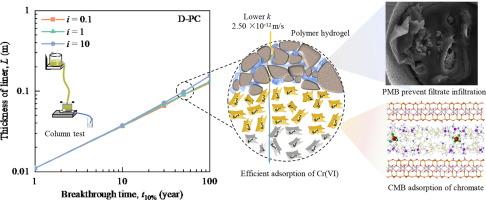
Chromium and its compounds, as industrial solid wastes featuring high storage capacity but low utilization rate and high environmental risk. Therefore, a liner composed of cetyltrimethylammonium bromide modified bentonite (CMB), polymer modified bentonite (PMB), and sand was developed to remove chromium pollution in groundwater of chromium slag landfills. Microscopic characterizations and molecular dynamic simulations were employed to elucidate the modification and adsorption/impermeability mechanisms of CMB and PMB. The cetyltrimethylammonium (CTMA+) chains were intercalated into the interlayer space of NaB, with the adsorption mechanism attributed to electrostatic interactions between the head groups of CTMA+ and CrO42-. SEM-EDS revealed that PMB exhibited an enhanced three-dimensional network structure woven by entangled polymer chains and the orthogonally aligned stacks of bentonite plates prevented NaB from undergoing cation exchange, a key mechanism for impermeability enhancement. Five long-term column tests were conducted to determine the transport parameters of chromium in the modified liner. The hydraulic conductivity of the single-liner CPBS and double-liner D-PC was 2.18 × 10⁻¹⁰ m/s and 2.50 × 10⁻¹² m/s, respectively, meeting the typical requirement of hydraulic barriers for contaminant containment. Analytic calculations were employed to evaluate the service life of CPBS and D-PC liners under varying hydraulic gradients in chromium-contaminated groundwater. Notably, the D-PC exhibits minimal sensitivity to changes in hydraulic gradient, with a required thickness of approximately 0.09 m for a 50-year service life, indicating broad prospects in control of environmental risks associated with groundwater contamination at polluted sites.
期刊介绍:
Separation and Purification Technology is a premier journal committed to sharing innovative methods for separation and purification in chemical and environmental engineering, encompassing both homogeneous solutions and heterogeneous mixtures. Our scope includes the separation and/or purification of liquids, vapors, and gases, as well as carbon capture and separation techniques. However, it's important to note that methods solely intended for analytical purposes are not within the scope of the journal. Additionally, disciplines such as soil science, polymer science, and metallurgy fall outside the purview of Separation and Purification Technology. Join us in advancing the field of separation and purification methods for sustainable solutions in chemical and environmental engineering.





 京公网安备 11010802042870号
京ICP备2023020795号-1
京公网安备 11010802042870号
京ICP备2023020795号-1

 分享
分享
 求助内容:
求助内容: 应助结果提醒方式:
 扫码关注我们
