{"title":"考察了溶剂和提取方法对咖啡渣中酚类化合物回收效果的影响","authors":"Naira Linhares Sabino, Henrique Maziero Fogarin, Sarha Lucia Murillo-Franco, Mariana Oliviera Bérgamo, Leticia Vicente Moreno, Debora Danielle Virginio da Silva, Cristiano Soleo Funari, Kelly Johana Dussán","doi":"10.1016/j.seppur.2025.131793","DOIUrl":null,"url":null,"abstract":"Spent coffee grounds (SCGs) represent a significant by-product with a high potential of extract bioactive compounds. This study investigates the potential of SCGs as a source for the extraction of phenolic compounds, which have applications in the pharmaceutical, cosmetic and food industries. In this work, several solvents and two extraction techniques were studied: Soxhlet as a reference and dynamic maceration for understanding the yield of extraction and the possible compounds that can be obtained. For dynamic maceration with a single liquid phase, higher extraction yields were observed for solvents with medium to high polarity, notably acetone (19.64 % ± 0.05) and isopropanol (14.66 % ± 0.76). Whereas ethanol (23.85 % ± 0.47) and acetone (20.03 % ± 0.27) led to best yields for Soxhlet. The primary phenolic compounds extracted were gallic acid, caffeic acid, 2,4-dihydroxybenzoic acid, 5-HMF, and furfural. In addition, when dynamic maceration and Soxhlet were tested with two liquid phases (a polar and a non-polar solvent), the yields were even better: 16.28 ± 2.01 % and 28.45 ± 2.48 %, respectively. A sustainability assessment was also made. Analytical Greenness Calculator indicated dynamic maceration (score: 0.6) as greener than the reference Soxhlet extraction (score: 0.5), requiring less energy, solvent, and time. These findings underscore the critical role of solvent selection in optimizing extraction processes, as well as the importance of selecting appropriate extraction techniques to maximize yield of value compounds in by-product like SCGs.","PeriodicalId":427,"journal":{"name":"Separation and Purification Technology","volume":"34 1","pages":""},"PeriodicalIF":9.1000,"publicationDate":"2025-01-24","publicationTypes":"Journal Article","fieldsOfStudy":null,"isOpenAccess":false,"openAccessPdf":"","citationCount":"0","resultStr":"{\"title\":\"Investigating the influence of solvents and extraction methods on the efficacy of phenolic compound recovery from spent coffee grounds\",\"authors\":\"Naira Linhares Sabino, Henrique Maziero Fogarin, Sarha Lucia Murillo-Franco, Mariana Oliviera Bérgamo, Leticia Vicente Moreno, Debora Danielle Virginio da Silva, Cristiano Soleo Funari, Kelly Johana Dussán\",\"doi\":\"10.1016/j.seppur.2025.131793\",\"DOIUrl\":null,\"url\":null,\"abstract\":\"Spent coffee grounds (SCGs) represent a significant by-product with a high potential of extract bioactive compounds. This study investigates the potential of SCGs as a source for the extraction of phenolic compounds, which have applications in the pharmaceutical, cosmetic and food industries. In this work, several solvents and two extraction techniques were studied: Soxhlet as a reference and dynamic maceration for understanding the yield of extraction and the possible compounds that can be obtained. For dynamic maceration with a single liquid phase, higher extraction yields were observed for solvents with medium to high polarity, notably acetone (19.64 % ± 0.05) and isopropanol (14.66 % ± 0.76). Whereas ethanol (23.85 % ± 0.47) and acetone (20.03 % ± 0.27) led to best yields for Soxhlet. The primary phenolic compounds extracted were gallic acid, caffeic acid, 2,4-dihydroxybenzoic acid, 5-HMF, and furfural. In addition, when dynamic maceration and Soxhlet were tested with two liquid phases (a polar and a non-polar solvent), the yields were even better: 16.28 ± 2.01 % and 28.45 ± 2.48 %, respectively. A sustainability assessment was also made. Analytical Greenness Calculator indicated dynamic maceration (score: 0.6) as greener than the reference Soxhlet extraction (score: 0.5), requiring less energy, solvent, and time. These findings underscore the critical role of solvent selection in optimizing extraction processes, as well as the importance of selecting appropriate extraction techniques to maximize yield of value compounds in by-product like SCGs.\",\"PeriodicalId\":427,\"journal\":{\"name\":\"Separation and Purification Technology\",\"volume\":\"34 1\",\"pages\":\"\"},\"PeriodicalIF\":9.1000,\"publicationDate\":\"2025-01-24\",\"publicationTypes\":\"Journal Article\",\"fieldsOfStudy\":null,\"isOpenAccess\":false,\"openAccessPdf\":\"\",\"citationCount\":\"0\",\"resultStr\":null,\"platform\":\"Semanticscholar\",\"paperid\":null,\"PeriodicalName\":\"Separation and Purification Technology\",\"FirstCategoryId\":\"5\",\"ListUrlMain\":\"https://doi.org/10.1016/j.seppur.2025.131793\",\"RegionNum\":1,\"RegionCategory\":\"工程技术\",\"ArticlePicture\":[],\"TitleCN\":null,\"AbstractTextCN\":null,\"PMCID\":null,\"EPubDate\":\"\",\"PubModel\":\"\",\"JCR\":\"Q1\",\"JCRName\":\"ENGINEERING, CHEMICAL\",\"Score\":null,\"Total\":0}","platform":"Semanticscholar","paperid":null,"PeriodicalName":"Separation and Purification Technology","FirstCategoryId":"5","ListUrlMain":"https://doi.org/10.1016/j.seppur.2025.131793","RegionNum":1,"RegionCategory":"工程技术","ArticlePicture":[],"TitleCN":null,"AbstractTextCN":null,"PMCID":null,"EPubDate":"","PubModel":"","JCR":"Q1","JCRName":"ENGINEERING, CHEMICAL","Score":null,"Total":0}
Investigating the influence of solvents and extraction methods on the efficacy of phenolic compound recovery from spent coffee grounds
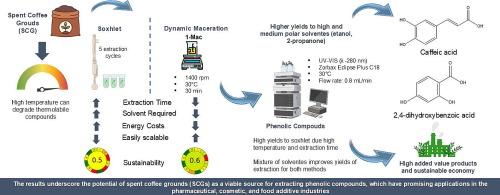
Spent coffee grounds (SCGs) represent a significant by-product with a high potential of extract bioactive compounds. This study investigates the potential of SCGs as a source for the extraction of phenolic compounds, which have applications in the pharmaceutical, cosmetic and food industries. In this work, several solvents and two extraction techniques were studied: Soxhlet as a reference and dynamic maceration for understanding the yield of extraction and the possible compounds that can be obtained. For dynamic maceration with a single liquid phase, higher extraction yields were observed for solvents with medium to high polarity, notably acetone (19.64 % ± 0.05) and isopropanol (14.66 % ± 0.76). Whereas ethanol (23.85 % ± 0.47) and acetone (20.03 % ± 0.27) led to best yields for Soxhlet. The primary phenolic compounds extracted were gallic acid, caffeic acid, 2,4-dihydroxybenzoic acid, 5-HMF, and furfural. In addition, when dynamic maceration and Soxhlet were tested with two liquid phases (a polar and a non-polar solvent), the yields were even better: 16.28 ± 2.01 % and 28.45 ± 2.48 %, respectively. A sustainability assessment was also made. Analytical Greenness Calculator indicated dynamic maceration (score: 0.6) as greener than the reference Soxhlet extraction (score: 0.5), requiring less energy, solvent, and time. These findings underscore the critical role of solvent selection in optimizing extraction processes, as well as the importance of selecting appropriate extraction techniques to maximize yield of value compounds in by-product like SCGs.
期刊介绍:
Separation and Purification Technology is a premier journal committed to sharing innovative methods for separation and purification in chemical and environmental engineering, encompassing both homogeneous solutions and heterogeneous mixtures. Our scope includes the separation and/or purification of liquids, vapors, and gases, as well as carbon capture and separation techniques. However, it's important to note that methods solely intended for analytical purposes are not within the scope of the journal. Additionally, disciplines such as soil science, polymer science, and metallurgy fall outside the purview of Separation and Purification Technology. Join us in advancing the field of separation and purification methods for sustainable solutions in chemical and environmental engineering.




 京公网安备 11010802042870号
京ICP备2023020795号-1
京公网安备 11010802042870号
京ICP备2023020795号-1

 分享
分享
 求助内容:
求助内容: 应助结果提醒方式:
 扫码关注我们
